Compiled from clinical pathology references. Medically reviewed by Dr Cristian Dunker, Principal Dentist, ArtSmiles Cosmetic Dentistry.
Quick summary
Also called | White line of the cheek, occlusal line, frictional cheek line |
How urgent? | 🟢 Not urgent at all, a benign normal anatomical variant that needs no treatment |
Common or rare? | Very common; can be found in most adults if looked for carefully |
Who it affects | Both sexes equally, all ages from the late teens onwards; more pronounced in people who clench or grind their teeth |
Who treats it | General dentist for reassurance; rarely needs anything more than an explanation, although bruxism (habitual teeth grinding or clenching) if present can be addressed with a splint |
Based on | Neville, Cawson and Regezi |
Run your tongue along the inside of your cheek where your upper and lower teeth meet, and you may feel a slightly raised, smooth, horizontal ridge, and see a faint white line in the mirror. The Latin name linea alba simply means white line, and it is one of the most common normal findings in adult mouths.
This article from the team at ArtSmiles, reviewed by Dr Cristian Dunker, explains what linea alba is, why it forms, and why it almost always needs no treatment.
What is it?
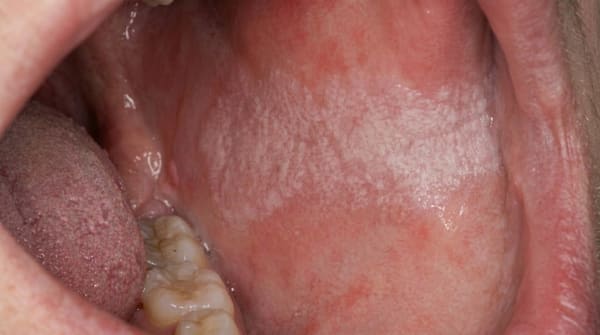
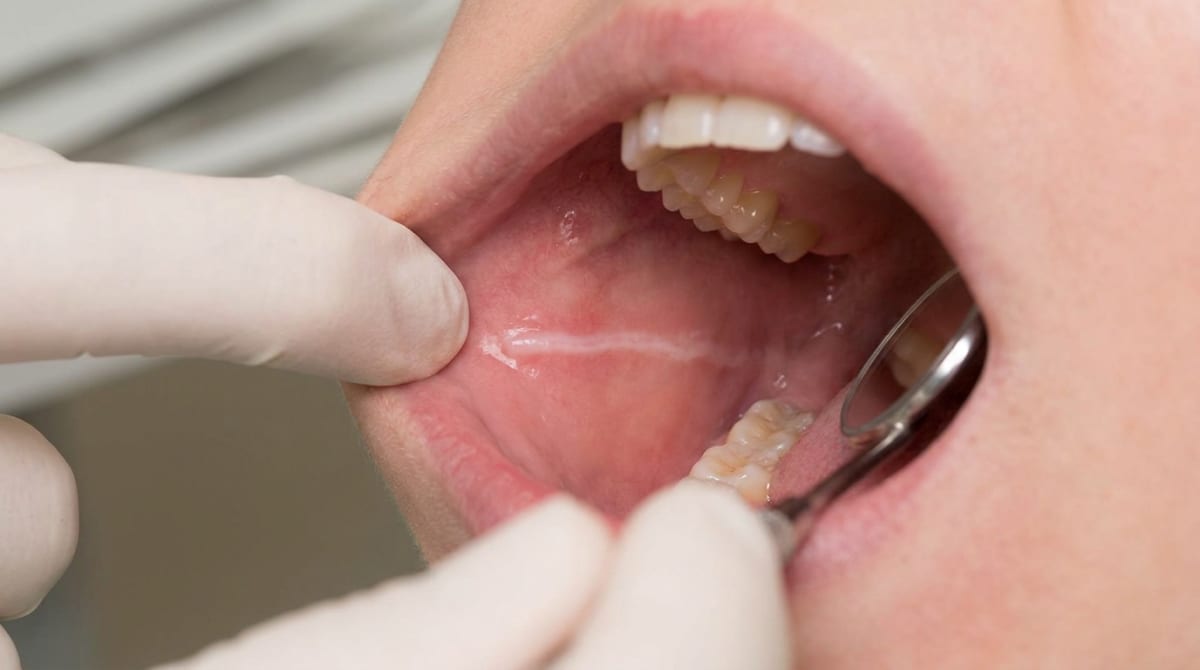
Linea alba is a horizontal white line on the buccal mucosa (the soft lining inside the cheek) (cheek lining) at the level where the upper and lower teeth meet (the occlusal plane (the line along which the upper and lower teeth meet)). It is caused by gentle, repeated friction of the teeth against the cheek over many years. The cheek responds by laying down a slightly thicker keratin layer for protection, and that thicker layer reflects light differently, appearing white.
Common features include:
A raised, smooth, white horizontal line running from front to back along the cheek.
Bilateral and symmetrical, usually on both cheeks.
No pain, no ulceration, no bleeding.
Cannot be wiped off.
Often more pronounced in people with clenching or grinding habits.
Who tends to get it?
Linea alba can be found in:
Most adults if examined carefully.
Adults with bruxism (grinding) or clenching habits, in whom it is more pronounced.
People with close tooth contact patterns or edge-to-edge bites.
People who deliberately suck or press the cheek against the teeth as a habit.
Both sexes equally.
All ages beyond the early teens, when teeth come into full occlusion.
What causes it?
The cause is simple mechanical friction. The teeth and cheek are in close contact during chewing, swallowing, talking, and during any clenching or grinding habit. The cheek responds to repeated low-grade rubbing by producing a thicker layer of surface keratin, a normal protective adaptation seen on every part of the body that experiences repeated friction (such as the calluses on the hands of a manual worker).
Factors that make linea alba more pronounced include:
Bruxism (grinding, often during sleep).
Clenching during the day, often associated with stress.
A habit of pressing the cheek against the teeth.
Close tooth contact in certain bite patterns.
Edentulous areas where soft tissue can fold over the teeth differently.
How does it develop?
Linea alba develops slowly:
Teeth begin to make light contact with the cheek lining.
The cheek responds with a slightly thicker keratin layer.
Over months to years, the layer becomes visible as a faint horizontal line.
With ongoing friction, the line is maintained.
If the friction stops (for example after losing back teeth on one side), the line on that side may fade.
What might you notice?
Common observations include:
A whitish, slightly raised line on the inside of one or both cheeks.
No pain or discomfort.
The line being more obvious on waking in people who grind their teeth at night.
The line being symmetrical, on both cheeks at the same level.
What an X-ray might show
Linea alba is a surface change of the cheek lining and does not show on X-rays.
What happens at the dentist?
When linea alba is identified at ArtSmiles, the visit usually involves:
A short examination to confirm the typical horizontal pattern.
A check for any related findings, bruxism wear on the teeth, clenching habits, masseter (the main chewing muscle at the angle of the jaw) muscle hypertrophy.
Reassurance that the line itself is harmless.
A discussion of any underlying habit, if bruxism is present, a night-time occlusal splint may be recommended to protect the teeth.
We do not investigate or treat linea alba itself. The conversation may, however, lead naturally into a discussion of bruxism or stress where appropriate.
Is this serious?
Linea alba is not serious in any way. It is a normal finding and does not require any specific care.
Could it be something else?
A few other conditions can produce white changes on the cheek lining:
Frictional keratosis of a localised, irregular area, for example a sharp tooth edge rubbing in one spot.
Morsicatio buccarum, chronic cheek-chewing producing a shaggy, frayed white surface.
Leukoedema, a soft, faint white-grey film, more diffuse than linea alba and disappearing when stretched.
Lichen planus, lacy white streaks, often symmetrical but with characteristic pattern.
White sponge naevus, hereditary soft folded white change present from a young age.
Leukoplakia, persistent white patch with potential malignant change; usually distinct from the symmetrical linear pattern of linea alba.
A clinician's eye, knowing the typical pattern, sorts these out easily.
How is it treated?
No treatment is needed. When linea alba is associated with significant bruxism or clenching, the focus is on the underlying habit:
Occlusal splint (night guard) for sleep bruxism.
Stress management strategies.
Physiotherapy or jaw-relaxation exercises for daytime clenching.
Botulinum toxin for the masseter muscle in selected severe cases (under specialist care).
Treating the line itself with topical medicines, lasers or surgery is not appropriate.
What's the long-term outlook?
Linea alba is stable and benign throughout life. Once you know what it is, you can safely ignore it.
If you have noticed a white line on the inside of your cheek and would like reassurance, please book a check-up. We will examine the area and confirm the diagnosis at the same visit.
A note on this article
This article is for educational purposes only and does not constitute a clinical diagnosis. Please consult a registered dental practitioner for assessment and treatment advice.
The cover image above is an AI-generated illustration based on the most common visible features of this condition described in clinical pathology references. It is not a photograph of a real case and should not be used to diagnose or rule out the condition in your own situation. If you are concerned about something you have noticed, please book an assessment with a registered dental practitioner.
References
Neville, B. W., Damm, D. D., Allen, C. M., & Chi, A. C. (2016). Oral and maxillofacial pathology (4th ed., Ch. 10: Epithelial Pathology, Linea Alba). Elsevier.
Cawson, R. A., & Odell, E. W. (2017). Cawson's essentials of oral pathology and oral medicine (8th ed., Ch. 16: Premalignant Conditions, cross-reference). Elsevier.
Regezi, J. A., Sciubba, J. J., & Jordan, R. C. K. (2017). Oral pathology: clinical pathologic correlations (7th ed., Ch. 3: Red and White Lesions). Elsevier.