Compiled from clinical pathology references. Medically reviewed by Dr Cristian Dunker , Principal Dentist, ArtSmiles Cosmetic Dentistry.
Quick summary
Also called | Erythema migrans, benign migratory glossitis, wandering rash of the tongue, erythema areata migrans, stomatitis areata migrans |
How urgent? | 🟢 Not urgent, benign and self-limiting; reassurance is the main treatment |
Common or rare? | Common, affects 1-3% of the population |
Who it affects | People of all ages, with some studies showing twice as many women as men; often present from childhood and stable over decades |
Who treats it | General dentist for diagnosis and reassurance; rarely needs any specific treatment |
Based on | Neville, with cross-references in Cawson and Regezi |
What is it?
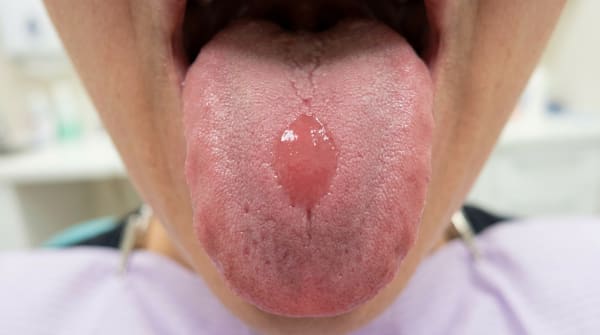
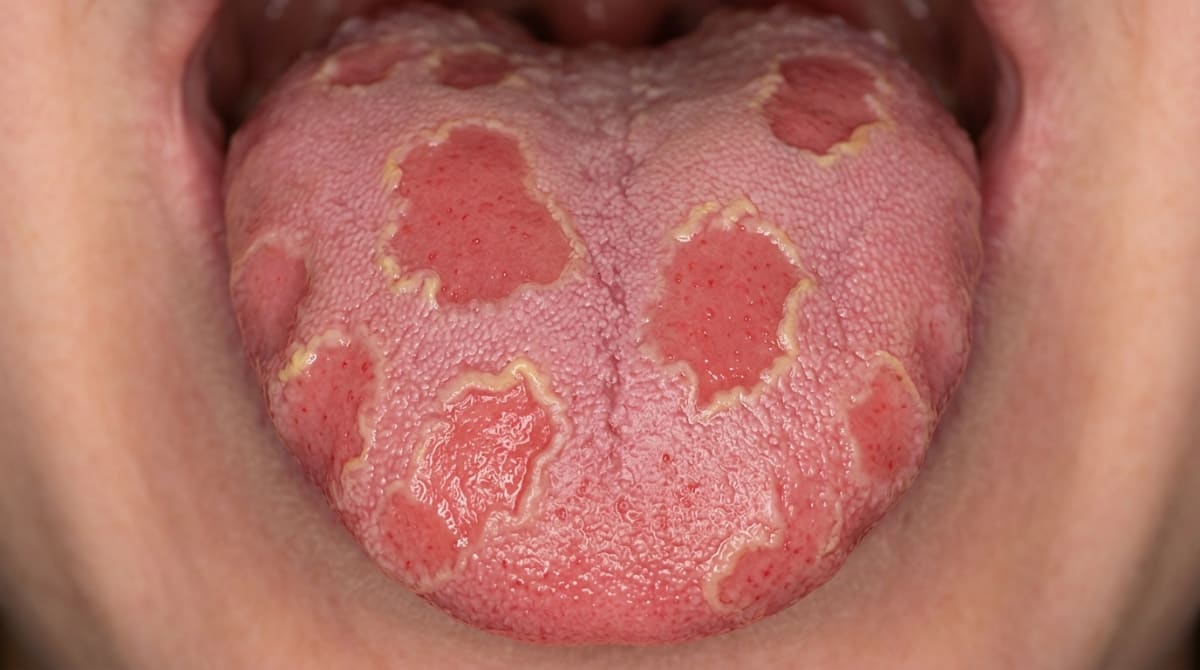
Geographic tongue is a common, harmless condition in which the upper surface of the tongue develops red patches surrounded by slightly raised, yellow-white serpentine borders that look like the borders of a map. The textbooks describe it formally as erythema migrans, Latin for "wandering redness", because the patches typically heal in one place and reappear in another over days or weeks. Despite its dramatic appearance, geographic tongue is a benign variation of normal that affects 1-3% of the population. It is not an infection, not a cancer, and not contagious.
Who tends to get it?
The textbooks describe a fairly distinctive profile:
Affects 1-3% of the general population, making it one of the more common oral conditions.
Some studies show a 2:1 female-to-male ratio, though others find no sex predilection.
Often present from childhood, although it can begin at any age.
Affects people across all ethnic groups.
Around one-third of people with fissured tongue also have geographic tongue, and the two conditions are thought to share a hereditary basis.
Slightly more common in people with psoriasis, patients with psoriasis show geographic tongue at a rate of about 10%, compared to 2.5% in matched controls.
A possible association with celiac disease has been reported but is not consistently confirmed.
Less common in cigarette smokers, in some studies, although smoking is not protective in any meaningful sense.
What causes it?
The cause is not fully understood, but the textbooks describe several recognised contributors:
Inherited tendency, a polygenic predisposition, often with relatives showing the same pattern.
Shared genetic basis with fissured tongue, both conditions cluster together in families.
Possible link with psoriasis, patients carrying the HLA-Cw6 genotype, which is also associated with psoriasis, are over-represented among people with geographic tongue. Microscopically the two conditions look similar.
Possible association with celiac disease in some populations.
Stress and hormonal change are sometimes anecdotally reported as triggers for flare-ups, although the evidence is weak.
It is important to note that geographic tongue is not caused by infection, food intolerance, vitamin deficiency, smoking or oral hygiene. Most people with geographic tongue have it for life, with periodic flare-ups and quiet periods.
How does it develop?
Geographic tongue develops when the small "hairs" on the upper surface of the tongue, the filiform papillae (the tiny hair-like projections on the tongue surface), disappear in patches, exposing the smoother red mucosa underneath. Around the edges of these patches, there is a slightly raised, yellow-white border made up of inflammation and accumulated keratin. Microscopically, the textbooks describe a psoriasiform mucositis (inflammation pattern similar to skin psoriasis), a pattern of inflammation similar to that of skin psoriasis, with thickening of the epithelium, neutrophils accumulating in the upper layers as Munro abscesses (microscopic clusters of immune cells), and inflammation in the underlying connective tissue. The patches grow centrifugally, outward in all directions, over days, then heal centrally, while new patches appear elsewhere. The result is a constantly changing "map" on the tongue surface.
What might you notice?
What it looks like
The classic appearance is well described:
Multiple, well-demarcated red patches on the upper surface of the tongue, particularly the front two-thirds.
The patches have slightly raised, yellow-white, serpentine or scalloped borders.
The patches change position over days to weeks, disappearing from one area and reappearing in another.
A few solitary patches in some patients; multiple patches in others.
Less commonly, similar lesions can appear on the floor of the mouth, the inside of the cheeks or lips, or rarely the soft palate (called "ectopic" geographic tongue or stomatitis areata migrans).
What it feels like
Most geographic tongue is asymptomatic. Some people experience:
Mild burning or sensitivity to hot, spicy or acidic foods, particularly when patches are active.
A faintly sore tongue during flare-ups, especially in children.
No pain at all in most adult patients.
Worsening with stress, illness, hormonal changes in some people, although this is variable.
The textbooks specifically note that geographic tongue is one of the more common reasons for patients to ask about their tongue, simply because the appearance is so striking.
What an X-ray might show
Geographic tongue is confined to the surface and does not show on X-rays.
What happens at the dentist?
Geographic tongue is most often picked up at a routine dental check-up and clean at ArtSmiles or when the patient asks about a changing appearance on their tongue. The dentist will typically:
Examine the tongue carefully, noting the location, shape and movement of the patches.
Take a careful history, when the patient first noticed the patches, whether they have moved over time, and whether anything seems to make them better or worse.
Look for any associated fissured tongue, which is commonly present.
Ask about psoriasis or family history of psoriasis, since the two are linked.
Reassure that geographic tongue is benign and self-limiting.
Recommend biopsy only when the diagnosis is uncertain, for example, if the patches are unusually large, fixed in one location, or accompanied by ulceration.
Is this serious?
🟢 Geographic tongue is benign. The textbooks specifically note that no treatment is generally indicated and that reassurance is often all that is necessary. There is no link to cancer, no contagious risk and no long-term harm. The reason patients sometimes worry is that the constantly changing pattern can look alarming, particularly when first noticed.
If you have noticed map-like red patches on your tongue that move and change over days or weeks, particularly without persistent pain or ulceration, it is most likely geographic tongue. A check-up can usually confirm this with a simple examination.
Could it be something else?
Several conditions can produce red or patchy areas on the tongue. The textbooks list these as the main differentials:
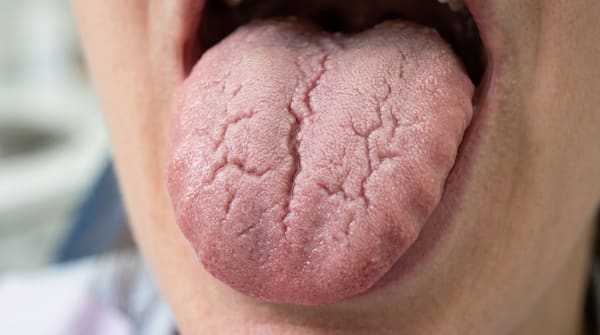
Fissured tongue, has deep grooves rather than red patches, although the two often coexist.
Oral lichen planus, produces lacy white lines (Wickham striae, fine white lace-like lines) and red patches that are usually fixed, symmetrical and bilateral, not migratory.
Erythematous (atrophic) candidiasis, produces a smooth, red, sometimes painful tongue, often under a denture; responds to antifungals.
Oral leukoplakia or erythroplakia, fixed white or red patches that do not migrate, with a small but real cancer risk.
Oral lupus erythematosus, can produce red atrophic areas with white striae, often with skin or systemic features.
Reactive arthritis (Reiter syndrome), can produce tongue lesions that resemble geographic tongue, alongside arthritis, urethritis and conjunctivitis.
Anaemia or vitamin deficiency, can produce a smooth, sore, red tongue (atrophic glossitis), but the change is usually diffuse rather than map-like.
The combination of migratory pattern, serpentine white borders, and lack of any systemic illness is the strongest clue toward geographic tongue.
How is it treated?
The textbooks all agree: geographic tongue rarely needs treatment.
At-home measures and habits:
Continue normal oral hygiene, brushing twice a day with fluoride toothpaste and gentle tongue brushing.
Avoid hot, spicy or acidic foods during a flare-up if these provoke burning. Common irritants include chilli, vinegar, citrus, alcohol and very hot drinks.
Avoid foods you have noticed cause flares for you personally, even if they are not classic triggers.
Photograph the appearance if you want to confirm later that the pattern is changing and migrating, which supports the diagnosis.
Professional steps your dentist may consider:
Confirming the diagnosis by clinical examination and reviewing the migratory pattern over time.
Reassuring the patient that the appearance is harmless.
Topical corticosteroids (such as fluocinonide gel or betamethasone gel) applied as a thin film to lesional areas a few times a day, only in the rare cases where burning or tenderness is significantly affecting quality of life.
Topical antifungals if there is concurrent candidiasis or sensitivity to spicy foods is severe; the textbooks describe these as occasionally helpful for symptomatic patients.
Investigating for associated conditions such as psoriasis or celiac disease if there are systemic symptoms suggesting them.
No specific long-term follow-up beyond routine dental care.
A patient-centred approach matters here too. The constantly changing appearance can be alarming, particularly for parents seeing it on a child's tongue for the first time. Calm, clear explanation that geographic tongue is benign, common and self-limiting is itself part of effective care, values that sit at the heart of our clinical philosophy.
What's the long-term outlook?
The outlook is excellent. Geographic tongue is a stable, lifelong condition that does not progress to anything dangerous. Many people have it from childhood and notice it only intermittently when patches flare up. There is no link to cancer, no need for special review beyond routine dental care, and no impact on general health. For people who once worried about the appearance, identifying it as geographic tongue is usually the most reassuring single step in the conversation.
A note on this article
This article is for educational purposes only and does not constitute a clinical diagnosis. Please consult a registered dental practitioner for assessment and treatment advice.
The cover image above is an AI-generated illustration based on the most common visible features of this condition described in clinical pathology references. It is not a photograph of a real case and should not be used to diagnose or rule out the condition in your own situation. If you are concerned about something you have noticed, please book an assessment with a registered dental practitioner.
References
Neville, B. W., Damm, D. D., Allen, C. M., & Chi, A. C. (2023). Oral and maxillofacial pathology (5th ed.). Elsevier. Chapter 16, Dermatologic Diseases: Erythema Migrans (Geographic Tongue; Benign Migratory Glossitis), with detailed clinical features, histopathology and association with psoriasis (HLA-Cw6) and celiac disease, pp. 784 to 786.
Cawson, R. A., & Odell, E. W. (2017). Cawson's essentials of oral pathology and oral medicine (8th ed.). Elsevier. Chapter 16, Oral Premalignancy: cross-reference for erythema migrans on the tongue.
Regezi, J. A., Sciubba, J. J., & Jordan, R. C. K. (2017). Oral pathology: Clinical pathologic correlations (7th ed.). Elsevier. Chapter 3, Red and Blue Lesions: Geographic Tongue, pp. 96 to 98.
Frequently asked questions
What is geographic tongue?
Geographic tongue (also called benign migratory glossitis) is a common, harmless condition where red, smooth, map-like areas (called depapillated patches) appear on the top and sides of the tongue, bordered by white or yellow serpiginous lines. The pattern shifts over days to weeks — hence 'migratory'.
What causes geographic tongue?
The cause is unknown. It is associated with fissured tongue, psoriasis, atopic conditions (eczema, asthma), and stress. It is not infectious and not contagious. Family clustering suggests a genetic component. Hormonal cycles, certain foods (spicy, acidic, cheese) and stress can trigger flares.
Is geographic tongue serious?
No. Geographic tongue is completely benign and never turns into cancer. The main issue is the burning or stinging sensation some people experience, especially with spicy or acidic foods. Most people have no symptoms and only discover the condition during a dental visit.
How is it treated?
Most cases need only reassurance. For symptomatic patients, avoiding trigger foods, using a bland diet during flares, and rinsing with cool water help. Topical corticosteroids, topical anaesthetic gels and zinc supplementation can ease severe symptoms. Persistent burning may need to be re-evaluated for other causes (candidiasis, anaemia, dry mouth).