Compiled from clinical pathology references. Medically reviewed by Dr Cristian Dunker, Principal Dentist, ArtSmiles Cosmetic Dentistry.
Quick summary
Also called | Enlarged tongue, true macroglossia, relative (pseudo-) macroglossia |
How urgent? | 🟡 Depends on cause; 🔴 urgent if sudden allergic swelling (angio-oedema, sudden severe allergic swelling of the soft tissues) or breathing/feeding problems in a newborn |
Common or rare? | Uncommon overall; relative macroglossia is common in Down syndrome |
Who it affects | Children with congenital syndromes; adults with hormonal conditions, infiltrative diseases or allergies |
Who treats it | GP and specialist team direct medical care; dentist supports dental complications and onward referral |
Based on | Neville, Cawson, with cross-references in Regezi |
What is it?
Macroglossia (from the Greek makros large, and glossa tongue) means abnormal enlargement of the tongue. The textbooks describe two main patterns:
True macroglossia, an actual increase in the tongue's mass due to muscle overgrowth, abnormal tissue infiltration or a local growth.
Relative (pseudo-) macroglossia, a tongue that is normal in size but appears too large because the jaw and oral cavity are small, for example in some craniofacial syndromes.
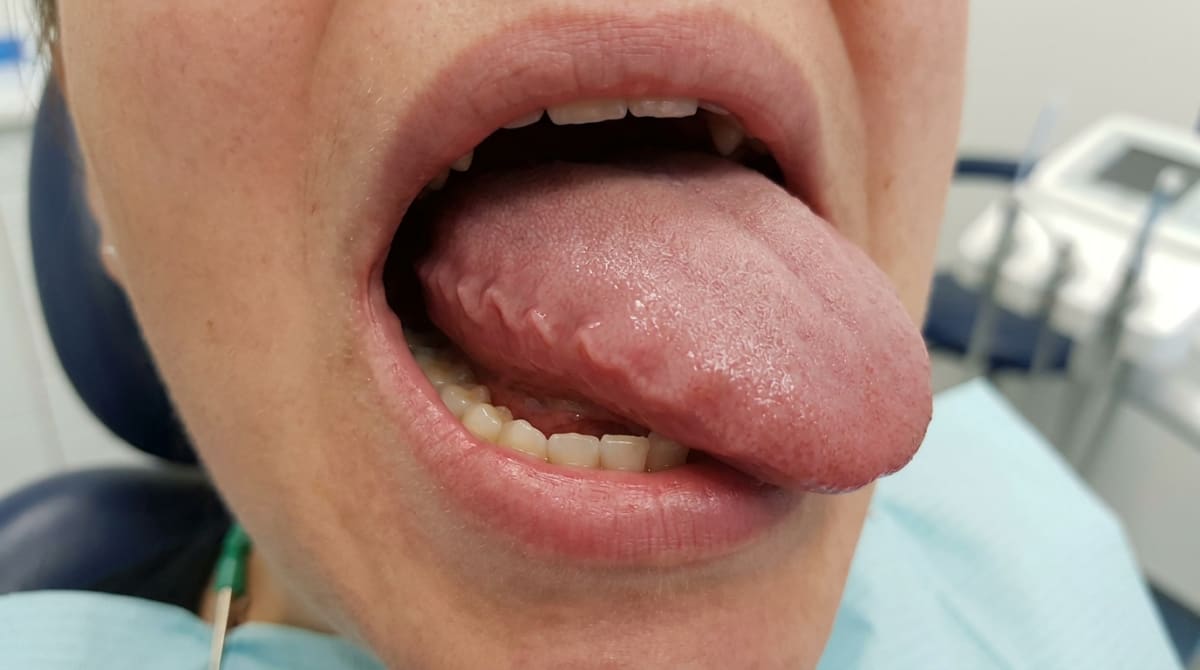
Common features include a tongue that protrudes between the teeth at rest, tooth indentations (scalloping) along the sides of the tongue, difficulty closing the lips fully, drooling, speech changes (particularly with the s, z, t and d sounds), open bite and forward tooth movement over time, and breathing difficulties in severe cases.
Who tends to get it?
The textbooks describe a range of presentations:
Children with Down syndrome, usually relative macroglossia from a smaller upper jaw.
Newborns with Beckwith-Wiedemann syndrome, a rare overgrowth syndrome with characteristic large tongue.
Patients with hypothyroidism, tongue swelling from fluid build-up in the tissues.
Patients with acromegaly (a condition of excess growth hormone in adults), slow tongue enlargement from excess growth hormone in adults.
Patients with amyloidosis (a condition where abnormal protein builds up in body tissues), protein deposits in the tongue making it firm and enlarged.
Patients with infiltrating tumours, such as lymphangioma (a benign growth made of small lymph vessels), haemangioma (a benign growth made of small blood vessels) or neurofibroma (a benign nerve tissue growth).
Patients with allergic reactions (angio-oedema), sudden tongue swelling that can be a medical emergency.
Patients with infections, abscess or deep fungal infection of the tongue.
Patients with vitamin deficiencies, B12 or iron deficiency producing inflamed enlarged tongue.
What causes it?
The textbooks group causes into several categories:
Congenital, Down syndrome, Beckwith-Wiedemann syndrome, mucopolysaccharidoses (a group of rare inherited storage disorders), congenital hypothyroidism, vascular and lymphatic malformations.
Endocrine, adult hypothyroidism and acromegaly.
Infiltrative, amyloidosis, sarcoidosis (a systemic disease that forms small clusters of immune cells in body tissues), lymphoma (a cancer of the lymphatic system), salivary gland tumours.
Inflammatory, angio-oedema, infection, glossitis.
Traumatic, bleeding into the tongue (haematoma, a small collection of blood under the surface).
Habitual, relative macroglossia from chronic mouth breathing or thumb sucking.
Idiopathic, no specific cause identified in some patients.
How does it develop?
The course depends on the underlying cause. Congenital syndromes are present from birth and usually stable. Hypothyroidism produces slow enlargement over months as fluid accumulates in the tissues, and it is reversible with thyroid hormone replacement. Acromegaly causes slow enlargement over years. Amyloidosis produces gradual firmness and enlargement as protein deposits build up. Tumours produce localised growth. Allergic angio-oedema causes sudden, dramatic swelling within minutes and is a medical emergency. Infection produces rapid, painful swelling with redness and fever.
What might you notice?
What it looks like
Common observations include:
A tongue that looks too big for the mouth, sometimes protruding between the teeth at rest.
Tooth indentations (scalloping) along the sides of the tongue where it presses against the teeth.
Open bite, with the front teeth not meeting because of constant tongue pressure.
Drooling particularly at night.
A noticeable change in tongue size over months when the cause is acquired (hypothyroidism, acromegaly).
What it feels like
Patients commonly report difficulty articulating clearly, trouble keeping food in the mouth while chewing, snoring or sleep apnoea (repeated pauses in breathing during sleep), and (in severe cases) breathing difficulties when lying flat. Sudden allergic swelling of the tongue is frightening and can compromise the airway, requiring emergency treatment.
What an X-ray might show
Dental X-rays are not the main tool for diagnosing macroglossia. The diagnosis is clinical, with imaging (ultrasound, MRI) used by the medical team when an infiltrative cause or vascular malformation is suspected. A dental panoramic X-ray may incidentally show the wider craniofacial pattern in syndromic cases.
What happens at the dentist?
When macroglossia is noticed at a dental check-up at ArtSmiles, the visit usually involves:
A detailed medical history, covering childhood illnesses, family history, current medical conditions, recent medicines and allergies.
A careful examination of the tongue, the rest of the mouth, the lymph nodes and the general appearance.
A dental examination for scalloping, open bite, tooth wear and any related findings.
Photographs for the file and to track any change over time.
Referral to a GP or specialist to investigate the underlying cause, which often takes priority over dental management.
Coordination with thyroid, endocrinology, paediatric or oral medicine specialists, depending on the suspected cause.
Dental management of any complications, such as open bite, with orthodontic referral when appropriate.
Is this serious?
🟡 Macroglossia itself is rarely dangerous, but the seriousness depends on the cause. Concerns include:
🔴 Sudden allergic angio-oedema, of the tongue is a medical emergency that can block the airway.
🔴 Severe macroglossia at birth, can affect breathing and feeding and may need urgent paediatric care.
Amyloidosis, can be a sign of multiple myeloma or other serious systemic disease.
Acromegaly, affects multiple body systems and needs hormonal management.
Hypothyroidism, has wider health implications and is treatable with thyroid replacement.
Could it be something else?
A truly enlarged tongue should be distinguished from conditions that affect the tongue without enlarging it:
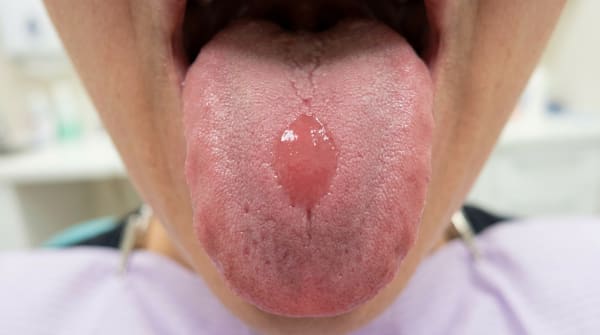
Median rhomboid glossitis, a smooth red patch in the middle of the tongue without overall enlargement.
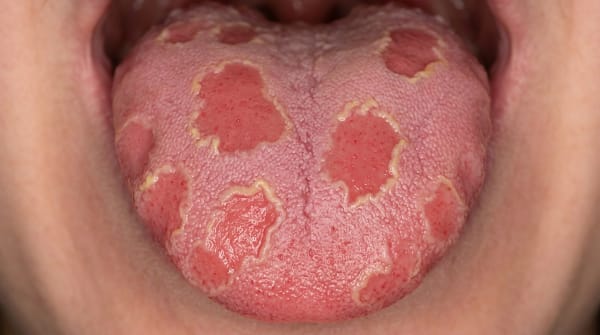
Geographic tongue, irregular map-like red patches that change pattern over days; no enlargement.
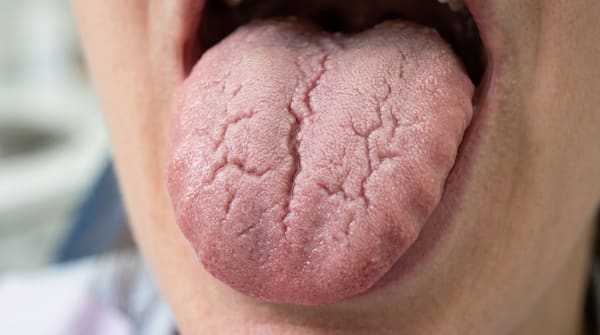
Fissured tongue, deep grooves on the tongue surface without overall enlargement.
Tumours of one part of the tongue, localised swelling rather than generalised enlargement.
Postoperative or post-traumatic swelling, usually short-lived and related to a clear recent event.
A combination of history, examination and (when needed) investigation clarifies the picture.
How is it treated?
Treatment is directed at the underlying cause, with the dentist supporting dental and oral aspects.
Medical treatment from your GP or specialist:
Hypothyroidism, thyroid hormone replacement; the tongue usually returns toward normal size over months.
Acromegaly, pituitary surgery, medication or radiotherapy directed by an endocrinologist.
Amyloidosis, chemotherapy and management of the underlying disease.
Angio-oedema, antihistamines, corticosteroids and adrenaline (for severe attacks), with specialist allergist review.
Vascular and lymphatic malformations, sclerotherapy (injection treatment that shrinks abnormal vessels), surgery or laser by specialists.
Surgical reduction (partial glossectomy, surgical removal of part of the tongue), reserved for severe macroglossia affecting the airway, eating or speech.
Dental and supportive steps:
Orthodontic management of any open bite resulting from chronic macroglossia.
Speech therapy for articulation difficulties.
Sleep medicine input if snoring or sleep apnoea develops.
Regular dental review, with particular attention to the gums and the bite as the tongue presses against the teeth.
A patient-centred approach matters here. Macroglossia can have an emotional and social impact, particularly in children. Calm, clear explanation, well-coordinated medical referral and ongoing support are themselves part of effective care, values that sit at the heart of our clinical philosophy.
What's the long-term outlook?
The outlook depends entirely on the cause. Hypothyroid macroglossia improves with thyroid replacement. Acromegaly-related macroglossia stabilises with effective treatment. Congenital macroglossia in Down syndrome is usually stable through life. Severe cases benefit from a multidisciplinary approach, with the dentist supporting the wider medical team and managing the dental consequences of constant tongue pressure on the teeth.
A note on this article
This article is for educational purposes only and does not constitute a clinical diagnosis. Please consult a registered dental practitioner for assessment and treatment advice.
The cover image above is an AI-generated illustration based on the most common visible features of this condition described in clinical pathology references. It is not a photograph of a real case and should not be used to diagnose or rule out the condition in your own situation. If you are concerned about something you have noticed, please book an assessment with a registered dental practitioner.
References
Neville, B. W., Damm, D. D., Allen, C. M., & Chi, A. C. (2023). Oral and maxillofacial pathology (5th ed.). Elsevier. Chapter 1, Developmental Defects of the Oral and Maxillofacial Region: Macroglossia, with congenital and acquired causes.
Cawson, R. A., & Odell, E. W. (2017). Cawson's essentials of oral pathology and oral medicine (8th ed.). Elsevier. Chapter 2, Disorders of Development: cross-reference for macroglossia.
Regezi, J. A., Sciubba, J. J., & Jordan, R. C. K. (2017). Oral pathology: Clinical pathologic correlations (7th ed.). Elsevier. Chapter 5, Connective Tissue Lesions: cross-reference for tongue enlargement.
Frequently asked questions
What is macroglossia?
Macroglossia is an abnormally enlarged tongue. It can be true enlargement (the tongue itself is bigger) or relative enlargement (the tongue is normal size but sits in a small mouth or jaw). Patients typically present with tooth scalloping along the side of the tongue, difficulty speaking, drooling and breathing problems in severe cases.
What causes macroglossia?
Causes include congenital conditions (Down syndrome, Beckwith-Wiedemann syndrome, congenital hypothyroidism), acquired conditions (acromegaly, amyloidosis, hypothyroidism in adults, myxoedema), local lesions (lymphangioma, haemangioma, neoplasms, infection or abscess), and obstructive sleep apnoea. Edentulous patients can develop apparent macroglossia from loss of dental support.
How is the cause of macroglossia investigated?
Workup depends on the age and history. Newborns are screened for congenital syndromes, hypothyroidism and Beckwith-Wiedemann. Adults are checked for acromegaly (growth hormone), thyroid function and amyloidosis (serum and urine electrophoresis, biopsy). Imaging defines the local extent. Sleep studies assess for obstructive sleep apnoea.
How is macroglossia treated?
Treatment depends on the cause. Reversing the underlying condition (treating hypothyroidism, controlling acromegaly, removing a vascular malformation) often shrinks the tongue. Severe persistent macroglossia may need partial glossectomy to improve speech, breathing and oral hygiene. Children with congenital macroglossia are managed by a paediatric team.