Compiled from clinical pathology references. Medically reviewed by Dr Cristian Dunker , Principal Dentist, ArtSmiles Cosmetic Dentistry.
Quick summary
Also called | Oral psoriasis, mucosal psoriasis |
How urgent? | 🟢 Not dangerous, oral lesions are uncommon, harmless and rarely need specific dental treatment |
Common or rare? | Psoriasis affects about 2% of the population; true oral psoriatic plaques are rare, but geographic tongue (a benign condition where smooth red patches appear and shift around the tongue surface) is more common in psoriasis |
Who it affects | People with skin psoriasis; both sexes affected; oral changes most often appear when skin disease is active |
Who treats it | Dermatologist for the skin disease; general dentist for assessment and reassurance about oral findings |
Based on | Cawson, Neville |
What is it?
Psoriasis is a common, long-term skin disease in which patches of thickened, red, silvery-scaled skin appear on the elbows, knees, scalp and other areas. The textbooks describe it as a disease of about 2% of the population, with a strong genetic component and an immune-driven cause. Most people with psoriasis never have any oral signs at all. When oral changes do occur, they take two main forms:
True oral psoriatic plaques, rare, often translucent or whitish patches in the mouth.
Geographic tongue (erythema migrans), a much more common pattern of map-like red patches with white borders that occurs more often in people with psoriasis than in the general population. Microscopically, geographic tongue and psoriasis are very similar, leading some authors to describe geographic tongue as "oral psoriasis".
The oral manifestations of psoriasis are benign, often asymptomatic, and rarely need specific treatment.
Who tends to get it?
The textbooks describe a fairly recognisable pattern:
People with established cutaneous psoriasis, the diagnosis of oral psoriasis should only be considered when there is also a clear skin diagnosis.
About 10% of psoriatic patients show geographic tongue, compared with about 2.5% of age- and sex-matched controls.
People carrying the HLA-Cw6 genotype, a genetic marker shared between psoriasis and geographic tongue.
Adults more often than children, although psoriasis can occur at any age.
No strong sex predilection.
True oral psoriatic plaques are unusual in any age group, even among people with severe skin disease.
What causes it?
The textbooks describe psoriasis as a multifactorial immune-mediated condition:
Genetic predisposition, including HLA-Cw6 and other risk variants.
Immune dysregulation, particularly involving T-helper cells and interleukins (IL-17, IL-23) that drive epithelial proliferation.
Trigger factors, including stress, infection (especially streptococcal), certain medications (lithium, beta-blockers), smoking, alcohol and trauma.
Increased epithelial turnover, the surface cells of the skin (and occasionally the mouth) divide and mature too quickly, producing the thick, silvery scale on skin and a similar disordered pattern on mucosa.
How does it develop?
On the skin, increased epithelial turnover and inflammation produce the classic raised, red, silvery-scaled plaques. In the mouth, the same biological process produces a much more variable picture. The textbooks describe oral psoriatic plaques as ranging from translucent whitish plaques to patches that look very similar to erythema migrans (geographic tongue), well-defined red areas with raised, slightly white serpentine borders. Microscopically, both true oral psoriasis and geographic tongue show a "psoriasiform (looking like psoriasis under the microscope) mucositis", thickening of the epithelium with neutrophil collections (Munro abscesses) high in the surface layers.
What might you notice?
What it looks like
The textbooks describe several patterns:
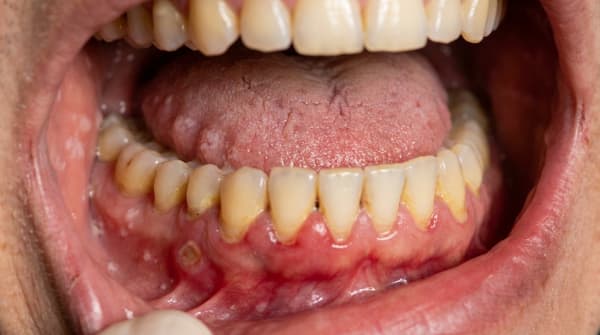
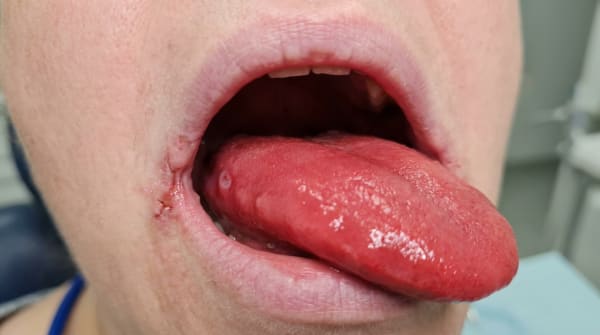
Geographic tongue, multiple, well-demarcated red patches with raised, yellow-white serpentine borders that move around on the upper surface of the tongue over days or weeks.
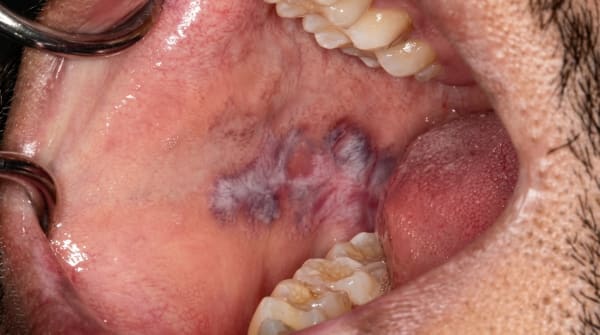
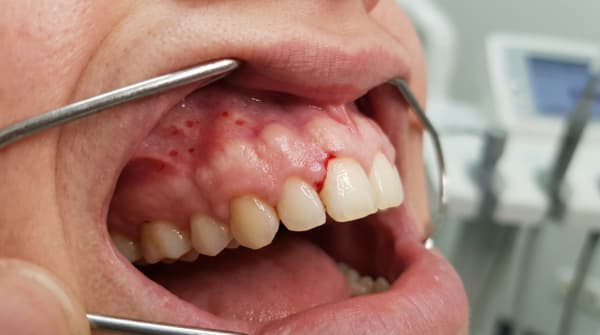
Translucent whitish patches on the cheek, palate or tongue, uncommon.
Diffuse erythema or depapillated areas of the tongue.
Pustular oral psoriasis, extremely rare, with small white-yellow pustules on the cheek or palate, usually only in patients with severe pustular skin psoriasis.
Cracked lips and fissuring of the angles of the mouth, sometimes overlapping with angular cheilitis.
What it feels like
Most oral lesions of psoriasis are asymptomatic. When symptoms occur they may include:
Mild burning or sensitivity to hot, spicy or acidic foods.
Tenderness during flare-ups of skin disease.
An unfamiliar surface texture noticed with the tongue.
A worsening of symptoms during periods of physical or emotional stress.
Significant pain, ulceration or bleeding is not part of typical oral psoriasis and should prompt other investigation.
What an X-ray might show
Oral psoriasis is confined to the soft tissue and not visible on X-rays. Patients with severe psoriatic arthritis (joint inflammation that occurs in some patients with psoriasis) may show changes in the temporomandibular joint on imaging, but this is unusual.
What happens at the dentist?
Oral lesions are most often picked up at a routine dental check-up and clean at ArtSmiles, or when a patient with known psoriasis asks about mouth changes. The dentist will typically:
Take a careful history about skin psoriasis, current dermatology care, and any medications (including biologics), newer injectable medicines that block specific parts of the immune response.
Examine the mouth carefully, looking particularly for geographic tongue patterns, translucent plaques and angular cheilitis.
Reassure when the findings match the recognised oral patterns of psoriasis.
Coordinate with the dermatologist when the oral findings are unusual or significantly affect quality of life.
Recommend biopsy only when the diagnosis is uncertain, for example, if the lesion does not behave like geographic tongue or shows features unusual for oral psoriasis.
Is this serious?
🟢 The oral manifestations of psoriasis are benign. They do not progress to cancer, are not contagious and rarely need specific dental treatment. The reason to recognise them is to avoid mistaking them for other, sometimes more serious oral conditions, and to give patients with psoriasis a clear understanding of how their skin disease may show up in the mouth.
If you have psoriasis and have noticed changes in your mouth, particularly map-like patches on your tongue, it is worth booking an assessment so the appearance can be confirmed and any concerns ruled out.
Could it be something else?
Several other conditions can produce similar oral findings. The textbooks list these as the main differentials:
Geographic tongue in someone without psoriasis, looks the same but with no skin disease and no HLA-Cw6 link.
Oral lichen planus, produces lacy white lines and red atrophic patches, usually symmetrical and stable rather than migratory.
Oral leukoplakia, fixed white patches that do not migrate; biopsy distinguishes them.
Erythematous candidiasis, diffuse red atrophic tongue, often with burning, that responds to antifungals.
Reactive arthritis (Reiter syndrome), can produce oral lesions resembling geographic tongue, alongside arthritis, urethritis and conjunctivitis.
How is it treated?
Management of the skin disease is the responsibility of a dermatologist. Dental management is supportive.
At-home measures and habits:
Continue any skin treatments prescribed by your dermatologist.
Maintain excellent oral hygiene, brushing twice a day with fluoride toothpaste and flossing daily.
Avoid hot, spicy or acidic foods during oral flare-ups if they cause discomfort.
Stop smoking and limit alcohol, both can worsen psoriasis on skin and in the mouth.
Manage stress, a recognised trigger for psoriasis flare-ups.
Professional steps your dentist may consider:
Confirming the diagnosis by clinical examination, in the context of known cutaneous psoriasis.
Reassuring the patient that the oral changes are benign.
Topical corticosteroids (such as fluocinonide gel) for short-term relief in the rare cases where oral lesions are persistently painful.
Treating coexisting angular cheilitis with a combined antifungal-corticosteroid cream.
Coordinating with the dermatologist for patients on biologic therapies, since these can affect oral health and dental treatment timing.
Routine dental care otherwise, with the patient's overall psoriasis status in mind.
A patient-centred approach matters here too. People with psoriasis often manage their condition for life and may not realise that mouth changes can be part of the picture. Calm, clear explanation that the oral findings are benign and rarely need specific treatment is itself part of effective care, values that sit at the heart of our clinical philosophy.
What's the long-term outlook?
The outlook for oral manifestations of psoriasis is excellent. Geographic tongue patterns and rare oral psoriatic plaques are benign and often improve when the skin disease is well controlled. They do not progress to cancer or other dangerous conditions and rarely cause lasting symptoms. Regular dental review, coordinated care with the dermatology team, and good general oral health are the most important factors in a good long-term outcome.
A note on this article
This article is for educational purposes only and does not constitute a clinical diagnosis. Please consult a registered dental practitioner for assessment and treatment advice.
The cover image above is an AI-generated illustration based on the most common visible features of this condition described in clinical pathology references. It is not a photograph of a real case and should not be used to diagnose or rule out the condition in your own situation. If you are concerned about something you have noticed, please book an assessment with a registered dental practitioner.
References
Cawson, R. A., & Odell, E. W. (2017). Cawson's essentials of oral pathology and oral medicine (8th ed.). Elsevier. Chapter 15, Soft Tissue Disease: Psoriasis, with the note that oral psoriatic plaques are rare and the link to erythema migrans, p. 258.
Neville, B. W., Damm, D. D., Allen, C. M., & Chi, A. C. (2023). Oral and maxillofacial pathology (5th ed.). Elsevier. Chapter 16, Dermatologic Diseases: Erythema Migrans (Geographic Tongue), with discussion of the psoriasis association and HLA-Cw6 link, pp. 785 to 786.
Regezi, J. A., Sciubba, J. J., & Jordan, R. C. K. (2017). Oral pathology: Clinical pathologic correlations (7th ed.). Elsevier. Chapter on Red and Blue Lesions: cross-reference for psoriasiform mucositis pattern in geographic tongue.
Frequently asked questions
Does psoriasis affect the mouth?
Oral psoriasis is uncommon but well documented. The most commonly reported associations are geographic tongue (benign migratory glossitis) and fissured tongue, both of which are seen more often in people with psoriasis than in the general population. True oral psoriatic plaques (well-defined red patches with whitish borders) are rare.
What does oral psoriasis look like?
When present, oral psoriasis appears as well-defined, red, slightly elevated patches with a whitish or grey-white edge, most often on the cheeks, palate or lips. The patches can come and go in parallel with the skin disease. Geographic tongue (red areas with white serpiginous borders that move over days) is the most visible mouth finding.
How is oral psoriasis diagnosed?
Diagnosis is suggested by the skin diagnosis plus characteristic oral patches. Biopsy may be done to rule out look-alikes such as lichen planus or geographic tongue without psoriasis. Joint symptoms, nail changes and family history support the diagnosis.
How is it treated?
Most oral psoriasis lesions are mild and need only reassurance. Symptomatic patches can be treated with topical corticosteroids, sometimes calcineurin inhibitors. Systemic therapy for psoriasis (methotrexate, biologics) usually controls oral lesions as well. TMJ involvement in psoriatic arthritis may need additional management with rheumatology and a dentist familiar with TMD.