Compiled from clinical pathology references. Medically reviewed by Dr Cristian Dunker, Principal Dentist at ArtSmiles Cosmetic Dentistry.
Quick summary
Also called | Scrotal tongue, lingua plicata (Latin for "folded tongue"), plicated tongue, grooved tongue, furrowed tongue |
How urgent? | 🟢 Usually no action needed, most cases are harmless and don't require treatment |
Common or rare? | Common, affects roughly 2-5% of the general population, and as many as 30% of older adults |
Who it affects | Adults and children; prevalence and severity rise with age. Some studies show a slight male predilection. |
Who treats it | General dentist, usually picked up at a routine check-up |
Based on | Neville, Laskaris, with cross-references in Regezi and Cawson |
What is it?
Fissured tongue is a common, harmless variation in the appearance of the tongue, where the upper surface, known as the dorsum, develops multiple grooves or "fissures" of varying depth and pattern. The grooves usually range from about 2 to 6 millimetres deep. The condition has several other names: scrotal tongue, lingua plicata (Latin for "folded tongue"), or simply grooved tongue. It is considered a developmental variant rather than a disease, and rarely causes any serious problem.
Who tends to get it?
Fissured tongue can be seen at any age, but the prevalence and severity tend to rise with age. The textbooks place the overall prevalence in the general population at around 2 to 5%, although some studies using more relaxed diagnostic criteria report rates as high as 20 to 73%. By older adulthood, up to 30% of people may show fissures, and some studies have noted a slight male predilection. It is also more commonly observed in people with Down syndrome and in people with a personal or family history of psoriasis.
What causes it?
The exact cause is uncertain, but heredity appears to play the strongest role. The textbooks describe two genetic patterns:
A polygenic pattern, where a combination of multiple genes from each parent makes a person more likely to develop fissured tongue.
An autosomal dominant trait with incomplete penetrance, meaning the relevant gene can be passed from a single parent, but not everyone who inherits it will visibly develop the condition.
Several non-genetic factors are also linked to the appearance or worsening of fissures over time:
Ageing, fissures tend to deepen and multiply as the years pass.
Smoking, heavier smoking is associated with more pronounced fissuring.
History of psoriasis, there is a recognised link between psoriasis and fissured tongue.
Coexisting geographic tongue, also called erythema migrans or benign migratory glossitis. Geographic tongue is so often seen alongside fissured tongue that researchers suspect a shared genetic basis.
How does it develop?
Because fissured tongue is mostly inherited, in most people the grooves quietly develop as the tongue grows during childhood, becoming more obvious in adolescence and adulthood. There is no infection, no trauma, and no acquired disease driving the change, the tongue's surface simply forms with these characteristic furrows.
When microscopic samples are studied, the affected tongue surface shows a thickened, deepened pattern of the rete ridges, the wave-like undulations between the surface layer and the deeper tongue tissue, and the tiny "hairs" that normally sit on the filiform papillae (the small projections on the tongue's upper surface) are reduced or lost. White blood cells often migrate into the surface layer in small clusters. Interestingly, this microscopic pattern is similar to what is seen in geographic tongue and in psoriasis, supporting the idea that these conditions are biologically related.
What might you notice?
What it looks like
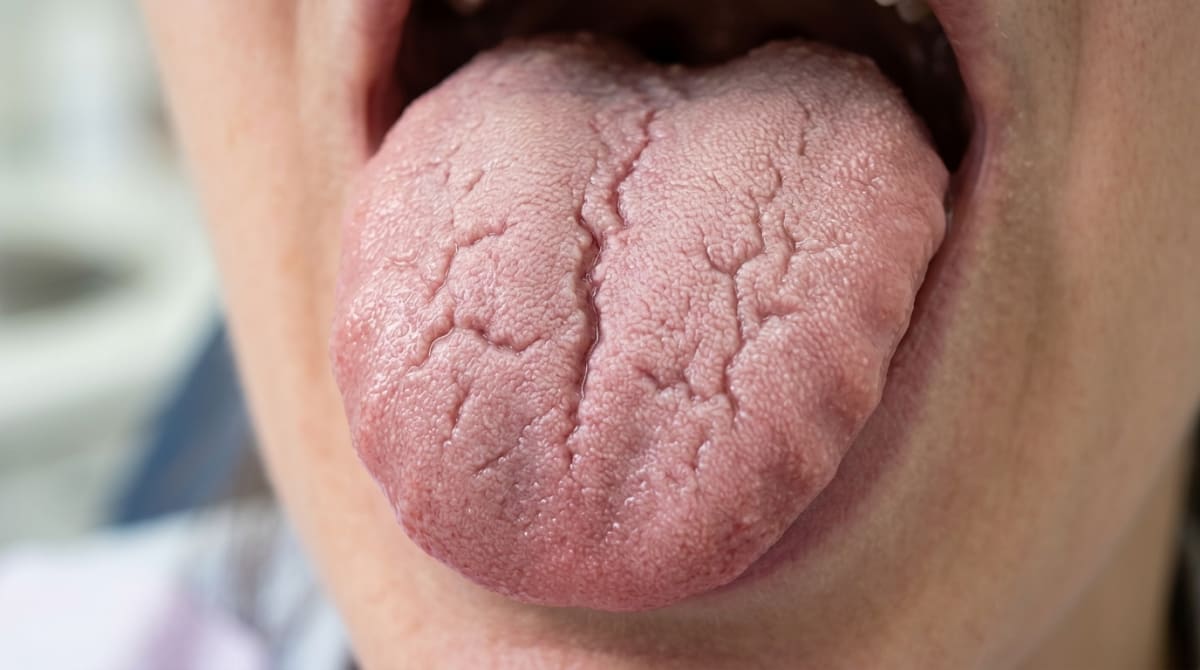
The tongue's upper surface shows multiple grooves or furrows. The pattern varies from person to person:
A deep central fissure running front-to-back, with smaller fissures branching off at right angles.
Multiple fissures spread across the entire upper surface, sometimes deep enough to make the tongue look as if it is divided into separate "islands" of tissue.
Fissures concentrated mainly along the sides of the tongue, the dorsolateral areas, with relatively smooth tissue in the middle.
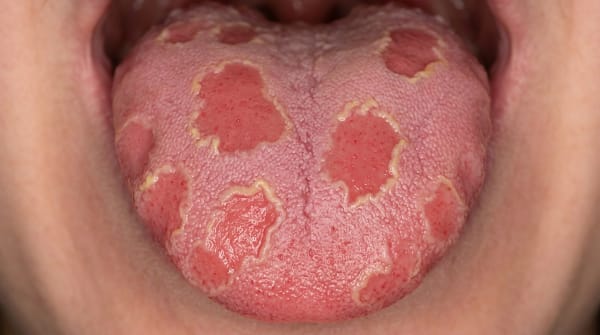
In many people, fissured tongue is also accompanied by patches of geographic tongue: red, smooth areas with white borders that change shape over days or weeks.
What it feels like
Most people with fissured tongue have no symptoms at all and only notice the appearance when looking in the mirror or being told by their dentist. A minority describe:
A mild burning sensation, particularly with hot, spicy or acidic foods.
A feeling of soreness, especially if food debris or dental plaque has lodged in the deeper grooves.
An unpleasant taste or odour from material trapped in the fissures.
What an X-ray might show
X-rays are not used to look for or assess fissured tongue. The diagnosis is made simply by inspecting the tongue.
What happens at the dentist?
Fissured tongue is usually picked up incidentally during a routine examination. A dentist at ArtSmiles, typically as part of a dental check-up and clean, will commonly:
Examine the tongue carefully, noting the depth, pattern and number of fissures.
Ask about symptoms such as burning, soreness or bad taste, and about how long the appearance has been present.
Look for signs of geographic tongue, which often coexists with fissured tongue.
Check for food or plaque debris in the grooves, since trapped material can be a source of irritation or odour.
Review the broader medical history, including any history of psoriasis, recurrent facial swelling, or facial nerve weakness, since fissured tongue can sometimes be one feature of broader conditions like Melkersson-Rosenthal syndrome, a rare condition combining recurrent facial swelling, facial paralysis and a fissured tongue.
Reassure when the appearance is isolated and unaccompanied by other concerning features.
A biopsy is rarely needed because the diagnosis is straightforward from clinical inspection.
Is this serious?
🟢 Fissured tongue is benign. It is not a sign of cancer, not contagious, and does not progress to anything dangerous. For most people, it is simply a variation in tongue surface that needs no treatment beyond keeping the tongue clean.
Could it be something else?
A grooved or unusual-looking tongue can sometimes be confused with other conditions. The textbooks list the following differentials:
Geographic tongue (erythema migrans, benign migratory glossitis), distinguished by red, smooth patches with raised white borders that move and change pattern over time. Fissured and geographic tongue commonly coexist.
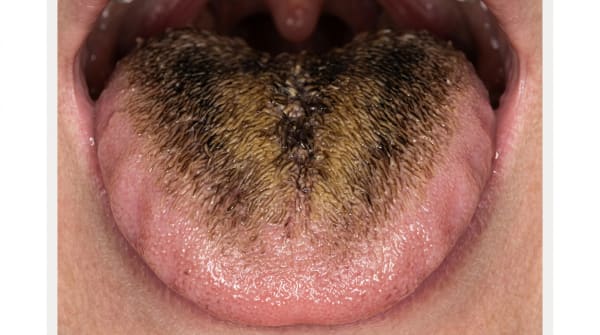
Hairy tongue (black hairy tongue), distinguished by elongated, discoloured filiform papillae that look like fine "hairs" on the tongue, rather than grooves.
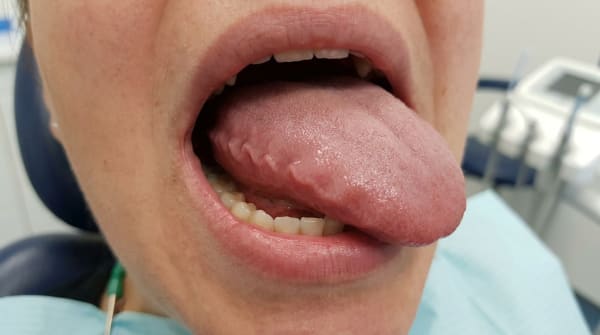
Crenated (scalloped) tongue, shows tooth-shaped indentations along the edges of the tongue from pressing against the teeth, rather than grooves on the upper surface.
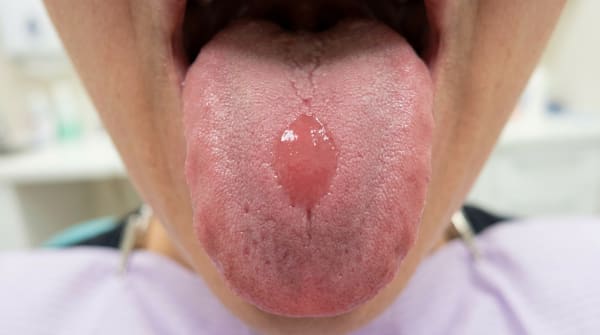
Median rhomboid glossitis, a single smooth red patch in the middle of the tongue, not multiple grooves.
Tongue changes in Sjögren syndrome, typically a dry, smooth, sometimes lobulated tongue that may show fissures from chronic dryness; usually accompanied by xerostomia and dry eyes.
Interstitial syphilitic glossitis, a rare, late-stage feature of untreated syphilis, with deep furrows and atrophy of the tongue muscle. Distinguished by clinical history and serology testing.
Melkersson-Rosenthal syndrome, a rare condition where fissured tongue appears together with recurrent facial swelling and facial nerve paralysis; the additional features set it apart.
Down syndrome, fissured tongue is more common in people with Down syndrome and is recognised as part of the broader syndrome rather than a stand-alone finding.
How is it treated?
Because fissured tongue is harmless, no specific treatment is generally required. The main goal is to keep the grooves clean so that food debris and bacteria do not build up.
At-home measures that may help:
Brush the upper surface of the tongue gently with a soft toothbrush or a tongue scraper after meals or at least once a day. This is the single most useful step.
Stay well hydrated, sipping water through the day flushes food debris out of the grooves.
Avoid trigger foods if you find that hot, spicy or acidic foods produce burning. Common irritants include chilli, vinegar, citrus and alcohol.
Limit smoking, beyond its general health impact, smoking is linked with deeper fissuring.
Professional steps your dentist may consider:
Confirming the appearance by clinical examination, usually without need for any test.
Treating any associated condition, for example, a fungal swab and antifungal therapy if there is an overlying yeast infection in the fissures, or a referral to a doctor if there are signs of Melkersson-Rosenthal syndrome.
Discussing nutrition and saliva flow if you have other tongue symptoms, since iron, B-vitamin or saliva-flow issues can amplify discomfort.
Referral to an oral medicine specialist for the rare cases where symptoms are unusually persistent or where the appearance suggests a broader systemic condition.
A warm, patient-centred approach matters here: many people who notice grooves on their tongue worry it is something serious, and clear explanation and reassurance are themselves part of effective care, values that sit at the heart of our clinical philosophy.
What's the long-term outlook?
The outlook is excellent. Fissured tongue is a benign condition and does not progress to cancer or any other serious disease. Many people live their entire life with a fissured tongue and never have a problem with it. The fissures themselves typically remain stable or deepen slightly with age, but they do not signal anything sinister. With simple tongue brushing and good general oral hygiene, the few people who do experience burning or soreness usually find their symptoms manageable.
A note on this article
This article is for educational purposes only and does not constitute a clinical diagnosis. Please consult a registered dental practitioner for assessment and treatment advice.
The cover image above is an AI-generated illustration based on the most common visible features of this condition described in clinical pathology references. It is not a photograph of a real case and should not be used to diagnose or rule out the condition in your own situation. If you are concerned about something you have noticed, please book an assessment with a registered dental practitioner.
References
Neville, B. W., Damm, D. D., Allen, C. M., & Chi, A. C. (2023). Oral and maxillofacial pathology (5th ed.). Elsevier. Chapter 1, Developmental Defects of the Oral and Maxillofacial Region: Fissured Tongue (Scrotal Tongue; Lingua Plicata), pp. 11-12.
Laskaris, G. Pocket atlas of oral diseases. Thieme. Chapter 12, Diseases of the Tongue: Fissured Tongue, pp. 94-95.
Regezi, J. A., Sciubba, J. J., & Jordan, R. C. K. (2017). Oral pathology: Clinical pathologic correlations (7th ed.). Elsevier. Chapter 3, Red and Blue Lesions: Geographic Tongue (with notes on associated fissured/plicated tongue), pp. 96-98.
Cawson, R. A., & Odell, E. W. (2017). Cawson's essentials of oral pathology and oral medicine (8th ed.). Elsevier. Chapter 34, Pain, Anxiety, Neurological and Psychogenic Disorders: Melkersson-Rosenthal syndrome (fissured tongue as a clinical component).
Frequently asked questions
What is a fissured tongue?
Fissured tongue (also called scrotal tongue or plicated tongue) is a common, harmless condition where the top surface of the tongue has one or several deep grooves or fissures. It is usually present from a young age, becomes more pronounced with age, and most people only discover it during a dental visit.
What causes fissured tongue?
Fissured tongue is mostly considered a normal variation. It is more common in people with geographic tongue and in people with psoriasis. It is also a feature of Melkersson-Rosenthal syndrome (with facial swelling and facial nerve palsy) and Down syndrome. Most cases are isolated and have no associated medical condition.
Does fissured tongue need treatment?
No. Fissured tongue is benign and does not need any treatment in itself. If the fissures collect food debris and cause bad breath or burning, gently brushing the top of the tongue with a soft brush or tongue scraper is usually all that's needed. Persistent burning or pain warrants evaluation for candidiasis or other conditions.
Could fissured tongue be a sign of disease?
Usually not. However, the association with psoriasis means that a fissured tongue in a patient with skin or joint symptoms can be a clue. The association with geographic tongue means the two often coexist. Sudden onset of deep fissures with other symptoms should prompt review.