Compiled from clinical pathology references. Medically reviewed by Dr Cristian Dunker, Principal Dentist, ArtSmiles Cosmetic Dentistry.
Rheumatoid arthritis (RA) is a long-term condition where the immune system mistakenly attacks the lining of the joints, causing pain, swelling and gradual joint damage. While most people associate RA with the hands and feet, it can also affect the mouth in several ways, most often through the temporomandibular joint (TMJ), the salivary glands, the gums, and through side effects of the medications used to control the disease.
This article from the team at ArtSmiles, reviewed by Dr Cristian Dunker, looks at the dental and oral side of RA. It does not replace your rheumatologist's management plan; instead, it explains what your dentist watches for and why your oral health matters when you live with RA.
Quick summary
At a glance | Detail |
|---|---|
Also called | RA-related oral disease; rheumatoid involvement of the temporomandibular joint; secondary Sjögren's syndrome (when dry mouth is part of the picture) |
How urgent? | 🟡 Worth a check-up, most oral effects of RA are manageable, but jaw pain, persistent dry mouth and sudden bite changes deserve a proper assessment |
Common or rare? | Common, joint surveys report up to 71% of patients with rheumatoid arthritis have clinical signs in the temporomandibular joints, and around 15% develop secondary Sjögren's syndrome |
Who it affects | Adults, mostly women, typically becoming symptomatic between 40 and 60 years; men tend to develop disease later |
Who treats it | General dentist working alongside your rheumatologist, with referral to an oral medicine specialist or oral-maxillofacial surgeon when needed |
Based on | Regezi, Neville, Cawson |
Who tends to get it?
RA affects roughly 0.6 to 1% of adults in countries with similar populations to Australia, with higher rates reported in some Indigenous communities. Women are affected two to three times more often than men, and symptoms usually start in middle age, typically between 40 and 60 years for women, often a little later for men.
When it comes to the mouth specifically:
TMJ involvement is reported in around 50 to 86% of people with RA depending on how it is measured. One large survey found 71% of patients had clinical TMJ signs and 79% had radiographic changes, although severe pain in the joint was much less common than in the hands.
Secondary Sjögren's syndrome (dry mouth and dry eyes alongside RA) develops in roughly 10 to 15% of people with RA.
Periodontal (gum) disease is more common and tends to be more severe in people with RA, and the relationship appears to run both ways.
What causes it?
The oral effects of RA come from three different sources:
The disease itself. RA produces antibodies, most importantly anti-citrullinated protein antibodies (ACPAs, antibodies against a chemically modified form of proteins) and rheumatoid factor, that drive chronic inflammation of the synovial lining of joints, including the TMJ.
Associated autoimmune conditions. RA is the most common systemic autoimmune disease linked with Sjögren's syndrome, where the immune system also targets the salivary and tear glands.
Medications used to treat RA. Disease-modifying drugs such as methotrexate, gold salts, hydroxychloroquine, sulfasalazine and penicillamine, together with bisphosphonates (medicines that slow bone breakdown) prescribed for osteoporosis that can accompany RA, can each cause specific oral side effects.
Known contributors to RA itself include genetic background (particularly HLA-DR1), female sex, smoking, silica exposure and possibly Epstein-Barr virus infection. Periodontal disease is also associated with developing RA, with research suggesting that the oral bacterium Porphyromonas gingivalis may help generate the citrullinated proteins that trigger ACPAs.
How does it develop?
In a healthy joint, the synovial lining is a thin, smooth membrane that lubricates the joint surfaces. In RA, this membrane becomes inflamed and thickens. A reactive tissue called pannus (an abnormal fibrous overgrowth of inflamed synovium that erodes cartilage and bone) creeps onto the cartilage and releases enzymes that erode it, then the bone underneath. Think of pannus like ivy growing across a stone wall: harmless at first, but eventually it works its way into the cracks and pulls the wall apart.
In the TMJ, this process can flatten the head of the lower jawbone (the condyle, the rounded upper end of the jawbone that sits in the joint) and roughen the socket above it. Where damage is severe, the condyles can shorten enough for the back teeth to meet too early and the front teeth to no longer touch, what dentists call an anterior open bite. The articular disc (the small cushioning pad inside the joint) may be perforated or replaced entirely by scar tissue.
In the salivary glands, lymphocytes infiltrate around the ducts in secondary Sjögren's syndrome. Over time, the glands lose their ability to produce normal saliva, leaving the mouth dry, the protective rinsing action reduced and the teeth more vulnerable to decay.
What might you notice?
What it looks like
The face usually looks normal, but in advanced TMJ involvement, the lower jaw can appear set back and the chin smaller (a class II malocclusion, a bite pattern where the upper teeth project further in front of the lower teeth than usual). The front teeth may no longer meet when the back teeth bite together.
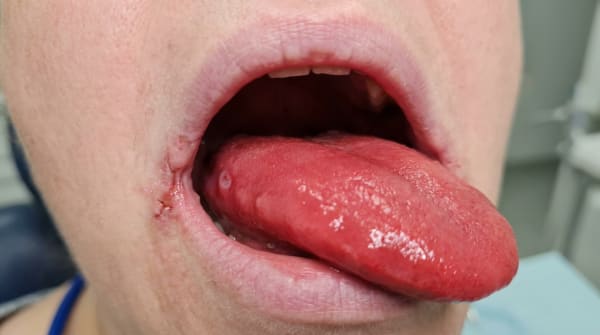
The tongue in secondary Sjögren's syndrome often becomes red, fissured (with deep grooves) and lobulated (with rounded swellings), with loss of the small papillae on the surface.
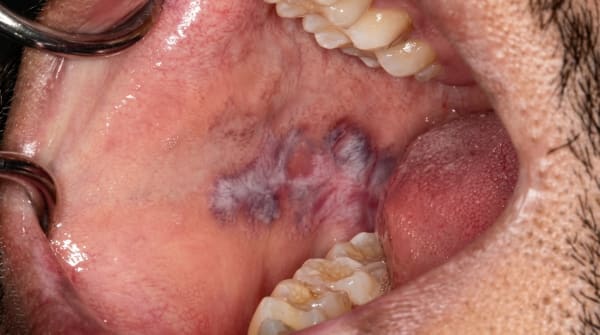
The lining of the mouth may look dry, shiny and parchment-like, sometimes sticking to a dental mirror or gloved finger during examination.
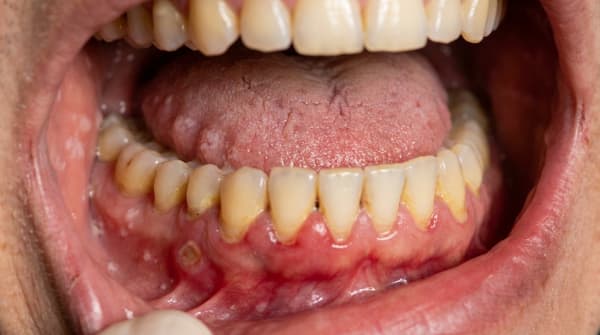
Decay along the gumline (cervical caries, decay at the neck of the tooth where it meets the gum) may appear quickly, even in people who previously had few problems.
Lichenoid reactions to medications appear as white lacy lines, red patches or shallow ulcers, most often on the tongue, inner cheeks or gums. See Lichenoid Drug Reactions.
What it feels like
Stiffness, a dull ache or tenderness in front of the ears, especially on waking, mirroring the morning stiffness felt in the hands.
Crepitus (a grating, sandy noise when the joint moves) or clicking when opening or closing the jaw.
Pressure-related discomfort, for example, biting down on one side may produce pain on the opposite joint.
A feeling that the mouth opens less far than it used to.
A persistent dry, sticky feeling, difficulty swallowing dry foods, altered taste, denture sores or burning. See Living with Dry Mouth for the patient-side response.
Soreness from oral thrush, angular cracks at the corners of the mouth (see Angular Cheilitis), or ulcers from medications such as methotrexate.
It is worth knowing that TMJ pain in RA is often surprisingly mild compared with what radiographs show, many people simply notice stiffness and noises rather than severe pain.
What an X-ray might show
Dental imaging can show flattening of the condyles, irregular surfaces, narrowed joint spaces and, later, frank erosions. Cone beam CT (a 3D dental X-ray) and MRI provide more detail, with MRI particularly useful for assessing the cushioning disc and any joint effusion. Where dry mouth has accelerated decay, X-rays often reveal multiple cervical or root-surface cavities.
What happens at the dentist?
At ArtSmiles, your dentist usually starts with a careful history, including the type of RA you have, how long you have had it, your current medications, and whether you take bisphosphonates for bone density. They may then:
Examine the TMJ for tenderness, listen for clicks or crepitus, and measure how far you can open your mouth.
Check for muscle tenderness in the masseters and temples.
Look at your bite and note any recent change in how the teeth meet.
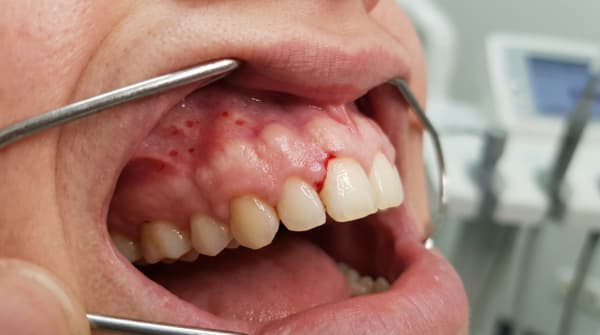
Inspect the lining of the mouth for dryness, redness, candida, lichenoid changes or ulcers.
Measure salivary flow if dry mouth is suspected.
Take radiographs (panoramic, CBCT or MRI) when warranted.
Refer for blood tests or a labial gland biopsy through your GP or rheumatologist if Sjögren's syndrome has not yet been formally diagnosed.
Where medication-induced lesions are suspected, your dentist will work with your rheumatologist before any drug change. If a bisphosphonate is involved, dental treatment is planned with extra care to reduce the risk of medication-related osteonecrosis of the jaw (MRONJ, a rare complication where a small area of jaw bone fails to heal after dental procedures in patients on certain bone-protective medications).
Is this serious?
🟡 The oral effects of RA are rarely emergencies, but they are not trivial either. Untreated, the consequences can include:
Progressive damage to the TMJ, leading to bite changes, anterior open bite and reduced mouth opening.
Rapid dental decay from chronic dry mouth, with potential for tooth loss.
Gum disease that may worsen RA control and vice versa.
Delayed recognition of medication side effects such as methotrexate ulcers, lichenoid reactions or, rarely, MRONJ.
If you have noticed any of these signs for more than two weeks, it is worth booking an assessment.
Could it be something else?
Many conditions can produce similar jaw, salivary or mucosal findings. The dentist's job is to work out which combination fits best.
Osteoarthritis of the TMJ, also causes flattening of the condyle and crepitus. Distinguished by older age of onset, single-joint involvement, absence of systemic inflammation, and usually mild or absent pain.
Temporomandibular disorders (TMD), clicking, jaw pain and limited opening can look identical. Distinguished by absence of joint erosion on imaging, more prominent muscle tenderness, and no systemic autoimmune markers.
Myofascial pain and fibromyalgia, diffuse muscle tenderness and chronic facial pain. Distinguished by widespread non-joint pain points and normal joint imaging.
Primary Sjögren's syndrome, produces the same dry mouth, dry eyes and salivary swelling. Distinguished by occurring without an associated connective tissue disease and a different autoantibody profile (very high anti-SS-B or La).
Systemic lupus erythematosus, can cause joint pain, oral ulcers and Sjögren-like dryness. Distinguished by characteristic rashes, anti-dsDNA antibodies and multi-organ involvement.
Systemic sclerosis (scleroderma), also causes limited mouth opening and dry mouth. Distinguished by tightening of the perioral skin, Raynaud's phenomenon (cold or stress-triggered colour change of the fingers), widened periodontal ligament on X-rays and rare jaw resorption.
Psoriatic arthritis, can affect the TMJ and even cause ankylosis (fusion of the joint). Distinguished by skin and nail psoriasis, a different joint distribution, and seronegative serology.
Ankylosing spondylitis, inflammatory joint disease involving the TMJ in some patients. Distinguished by spine and sacroiliac involvement, HLA-B27 positivity and male predominance.
Juvenile idiopathic arthritis (including Still's disease), important childhood-onset cause of TMJ damage with reduced opening and micrognathia. Distinguished by age of onset and growth-related jaw deformity.
Acute pyogenic arthritis of the TMJ, extremely rare but very painful, with redness, swelling and fever. Distinguished by acute onset, single-joint involvement and infection signs.
Oral lichen planus, produces white lacy lines on the cheeks identical to drug-induced lichenoid reactions. Distinguished by a typical bilateral, symmetrical pattern and no clear medication trigger.
How is it treated?
There is no single treatment for the oral effects of RA, care is shared between you, your dentist and your rheumatologist, and aimed at preventing damage rather than reversing it.
At home
Keep your overall RA control as steady as possible by following your rheumatologist's plan.
Prioritise gentle, twice-daily brushing with a soft brush and fluoride toothpaste, plus daily interdental cleaning. Hand stiffness can make this hard, an electric brush and floss holders may help.
For dry mouth, sip water often, avoid sugary or acidic drinks, and consider sugar-free chewing gum or lozenges to stimulate flow. Avoid alcohol-based mouthwashes.
Apply a high-fluoride toothpaste or rinse if your dentist recommends one.
For jaw symptoms, a soft diet during flares, gentle warmth and avoiding wide opening (yawn against the back of the hand) can ease soreness.
At the dental practice, treatment may include
Regular check-ups and professional cleans, often more frequent than the standard six months when RA is active or dry mouth is significant.
Topical fluoride applications and saliva substitutes.
Treatment of oral thrush (see Pseudomembranous Candidiasis), often with antifungal drops or gels rather than tablets that can interact with RA medications.
Conservative TMJ care: education, soft diet, jaw exercises, NSAIDs (with care, given existing RA medications), and an occlusal splint (a custom-made night guard that protects the teeth and reduces muscle activity) if grinding contributes to pain.
Restoration of decay using fillings, and replacement of failed restorations.
Periodontal therapy, since gum disease is more common and may influence RA control.
Specialist referral when severe TMJ destruction, suspected oral cancer, suspected MRONJ or unclear lichenoid lesions are involved. Surgical options for the joint, such as arthrocentesis (a gentle joint washout where the joint space is flushed with sterile fluid) or, rarely, joint replacement, are reserved for major destruction affecting function.
A note on bisphosphonates. If you take a bisphosphonate for osteoporosis associated with RA, please mention this before any extraction or implant. Your dentist will plan treatment to lower the risk of MRONJ, usually with prevention-first dentistry and good wound care.
What's the long-term outlook?
RA itself is a lifelong condition that cannot currently be cured, but modern disease-modifying drugs and biologics have transformed outcomes. With good systemic control:
TMJ involvement often stays mild and may never need joint surgery. Where damage has already occurred, symptoms can usually be managed conservatively and the bite stabilised.
Secondary Sjögren's syndrome is chronic, but the mouth and eye symptoms can be managed effectively with hydration, saliva substitutes, fluoride and regular dental care. Salivary gland damage itself is not reversible, so prevention of decay is the priority.
Drug-related lesions, lichenoid reactions, methotrexate ulcers and gold-induced stomatitis, generally resolve when the drug is changed in consultation with your rheumatologist.
MRONJ is uncommon with oral bisphosphonates for osteoporosis, and the risk can be reduced by careful planning and good oral hygiene.
The most important predictor of a smooth dental life with RA is regular preventive care, started early. People who maintain good control of both the disease and their oral hygiene generally keep their teeth, their bite and their comfort over the long term.
A note on this article
This article is for educational purposes only and does not constitute a clinical diagnosis. Please consult a registered dental practitioner for assessment and treatment advice.
The cover image above is an AI-generated illustration based on the most common visible features of this condition described in clinical pathology references. It is not a photograph of a real case and should not be used to diagnose or rule out the condition in your own situation. If you are concerned about something you have noticed, please book an assessment with a registered dental practitioner.
References
Regezi, J. A., Sciubba, J. J., & Jordan, R. C. K. (2017). Oral pathology: Clinical pathologic correlations (7th ed.). Elsevier. Chapter 8, Salivary gland diseases (Sjögren's syndrome and connective tissue disease section), pp. 195 to 199.
Neville, B. W., Damm, D. D., Allen, C. M., & Chi, A. C. (2023). Oral and maxillofacial pathology (5th ed.). Elsevier. Chapter 11, Salivary gland pathology (Sjögren syndrome), pp. 471 to 477; Chapter 18, Facial pain and neuromuscular diseases (Rheumatoid arthritis and Temporomandibular disorders), pp. 872 to 876.
Cawson, R. A., & Odell, E. W. (2017). Cawson's essentials of oral pathology and oral medicine (8th ed.). Elsevier. Chapter 11, Disorders of the temporomandibular joints and periarticular tissues (Rheumatoid arthritis), pp. 195 to 197; Chapter 18, Neoplastic and non-neoplastic diseases of salivary glands (Sjögren's syndrome), pp. 295 to 298; Chapter 25, Allergy and autoimmune disease, pp. 364 to 366; Chapter 35, Complications of systemic drug treatment (lichenoid reactions to gold), pp. 444 to 446.
Frequently asked questions
How does rheumatoid arthritis affect the mouth?
Rheumatoid arthritis (RA) commonly affects the temporomandibular joint (TMJ), causing jaw pain, clicking, limited opening and morning stiffness. Many patients develop secondary Sjögren's syndrome with dry mouth and dry eyes. RA shares risk factors and inflammatory pathways with periodontal disease, and the two often coexist.
What does TMJ involvement in RA feel like?
Patients describe pain in front of the ear, especially in the morning or after chewing, clicking or grinding sounds, restricted mouth opening and sometimes a change in bite (the back teeth meet first, leaving the front teeth apart) if joint destruction is severe. Imaging may show erosion of the condyle in advanced cases.
Do RA medications affect the mouth?
Yes. Methotrexate can cause mouth ulcers (improved by folic acid supplementation). Biologics and JAK inhibitors increase risk of oral candidiasis and reactivation of viral infections (herpes). Corticosteroids contribute to thrush, slow healing and dry mouth. NSAIDs can cause oral ulcers and lichenoid reactions. Tell your dentist all current medications.
Are there practical adjustments for dental visits with RA?
Yes. Schedule longer or shorter appointments based on how long the patient can keep their mouth open comfortably. Use a bite block. Position the patient carefully — many RA patients cannot lie flat or tilt back. Hand-held cleaning aids (electric toothbrushes, floss-holders, three-headed brushes) help when finger joints are involved. Pre-medication for joint replacements is no longer routinely required.