Compiled from clinical pathology references. Medically reviewed by Dr Cristian Dunker , Principal Dentist, ArtSmiles Cosmetic Dentistry.
Quick summary
Also called | Lateral periodontal abscess, gum abscess, parietal abscess |
How urgent? | 🔴 See a dentist promptly, a periodontal abscess is an active infection that can spread and cause rapid bone loss around the tooth. |
Common or rare? | Common, especially in adults with existing gum disease |
Who it affects | Mostly adults; rare in children and usually linked to a foreign body when it does occur |
Who treats it | General dentist, sometimes with a periodontist (gum specialist) for follow-up care |
Based on | Neville, Cawson, Laskaris, Regezi |
What is it?
A periodontal abscess is a pocket of pus that builds up in the gum next to a tooth, rather than at the tip of the root. It usually starts when bacteria become trapped inside a deep gum pocket and the tissue can no longer drain on its own. The result is a tender, red swelling on the side of the tooth that can come on quickly and feel quite sore.
Who tends to get it?
Periodontal abscesses are most common in adults, particularly those who already have gum disease (periodontitis) with deeper-than-normal pockets between the gum and tooth. People undergoing active periodontal therapy can also develop one, and patients with diabetes or reduced immunity are at higher risk. In children they are uncommon, and when they do happen they are usually linked to a foreign body, like a piece of fish bone or popcorn husk, being pushed into otherwise healthy gum tissue.
What causes it?
A periodontal abscess almost always arises in a pre-existing gum pocket where the local conditions suddenly change. Common triggers include:
A deep periodontal pocket (a deeper-than-normal gap where the gum has pulled away from the tooth root) where the gum closes over the opening, trapping bacteria inside.
Furcation involvement, where bone loss has exposed the area between the roots of a back tooth.
Foreign material such as a fish bone, popcorn husk, seed, or food debris pushed into the pocket.
Recent scaling or root planing, where deep calculus (the hardened, calcified form of plaque, also called tartar) is incompletely removed and the gum heals over the opening before the pocket has cleaned itself out.
Diabetes or other conditions that reduce the body's ability to control infection.
Less commonly, a cemental tear, where a small fragment of the root surface separates and causes localised inflammation.
Occasionally, trauma or unusual tooth shapes such as enamel pearls or grooves on the root.
In essence, anything that lets bacteria flourish in a pocket while blocking the natural drainage out of that pocket can set the stage for an abscess.
How does it develop?
Think of a deep periodontal pocket as a narrow sleeve between the gum and the root of the tooth. Normally, fluid trickles out of this sleeve and washes some of the bacteria away. When the opening at the top swells shut, or food packs in tightly, the bacteria inside multiply quickly. White blood cells rush in to fight the infection, and the mixture of bacteria, dead cells and tissue fluid forms pus.
With nowhere to escape, the pus puts pressure on the surrounding gum, periodontal ligament (the fibres that hold the tooth in its socket) and bone. The body responds by activating bone-resorbing cells, which dissolve more of the supporting bone. This is why a periodontal abscess can cause noticeable damage in just a few days. The tooth pulp (the soft nerve and blood vessel core of the tooth) inside usually stays alive, which is one of the key features that separates this from an abscess that comes from inside the tooth.
What might you notice?
What it looks like
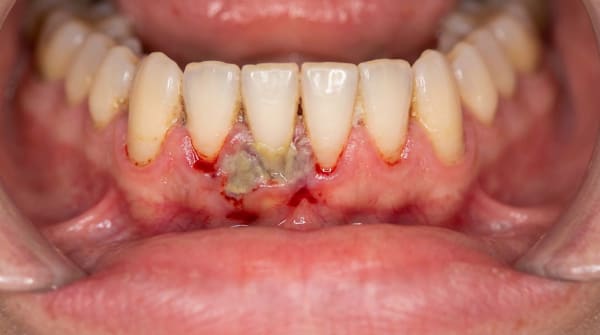
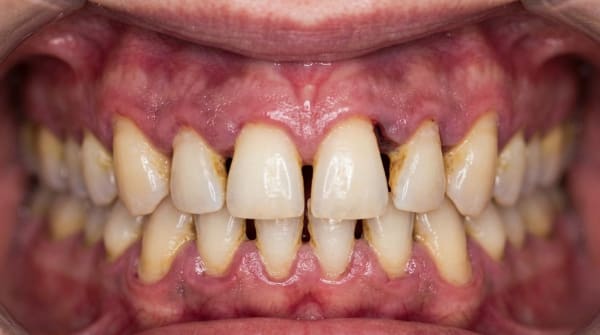
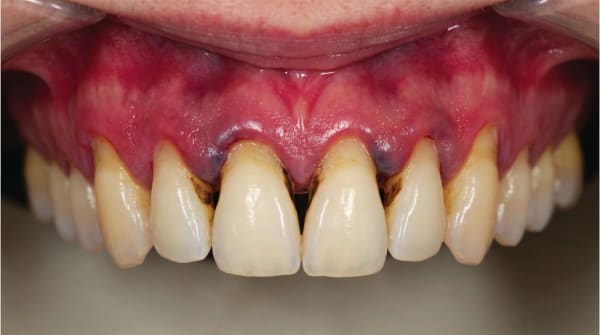
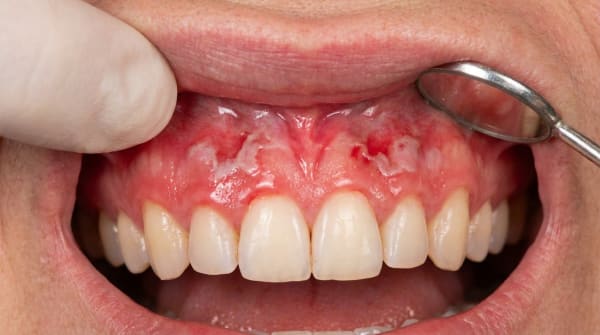
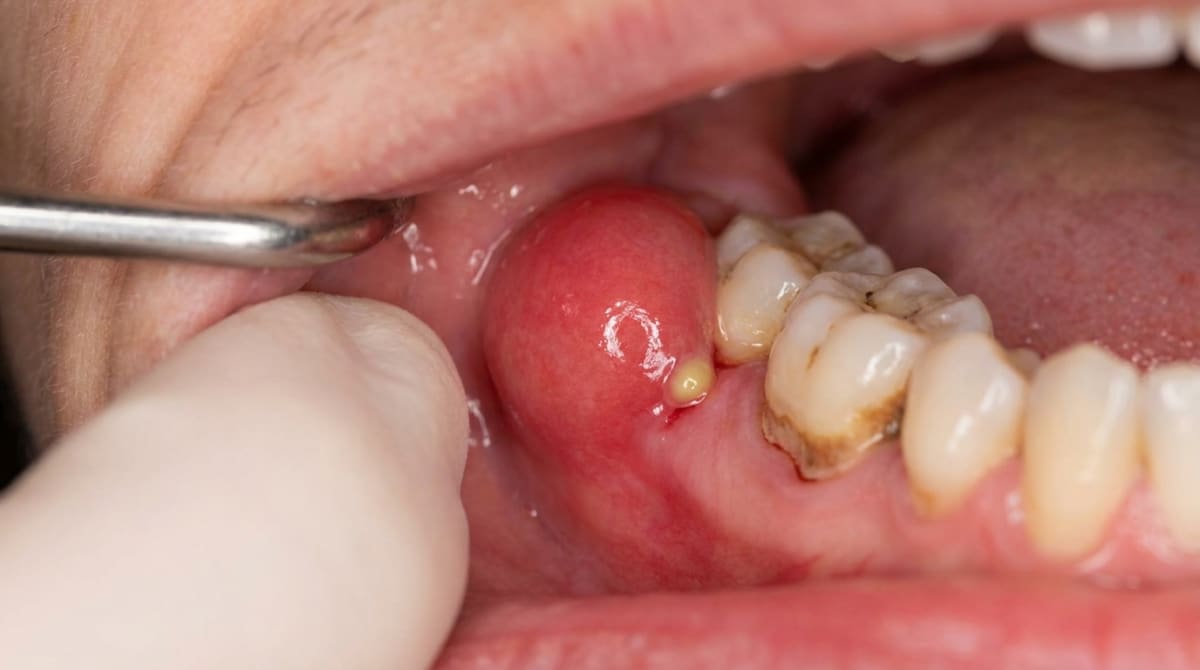
Most people see a localised red, shiny swelling on the gum next to a particular tooth, often pushing the gum outward like a small ball. The area can be bright red and smooth, or darker and slightly bruised-looking. In some cases the pus finds a way out through a small opening in the gum (sometimes called a sinus or fistula), which may release a yellow or whitish discharge. Pressing gently on the gum can cause more pus to seep out from beside the tooth.
What it feels like
A periodontal abscess usually feels like a constant, throbbing ache in the gum next to a specific tooth. The gum is very tender to touch. The tooth itself may feel sore to bite on, slightly loose, or as if it has lifted up a little out of the gum. Many people also notice a foul taste in the mouth as small amounts of pus drain into the sulcus (the tiny groove where the gum meets the tooth). If the infection is more advanced, fever, swollen lymph glands under the jaw and a general feeling of being unwell can develop.
When the abscess drains naturally, the pain often eases, but it can flare up again every time the opening closes over and pressure builds back up.
What an X-ray might show
In the first few days, a fresh abscess may not show much at all on an X-ray. After about a week, a darker (radiolucent) area may appear next to the side of the root, often on top of the bone loss already caused by long-standing gum disease. Vertical or angular bone loss along the root is a typical finding.
What happens at the dentist?
At ArtSmiles, your dentist will start by listening to your story, when the swelling started, what it feels like, whether it has happened before, and whether you have any medical conditions such as diabetes that can affect healing. They will then carefully examine the gum, looking for the swollen area and any sign of pus.
A fine periodontal probe (a thin, millimetre-marked instrument used to measure how deep the gum pocket goes) is gently slid into the gum next to the affected tooth to measure how deep the pocket is. A periodontal abscess almost always sits beside a deep pocket. Your dentist will also check whether the tooth feels alive (vital) using cold or electric pulp testing. A periodontal abscess typically arises beside a tooth with a healthy nerve, which helps separate it from an abscess starting inside the tooth.
An X-ray is usually taken to look at the bone around the tooth and rule out other problems. In more complex cases, for example, if the same area keeps flaring up, or if both the nerve and gum seem involved, your dentist may discuss a referral to a periodontist or endodontist (a dentist who specialises in root canal treatment) for further assessment.
Is this serious?
🔴 A periodontal abscess should be treated promptly. While it is rarely life-threatening, the infection can quickly destroy bone around the tooth, increase looseness, and in some cases spread into the surrounding tissues to cause facial swelling or cellulitis. Even when the pain temporarily settles after the pus drains, the underlying problem usually remains and the abscess can flare up again.
With timely care, the acute infection often calms down within a few days and the tooth can frequently be saved. Left untreated, repeated episodes can lead to so much bone loss that the tooth eventually needs to be removed.
If you've noticed any of these signs for more than two weeks, it's worth booking an assessment.
Could it be something else?
Several other conditions can cause a painful gum swelling next to a tooth. Your dentist works through these carefully because the treatment for each is different.
Periapical (dental) abscess, also causes a swollen, tender area, but the pus comes from a dead nerve inside the tooth. The tooth usually does not respond to vitality testing, while a tooth with a periodontal abscess is normally still alive.
Pericoronitis, inflammation around a partly erupted tooth, most often a lower wisdom tooth. It can look very similar but always involves a flap of gum sitting over an erupting crown rather than a deep pocket beside a fully erupted tooth.
Gingival abscess, pus that is limited to the gum margin or interdental papilla without involvement of the deeper periodontal ligament or bone. Usually caused by something pressed into the gum sulcus and resolves more easily.
Lateral periodontal cyst, a slow-growing developmental cyst that appears beside a tooth. It is typically painless and shows a well-defined radiolucency on X-ray, unlike the acute swelling of an abscess.
Periodontal fistula (sinus tract), a small opening on the gum draining pus from an underlying abscess. This is a sign of an existing abscess rather than a separate diagnosis, and the pulp of nearby teeth is usually still vital.
Combined periodontal-endodontic lesion, both a deep pocket and a non-vital tooth contribute to the infection. Vitality testing and X-ray patterns help distinguish it.
Gingival cyst of the adult, a soft, painless swelling on the attached gum, usually small and not infected.
Acute necrotising periodontitis (including HIV-associated forms), causes severe, deep, aching pain with rapidly destructive ulceration of the gums, rather than a single localised swelling.
Actinomycosis or other unusual infections, rarely, persistent gum swellings that fail to respond to standard care need further investigation to rule out these less common causes.
How is it treated?
Treatment of a periodontal abscess focuses on three things: relieving the pressure, cleaning the pocket and dealing with the underlying gum disease.
At home, before your appointment:
Warm salt-water rinses several times a day can help ease discomfort and encourage gentle drainage.
Continue to brush carefully around the area; avoid poking the swelling with sharp objects.
Over-the-counter pain relief, used as directed, can make you more comfortable until you are seen.
Avoid applying heat to the outside of the face, which can worsen swelling.
At the dentist, treatment may include:
Drainage of the abscess. This is most often done through the existing pocket. If that's not possible, a small incision through the overlying gum may be needed to release the pus.
Thorough cleaning of the pocket. Any plaque, calculus, food debris or foreign material is carefully removed, and the root surface is debrided (scraped clean) so the gum can reattach.
Antibiotics, not used for every abscess, but commonly prescribed when there is fever, swollen glands, spreading infection or significant general illness. Pain relief may also be recommended.
A soft diet and warm salt-water rinses for a few days while the area settles.
Definitive periodontal treatment once the acute symptoms have eased. This often involves a course of professional cleaning (scaling and root planing), oral hygiene coaching, and ongoing periodontal maintenance to keep the pockets shallow.
Periodontal surgery in some cases, to reshape deep pockets that can't be cleaned with scaling alone.
Removal of a cemental tear fragment if that is the underlying cause, sometimes possible non-surgically, sometimes requiring a small periodontal procedure.
Extraction is occasionally the most appropriate option if the tooth has lost too much supporting bone to be saved.
A periodontist may be involved when the gum disease is widespread, when pockets remain deep after initial treatment, or when the same area keeps flaring up despite good care.
What's the long-term outlook?
With prompt drainage and a good follow-up plan, most periodontal abscesses settle within days and the affected tooth can often be kept. The key, though, is what happens afterwards. A single abscess is usually a sign that the gums and supporting bone are not healthy in that area, and without ongoing care the same pocket, or another one, can flare up again.
Long-term success depends on managing the underlying periodontal disease: thorough daily brushing and interdental cleaning, regular professional cleans, and addressing risk factors such as smoking or poorly controlled diabetes. With consistent maintenance, periodontal health can be kept stable for many years. Without it, repeated infections and ongoing bone loss can eventually lead to tooth loss in the affected area.
A note on this article
This article is for educational purposes only and does not constitute a clinical diagnosis. Please consult a registered dental practitioner for assessment and treatment advice.
The cover image above is an AI-generated illustration based on the most common visible features of this condition described in clinical pathology references. It is not a photograph of a real case and should not be used to diagnose or rule out the condition in your own situation. If you are concerned about something you have noticed, please book an assessment with a registered dental practitioner.
References
Neville, B. W., Damm, D. D., Allen, C. M., & Chi, A. C. (2023). Oral and maxillofacial pathology (5th ed.). Elsevier. Chapter 4, Periodontal Diseases (Periodontal Abscess; Pericoronitis; Treatment and Prognosis), pp. 164 to 167.
Cawson, R. A., & Odell, E. W. (2017). Cawson's essentials of oral pathology and oral medicine (8th ed.). Elsevier. Chapter 5, Gingivitis and Periodontitis (Periodontal [Lateral] Abscess), pp. 87 to 89; Chapter 34, Lateral Periodontal Abscess, p. 432.
Laskaris, G. Pocket atlas of oral diseases. Thieme. Chapter 11, Periodontal Diseases (Periodontal Abscess; Periodontal Fistula), pp. 86 to 88.
Regezi, J. A., Sciubba, J. J., & Jordan, R. C. K. (2017). Oral pathology: Clinical pathologic correlations (7th ed.). Elsevier. Chapter 3, Parulis (Gingival Abscess), p. 54; Chapter 13, Periapical Abscess (for differential diagnosis), pp. 315 to 316.
Frequently asked questions
What's the difference between a periodontal abscess and a tooth abscess?
A periodontal abscess starts in the gum pocket from gum disease, not from inside the tooth. A periapical (tooth) abscess starts at the root tip from infected pulp tissue inside the tooth. The tooth itself is often still alive in a periodontal abscess. Treatment differs accordingly.
What does a periodontal abscess feel like?
Typical features are a sudden, painful, tender swelling on the gum next to a tooth, often with a 'pushed up' feeling. Pus may discharge spontaneously, leaving a bad taste. The tooth is usually mobile and tender to bite on, and there may be associated swelling and lymph node tenderness.
How is a periodontal abscess treated?
Initial treatment is drainage of the pus (either through the gum pocket or by a small incision), gentle debridement of the pocket, irrigation, and a course of antibiotics if there is spreading infection. Once the acute episode settles, comprehensive periodontal treatment of the underlying gum disease is essential to prevent recurrence.
Will the tooth survive a periodontal abscess?
Often yes, particularly if the abscess is caught early and the underlying gum disease is treated. Teeth with extensive bone loss and high mobility may not be saveable. Each tooth is assessed individually based on bone support, mobility, restorability and the patient's overall plan.