Compiled from clinical pathology references. Medically reviewed by Dr Cristian Dunker , Principal Dentist, ArtSmiles Cosmetic Dentistry.
Quick summary
Also called | Gingival cyst of the newborn (Bohn's nodules, dental lamina (the strand of tissue that gives rise to all teeth during development) cysts of the newborn); gingival cyst of the adult |
How urgent? | 🟢 Not urgent in either form, both are benign and harmless |
Common or rare? | The newborn form is very common (reported in 25-80% of newborns depending on the series); the adult form is rare |
Who it affects | Newborns up to about 3 months of age, and adults aged 40 and over (most often in the 50s to 70s) |
Who treats it | For newborns, no treatment is needed; for adults, a general dentist can excise the lump under local anaesthetic if needed |
Based on | Cawson, Neville, Laskaris |
What is it?
A gingival cyst is a small, fluid-filled cyst that develops in the gum tissue. The textbooks describe two distinct forms based on age:
Gingival cyst of the newborn, also called Bohn's nodules or dental lamina cysts of the newborn. These are tiny whitish nodules on the gum of a baby in the first few weeks of life. Despite the alarming appearance for new parents, they are completely harmless and usually disappear on their own within a few months.
Gingival cyst of the adult, a much rarer cousin that appears as a small, painless dome-shaped lump on the gum of an adult, most often in the lower canine and premolar area. It is benign and easily treated with a small excision.
Both forms come from the same underlying cell line, microscopic remnants of the dental lamina, the original tooth-forming tissue. They differ in age of presentation, appearance and management.
Who tends to get it?
Newborns
Reported in 25-80% of all newborns depending on the study and the strictness of the criteria used.
Most often noticed in the first few days to weeks of life.
The maxillary alveolus (upper gum) is more commonly involved than the mandibular (lower) gum.
The cysts have disappeared by about 3 months of age in the great majority of babies.
Adults
Most common in the fifth, sixth and seventh decades, roughly age 40 and over, with the peak after 50.
60-75% of cases occur in the lower canine and premolar area (the cheek-side gum of the lower front-to-middle teeth).
Rare in younger adults and not described in children once the newborn form has resolved.
Slightly more common in some series in men, but no strong sex predilection overall.
What causes it?
Both forms develop from the same cells, microscopic remnants of the dental lamina, the strand of tissue that originally formed the teeth. After tooth formation is complete, small islands of these cells normally remain quietly in the gum and gradually disappear. In gingival cysts, a few of these islands undergo cystic change, fluid accumulates and a small cyst develops.
The textbooks note one practical distinction:
In newborns, the cysts develop just below the surface of the gum and tend to rupture spontaneously into the mouth as the baby feeds and explores with the tongue.
In adults, the cysts develop deeper in the gum and may persist as small lumps until they are removed.
A separate group of small whitish nodules sometimes seen on the midline of the palate in newborns are called Epstein's pearls. These are not gingival cysts in the strict sense, they arise from non-odontogenic epithelium along the midline raphe, but they behave in exactly the same harmless, self-resolving way.
How does it develop?
A small island of dental lamina cells loses contact with the surface and starts to produce a tiny amount of fluid. Around this fluid, the cells form a thin lining. The little cyst then enlarges very slowly. In newborns, the overlying gum is thin and the cyst quickly approaches the surface, where it eventually ruptures into the mouth and disappears. In adults, the cyst sits deeper, with thicker overlying tissue, so it tends to be visible as a stable bump rather than rupturing on its own.
Microscopically, both forms are very similar: a thin epithelial lining with a flat surface and, in some cases, focal "plaques" of clear cells (rich in glycogen) within the lining.
What might you notice?
What it looks like
In newborns:
Multiple small whitish nodules on the alveolar ridge, usually 2-3 mm across.
Often appear as a row of pearly bumps along the gum.
Most commonly on the upper alveolus, sometimes the lower.
Some babies may also have similar nodules on the midline of the palate (Epstein's pearls).
In adults:
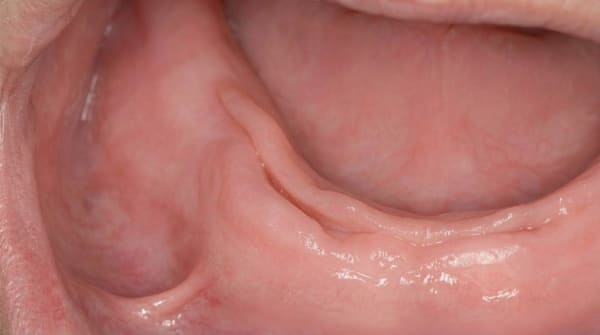
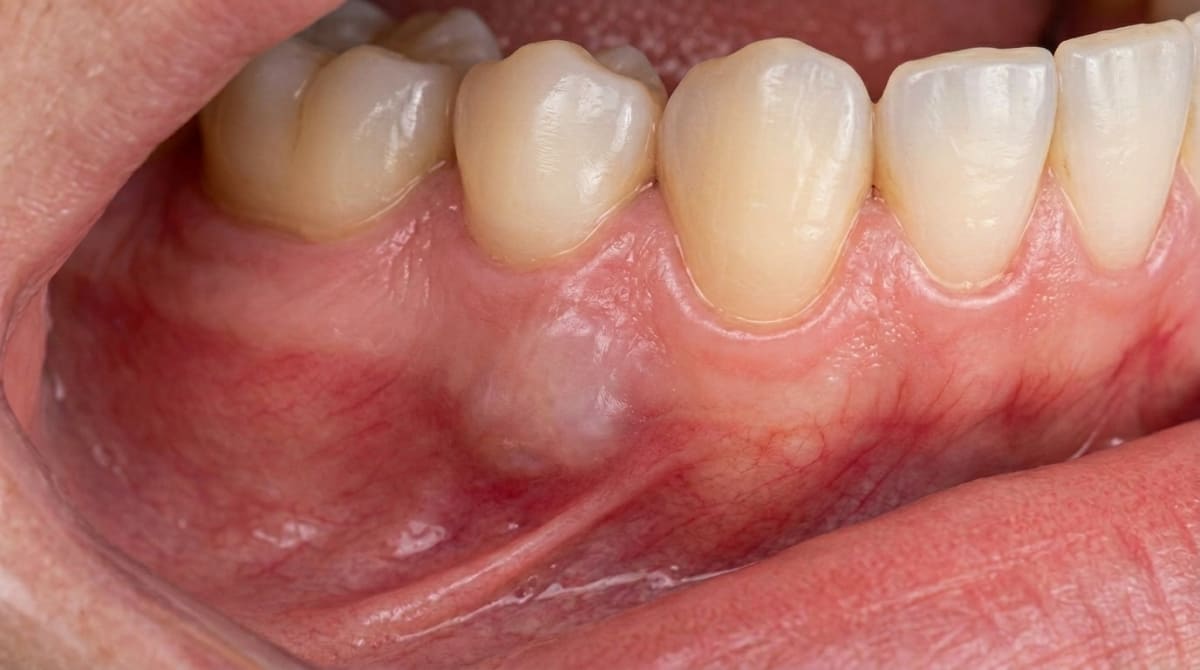
A single, dome-shaped swelling on the cheek-side gum, usually less than half a centimetre across.
Often bluish or blue-gray through the overlying gum.
The surface is smooth and intact.
The lesion is most often near a lower canine or premolar.
What it feels like
In newborns: completely painless. Most babies feed normally and are entirely unaware of the cysts. Some parents notice them while wiping the gums, or only see them when the baby smiles or cries.
In adults: generally painless. Some patients notice a slight bump while brushing or feel it with their tongue. Discomfort is unusual unless the cyst is bumped during eating.
What an X-ray might show
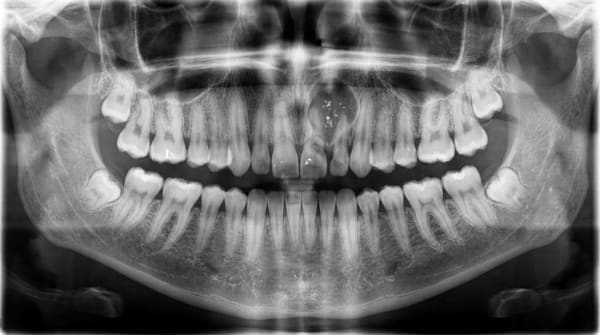
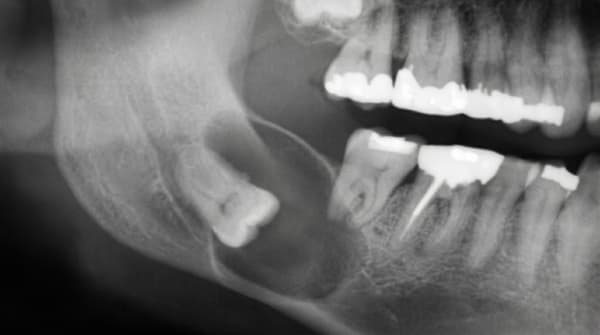
X-rays are not used in newborns. In adults, an X-ray of the area is usually normal, but occasionally shows a shallow saucer-like depression in the underlying bone where a long-standing cyst has pressed against the cortical bone.
What happens at the dentist?
Newborns
Most babies do not need to see a dentist for these nodules at all. Pediatricians, midwives and parents may notice them at a routine check, and reassurance is the main step. If a baby is brought to a dentist at ArtSmiles for any reason, a careful examination simply confirms the diagnosis and explains the natural course.
Adults
A gingival cyst of the adult is usually picked up at a routine dental check-up and clean or when the patient asks about a small lump they have noticed. The dentist will typically:
Examine the lump carefully and note its size, colour and consistency.
Test the vitality of nearby teeth with cold or electric pulp testing to rule out an inflammatory cause.
Take a periapical X-ray of the area to rule out a lateral periodontal cyst (a closely related developmental cyst that sits within the jaw bone), its bony counterpart, that may have eroded through the cortical bone.
Discuss simple excision under local anaesthetic, since the diagnosis is best confirmed on histopathology.
Is this serious?
🟢 Both forms are benign. Neither is cancer, neither is contagious, and neither progresses to anything serious. The newborn form resolves on its own; the adult form is removed mainly to confirm the diagnosis and to remove the lump.
If a small bump on your gum has not resolved after a few weeks, or if you are unsure what a small whitish nodule on your baby's gum is, it is worth booking an assessment so the appearance can be confirmed.
Could it be something else?
Several other conditions can produce small bumps on the gum. The textbooks list these as the main differentials:
For newborns:
Epstein's pearls, very similar but located along the midline of the hard palate.
Natal or neonatal teeth (teeth present at birth), actual teeth present at birth or erupting in the first month, distinguishable from cysts on examination.
Inclusion cysts of the palate, similar small whitish nodules on the lateral palate, also benign.
For adults:
Lateral periodontal cyst, the bony counterpart, sitting in the bone rather than the gum.
Mucocele, a salivary cyst more typical of the lower lip.
Peripheral fibroma or peripheral ossifying fibroma, firmer, fibrous nodules of the gum.
Periodontal abscess, tender, painful swelling of the gum from infection in a deep gum pocket.
Pyogenic granuloma, a fast-growing, often bleeding red lump, particularly common in pregnancy.
Hemangioma, a long-standing reddish-blue lesion that has been present for many years.
How is it treated?
For newborns:
No treatment is indicated. The textbooks all agree that gingival cysts of the newborn resolve spontaneously by rupturing into the mouth, usually within the first three months of life.
Reassurance is the main step, parents are often very worried by what looks like white spots in their baby's mouth.
No need for incision, drainage, antifungals or any other intervention. Treating these cysts as if they were thrush or an infection is unnecessary.
For adults:
Conservative surgical excision under local anaesthetic. The lump is gently lifted out of the gum, the small wound is closed with a stitch or two, and healing usually takes a couple of weeks.
Histopathological examination of the removed tissue, essential to confirm the diagnosis.
No special long-term follow-up beyond routine check-ups.
A patient-centred approach matters in both forms, particularly with anxious new parents, and with adult patients worried that a "cyst" might be something more serious. Clear, unhurried explanation that the lesion is benign and easily managed is itself part of effective care, values that sit at the heart of our clinical philosophy.
What's the long-term outlook?
The outlook for both forms is excellent.
Newborn form: the cysts resolve spontaneously within the first three months of life. There are no long-term consequences and no link to future dental development problems.
Adult form: once the cyst has been excised and the diagnosis confirmed on microscopy, recurrence is uncommon. The gum heals over a couple of weeks and there is no need for prolonged follow-up beyond routine review.
A note on this article
This article is for educational purposes only and does not constitute a clinical diagnosis. Please consult a registered dental practitioner for assessment and treatment advice.
The cover image above is an AI-generated illustration based on the most common visible features of this condition described in clinical pathology references. It is not a photograph of a real case and should not be used to diagnose or rule out the condition in your own situation. If you are concerned about something you have noticed, please book an assessment with a registered dental practitioner.
References
Neville, B. W., Damm, D. D., Allen, C. M., & Chi, A. C. (2023). Oral and maxillofacial pathology (5th ed.). Elsevier. Chapter 15, Odontogenic Cysts and Tumors: Gingival Cyst of the Newborn (with Epstein's pearls and Bohn's nodules) and Gingival Cyst of the Adult, pp. 697 to 699.
Cawson, R. A., & Odell, E. W. (2017). Cawson's essentials of oral pathology and oral medicine (8th ed.). Elsevier. Chapter 7, Cysts of the Jaws: Dental lamina cysts of the newborn (Bohn's nodules) and Gingival cysts of adults, p. 129.
Laskaris, G. Pocket atlas of oral diseases. Thieme. Chapter 14, Soft-Tissue Cysts: Gingival Cyst of the Newborn and Gingival Cyst of the Adult, p. 112.
Frequently asked questions
Are Bohn's nodules in newborns dangerous?
No. Bohn's nodules and other gingival cysts of the newborn are completely harmless. They appear as tiny whitish papules on a baby's alveolar ridge, often in the first few weeks of life, and almost always rupture and disappear on their own within the first three months. No treatment is needed.
Will an adult gingival cyst go away on its own?
Unlike the newborn form, an adult gingival cyst tends to persist as a small bump because it sits deeper in the gum tissue. It is benign and slow-growing, but most are removed under local anaesthetic, both to confirm the diagnosis on histopathology and to clear the lump.
How is a gingival cyst different from a lateral periodontal cyst?
They are closely related and both come from the same dental lamina cells. A gingival cyst sits in the soft gum tissue and is visible from the outside as a small dome-shaped bump. A lateral periodontal cyst sits inside the jaw bone next to a tooth and is usually only found on an X-ray.
Should I worry about whitish spots in my baby's mouth?
Most whitish spots on a newborn's gum are gingival cysts of the newborn (Bohn's nodules), or Epstein's pearls on the palate. They are benign and resolve on their own within a few months. A paediatrician or dentist can confirm the diagnosis. They do not need any treatment.