Compiled from clinical pathology references. Medically reviewed by Dr Cristian Dunker, Principal Dentist, ArtSmiles Cosmetic Dentistry.
Quick summary
At a glance | Detail |
|---|---|
Also called | Adult periodontitis (advanced gum disease with bone loss); chronic adult periodontitis |
How urgent? | 🟡 Worth assessing soon, the disease is slow but progressive; the earlier it is caught, the more teeth can be saved |
Common or rare? | Very common, the most frequent form of advanced gum disease in adults |
Who it affects | Mostly adults over 35; smokers, people with diabetes, and those with poor oral hygiene are at higher risk |
Who treats it | General dentist for non-surgical periodontal care; periodontist for advanced or surgical cases |
Based on | Neville, Cawson, Regezi |
Most people first hear about gum disease when their dentist mentions some bleeding during a clean. What many do not realise is that there are two stages, a reversible early form (gingivitis (the reversible early stage of gum disease)) and a slower, more serious form that quietly damages the bone around the teeth (chronic periodontitis). The good news is that chronic periodontitis can be controlled. The challenging news is that it has often been progressing for years before patients notice.
This article from the team at ArtSmiles, reviewed by Dr Cristian Dunker, explains what chronic periodontitis is, how it is treated, and why long-term maintenance matters.
What is it?
Chronic periodontitis is the slow, long-term form of periodontitis, disease of the supporting tissues around the teeth. It involves:
Gum inflammation that has persisted for years.
Loss of attachment between the gum and the tooth root.
Pocket formation where the gum has detached, allowing bacteria to thrive deeper.
Loss of bone supporting the teeth.
Loss of the periodontal ligament,, the tissue that holds each tooth in its socket like a hammock.
It typically progresses slowly but steadily, with occasional faster bursts. Aggressive periodontitis, by contrast, advances rapidly and is treated as a separate clinical pattern.
Who tends to get it?
Chronic periodontitis is the most common form of advanced gum disease and affects:
Adults, with prevalence rising with age. Some 30 to 50% of older adults have signs of moderate or severe disease in international surveys.
Smokers, in whom the disease is more common, more advanced and harder to treat.
Patients with diabetes, especially poorly controlled diabetes, the link between blood sugar and gum disease is two-way.
Patients with poor or inconsistent oral hygiene.
Patients with certain genetic susceptibilities.
Patients under chronic stress.
Patients with conditions or medicines that reduce saliva flow.
What causes it?
The fundamental cause is plaque (the soft, sticky film of bacteria on the tooth surface) bacteria along and below the gum line. Specific organisms commonly associated with chronic periodontitis include Porphyromonas gingivalis, Tannerella forsythia, Treponema denticola and Aggregatibacter actinomycetemcomitans.
Plaque alone, however, does not produce equal damage in everyone. How your own body responds (the immune response) is just as important as the bacteria themselves. Factors that worsen the response include:
Smoking, perhaps the strongest single environmental risk factor.
Poorly controlled diabetes.
Genetic susceptibility (specific gene variants amplify the inflammatory response).
Stress and poor sleep, which affect immune function.
Vitamin deficiencies, particularly vitamin C.
Hormonal changes (puberty, pregnancy, menopause), modulating, rather than causing, disease.
Certain medicines that affect gum response.
The disease is not contagious in the everyday sense, but the bacteria that drive it can be shared between close family members, particularly partners.
How does it develop?
The course is gradual:
Plaque accumulates along the gum line.
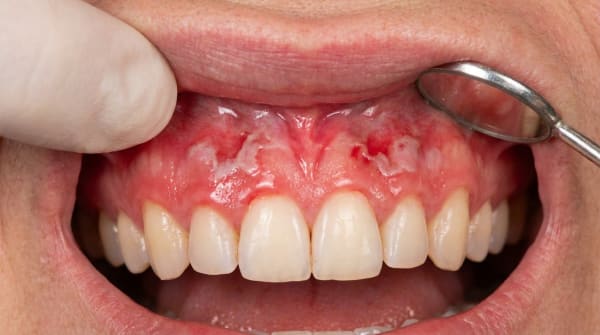
The gum becomes inflamed (gingivitis), red, swollen, bleeding.
With persistent inflammation, the connection between gum and tooth breaks down.
A periodontal pocket (a deeper-than-normal gap where the gum has pulled away from the tooth root) forms, providing a hidden space for further bacterial growth.
Bone loss begins, usually in a horizontal pattern around groups of teeth.
The pocket deepens, the bone loss continues, and teeth begin to feel less firm.
With ongoing disease, teeth start to drift, gaps open between teeth, and chewing becomes uncomfortable.
Without intervention, eventually some teeth become loose and may need to be extracted.
The progression is uneven, quiet for long periods, with occasional faster bursts of bone loss.
What might you notice?
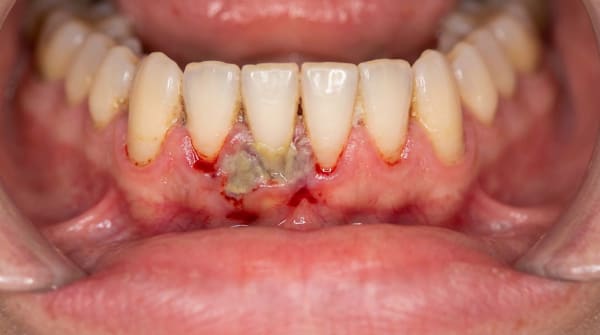
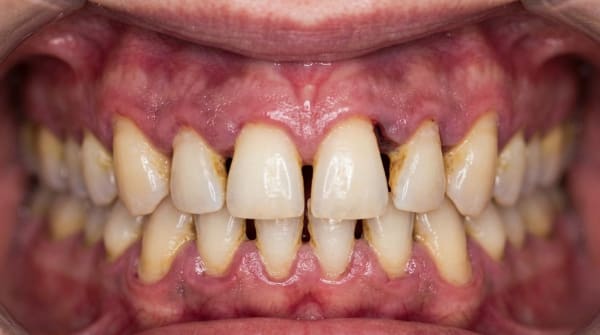
Chronic periodontitis can be silent for years. When symptoms appear, they may include:
Bleeding gums when brushing or flossing.
Gums that look puffy, red and tender.
Persistent bad breath, even after brushing.
A bad taste in the mouth.
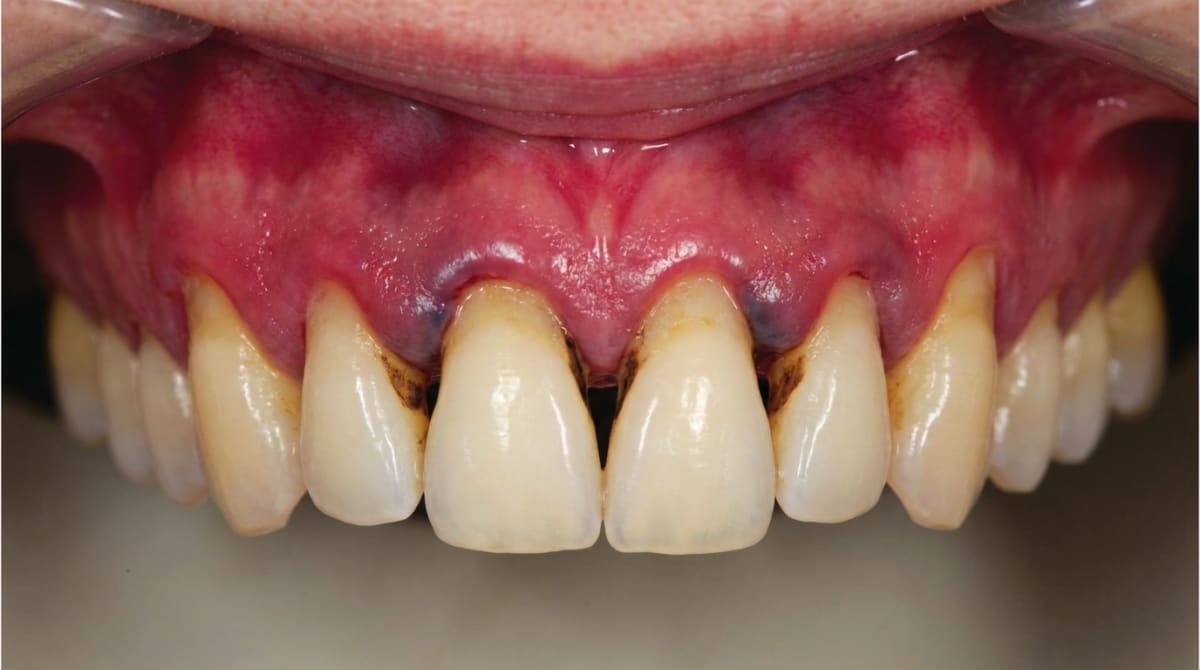
Receding gums, with teeth looking longer than they used to.
Black triangles opening between front teeth.
Sensitive root surfaces when eating cold or sweet food.
Loose or shifting teeth in advanced cases.
A change in the way teeth bite together.
Pain is often absent until disease is advanced, which is one of the reasons it can progress without prompting a dental visit.
What happens at the dentist?
A dental check-up for someone with, or at risk of, chronic periodontitis typically involves:
A full medical history, including smoking, diabetes and any relevant medicines.
A periodontal examination. Pocket depths are measured around every tooth (six points per tooth), gum bleeding noted, recession measured, plaque and calculus (hardened plaque, also called tartar) levels assessed.
Tooth mobility check.
Radiographs to assess the level of bone support around each tooth.
A diagnosis and staging. Modern classifications grade disease severity and progression risk, allowing tailored care.
A discussion about what we have found, what it means, and the steps to take.
Personalised home care advice, brushing technique, interdental cleaning, and any additional aids.
A treatment plan with realistic timeframes.
Is this serious?
Chronic periodontitis is a serious long-term condition because:
Tooth loss is a real possibility without treatment.
General health is affected, periodontitis is linked with diabetes control, cardiovascular health, pre-term birth and other conditions.
Eating, speaking and self-confidence suffer when teeth become loose or are lost.
Replacement teeth (bridges, dentures, implants) become more complex when bone is lost.
The reassuring side of the story is that timely treatment dramatically changes the long-term picture. Most patients can keep their natural teeth for life with appropriate care.
Could it be something else?
Several conditions can mimic or overlap with chronic periodontitis:
Aggressive (now grade C) periodontitis, rapid bone loss in young or otherwise healthy patients.
Necrotising periodontal diseases, painful ulcerated gums with grey slough.
Periodontal manifestations of systemic disease, leukaemia, HIV, neutrophil disorders, diabetes.
Endodontic-periodontal lesions, combined nerve and gum problems.
Drug-induced gingival overgrowth with secondary periodontitis.
Vertical fracture of a tooth root, which can mimic localised periodontitis.
A combination of clinical examination, X-rays and (when needed) blood tests sorts these out.
How is it treated?
Treatment of chronic periodontitis usually proceeds in several phases:
Initial therapy.
Oral hygiene instruction. Personalised brushing and interdental cleaning.
Smoking cessation support.
Professional cleaning, careful removal of plaque and calculus from above and below the gum line, often called scaling and root planing (deep cleaning to remove plaque and calculus from below the gumline). This may take one or several visits.
Reassessment. Six to eight weeks after initial therapy, the periodontal chart is re-measured to see what has improved and what remains.
Surgical phase (if needed).
Open flap surgery to access and clean deep pockets.
Regenerative procedures in selected sites where bone can be encouraged to grow back.
Mucogingival surgery to address recession.
Maintenance phase.
Regular maintenance visits every three to four months, where teeth are professionally cleaned and any pockets are reassessed.
Adjustments to home care as needed.
Restorative work to replace any teeth that have been lost, once the disease is stable.
What's the long-term outlook?
The long-term outlook is good for most patients who engage with treatment and maintenance. Studies of patients in regular periodontal care show that with consistent maintenance, additional bone loss is slow and few additional teeth are lost. Patients who do not attend maintenance visits, or who do not control plaque at home, generally lose more teeth over time.
Smoking cessation and good control of diabetes are the two changes most consistently shown to improve long-term outcomes.
If you have noticed bleeding gums, gum recession or any of the signs above, please book a periodontal review. The earlier we identify chronic periodontitis, the more we can do to keep your smile healthy for life.
A note on this article
This article is for educational purposes only and does not constitute a clinical diagnosis. Please consult a registered dental practitioner for assessment and treatment advice.
The cover image above is an AI-generated illustration based on the most common visible features of this condition described in clinical pathology references. It is not a photograph of a real case and should not be used to diagnose or rule out the condition in your own situation. If you are concerned about something you have noticed, please book an assessment with a registered dental practitioner.
References
Neville, B. W., Damm, D. D., Allen, C. M., & Chi, A. C. (2016). Oral and maxillofacial pathology (4th ed., Ch. 4: Periodontal Disease, Chronic Periodontitis). Elsevier.
Cawson, R. A., & Odell, E. W. (2017). Cawson's essentials of oral pathology and oral medicine (8th ed., Ch. 5: Periodontal Disease; Ch. 6). Elsevier.
Regezi, J. A., Sciubba, J. J., & Jordan, R. C. K. (2017). Oral pathology: clinical pathologic correlations (7th ed., Ch. 7: Periodontal Disease). Elsevier.
Frequently asked questions
What is chronic periodontitis?
Chronic periodontitis is the most common adult form of gum disease. It involves a long-standing bacterial inflammation of the gums that gradually destroys the bone and ligament holding the teeth in place. It usually progresses slowly, but bursts of more rapid bone loss can occur.
What are the early warning signs?
Persistent bleeding gums when brushing or flossing, gums that look red or puffy, bad breath, gaps appearing between teeth, gum recession or teeth feeling longer, and a feeling that teeth are looser or that bite has changed. Many of these are painless, which is why regular check-ups matter.
Can chronic periodontitis be cured?
It can be controlled, but the bone and ligament already lost do not fully regenerate without specialist regenerative procedures. With professional deep cleaning, excellent home care, smoking cessation and a strict maintenance schedule, most patients can stop further loss and keep their teeth for life.
How often do I need to see the dentist if I have chronic periodontitis?
After active treatment, supportive periodontal therapy typically means a professional clean every 3-4 months, sometimes more often in severe cases. Risk factors such as smoking, diabetes or genetic susceptibility may shorten the interval. The aim is to stay ahead of any flare-ups.