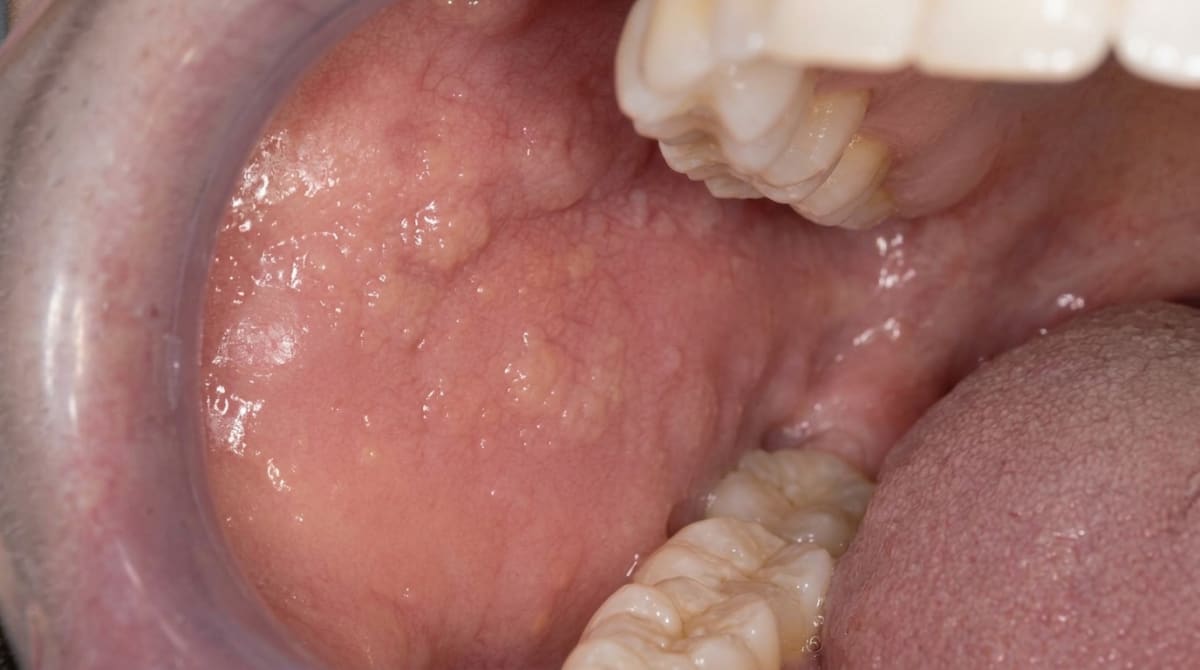
Compiled from clinical pathology references. Medically reviewed by Dr Cristian Dunker , Principal Dentist, ArtSmiles Cosmetic Dentistry.
Quick summary
Also called | Oral Crohn's disease, Crohn's of the mouth, regional enteritis (oral involvement) |
How urgent? | 🔴 See a dentist promptly, persistent mouth changes can sometimes be the first sign of bowel disease and warrant medical follow-up |
Common or rare? | Uncommon, oral changes are reported in roughly 10% to 20% of people with Crohn's disease, and occasionally appear before any gut symptoms |
Who it affects | Most often teenagers and young adults, but it can develop at any age |
Who treats it | Both, your gastroenterologist manages the underlying bowel disease, and your dentist or oral medicine specialist looks after the mouth |
Based on | Regezi, Neville, Cawson, Laskaris |
What is it?
Crohn's disease is a long-term inflammatory condition of the gut. Although it most often affects the lower part of the small bowel and the start of the colon, the inflammation can show up anywhere from the mouth to the anus. When it appears in the mouth, it can cause swollen lips, lumpy patches of cheek lining, deep ulcers in the gum sulcus, and a range of other changes that an alert dentist can sometimes spot before any tummy symptoms arise.
Who tends to get it?
Crohn's disease most commonly begins in teenagers and young adults, although it can develop at any age. The textbooks note that the prevalence of Crohn's disease appears to be increasing, and oral changes are reported in around 10% to 20% of people with the condition. Both men and women are affected. Importantly, the oral signs may either follow the bowel diagnosis, accompany it, or sometimes precede gastrointestinal symptoms by a long period, meaning a lip biopsy (a small tissue sample sent to the lab for testing) in the dental chair can occasionally pick up Crohn's before the gut has flared.
What causes it?
The cause of Crohn's disease remains unknown. The pathology references describe it as an inflammatory and probably immunologically mediated condition, in which the body's own immune system mounts a granulomatous reaction (a knot of immune cells) against tissue in the digestive tract. Several factors are recognised:
A genetic predisposition, Crohn's runs in some families.
An abnormal immune response, possibly to ordinary gut bacteria or food components.
Cigarette smoking is well known to exacerbate Crohn's disease, and patients are advised to stop.
Some food additives, such as cinnamon, benzoates and tartrazine, have been implicated in the closely related condition orofacial granulomatosis, which can overlap clinically with oral Crohn's.
It is not infectious and you cannot catch it from someone else.
How does it develop?
In Crohn's disease, the immune system gets stuck in an inflammatory loop and starts forming small clusters of immune cells called non-caseating granulomas. Think of a granuloma as a tiny, walled-off knot of inflammation, the body's attempt to wall off something it perceives as foreign. In the bowel these knots cause thickening, ulceration and scarring. In the mouth, the same process produces swollen lumps in the cheek lining, tense fullness in the lips, and deep splits in the gum sulcus. Because the inflammation sits deep in the tissue, the surface can look puckered or cobblestone (firm, raised, paved-looking) appearance, like the bumpy texture of a quilted leather sofa.
The granulomas in oral Crohn's are often small, loose, and scattered deep in the tissue, which is why a biopsy sometimes needs to be taken unusually deep to find them.
What might you notice?
What it looks like
The pathology references describe a recognisable cluster of orofacial features:
Diffuse soft or tense swelling of the lips, sometimes one lip, sometimes both, and the upper lip can become persistently enlarged with the red border turned outward.
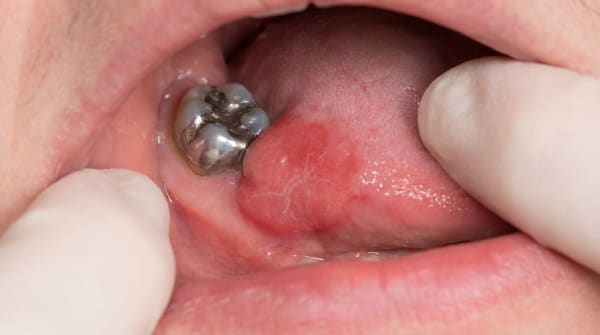
Cobblestone thickening of the cheek lining, small, multiple, hyperplastic nodules that give the buccal mouth lining (mucosa) a lumpy, paved-stone appearance.
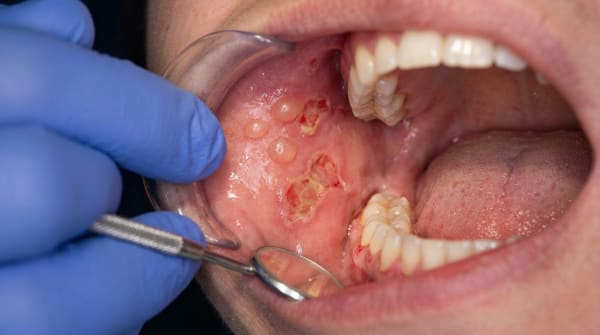
Deep linear ulcers in the labial or buccal vestibule, long furrows running along the gum sulcus, sometimes with hyperplastic folds of tissue alongside them.
Mucosal tags, small flaps of thickened mucosa hanging in the sulcus.
Swollen, red, irregular gums, a generalised gingival hyperplasia and erythema.
A glossy, sore tongue (glossitis), when iron, folate or vitamin B12 is poorly absorbed because of bowel disease.
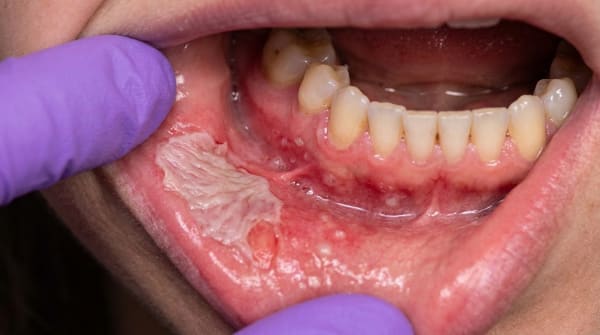
Aphthous-like (canker-sore) ulcers that recur in the mouth.
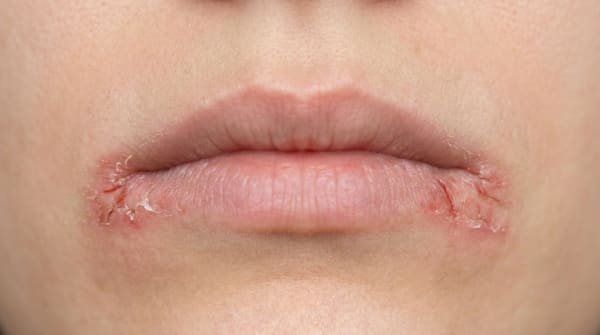
Angular cheilitis (cracking at the corners of the mouth) and lip fissuring.
A rarer finding is pyostomatitis vegetans, yellow-white pustules set on red mucosa that form snail-track patterns, mostly on the cheeks, soft palate and underside of the tongue. This is more often associated with ulcerative colitis but is described with Crohn's disease too.
What it feels like
The lip and cheek swelling itself is usually painless but feels tense and persistent. Mouth ulcers, particularly the deep linear ones in the sulcus, can be genuinely sore and may make eating, brushing and speaking uncomfortable. A sore, smooth tongue from anaemia can sting with hot or spicy foods. Some people notice altered taste or tingling. Importantly, the gut symptoms (abdominal pain, diarrhoea, weight loss, low-grade fever, sometimes rectal bleeding) may or may not be present at the time the mouth changes appear.
What an X-ray might show
Dental X-rays are not used to diagnose oral Crohn's, but they may pick up associated changes such as bone loss from periodontal disease or, occasionally, a buccal space infection complicating the condition. Imaging of the bowel, endoscopy, colonoscopy and small-bowel studies, is the responsibility of the gastroenterology team.
What happens at the dentist?
If your dentist at ArtSmiles sees a combination of cobblestone cheek mucosa, persistent lip swelling, deep linear ulcers, mucosal tags, or recurrent canker-like (aphthous)-like ulcers, they will take a careful medical history, including any tummy pain, change in bowel habit, weight loss, fatigue, or family history of inflammatory bowel disease.
Next steps may include:
A clinical examination of the lips, cheeks, gums, tongue and palate, and a check for angular cheilitis and lymph node enlargement.
An incisional biopsy (a small piece taken from the edge of the lesion) of an affected area, usually a lip or buccal lesion. Because the granulomas in oral Crohn's are often deep and patchy, the biopsy may need to be taken unusually deep, and a single negative biopsy does not rule the condition out.
Special stains on the biopsy to exclude tuberculosis, deep fungal infection and syphilis, which can mimic the picture.
Blood tests for evidence of malabsorption, low iron, folate, vitamin B12, calcium or albumin, and a raised inflammatory marker (ESR).
Referral to a gastroenterologist if there are gut symptoms, abnormal blood tests, or biopsy features consistent with Crohn's. They may organise endoscopy, ileocolonoscopy and small-bowel imaging.
Referral to an oral medicine specialist for ongoing management of resistant oral lesions.
The pathology textbooks specifically note that mucosal tags, cobblestone change and linear ulceration in the sulcus, especially when associated with abdominal symptoms, can lead to the diagnosis of Crohn's disease.
Is this serious?
🔴 Worth taking seriously. The mouth changes themselves are usually not dangerous, but they can be the visible tip of an underlying bowel disease that benefits from early diagnosis and treatment. Crohn's disease can cause complications such as bowel obstruction, fistulae (abnormal connecting tunnels between body cavities), abscesses, malnutrition and, over many years, an increased risk of bowel cancer. Mouth ulcers and lip swelling that persist for more than a couple of weeks, particularly in a teenager or young adult, should always prompt a thorough assessment.
If you've noticed any of these signs for more than two weeks, it's worth booking an assessment.
Could it be something else?
Several conditions can produce a similar clinical picture. Your dentist or specialist will work through these:
Orofacial granulomatosis, produces identical lip swelling, cobblestone mucosa and mucosal tags, and on biopsy shows the same non-caseating granulomas. It is distinguished by the absence of bowel involvement, although up to 60% of orofacial granulomatosis patients are eventually found to have subclinical Crohn's (present but not causing symptoms), so close follow-up is essential.
Melkersson-Rosenthal syndrome, a triad of recurring lip swelling, a fissured tongue and facial nerve palsy. Distinguished by the additional facial palsy and tongue fissuring, but biopsy looks similar.
Cheilitis granulomatosa (of Miescher), persistent painless lip swelling alone, considered by many to be a form of orofacial granulomatosis confined to the lip.
Sarcoidosis, another granulomatous disease that can cause lip swelling and nodular cheek lesions. Distinguished by raised serum angiotensin-converting enzyme, hilar lymphadenopathy (swollen lymph nodes at the centre of the lungs on chest imaging), and tighter, more discrete granulomas on biopsy.
Tuberculosis of the oral cavity, rare, but produces granulomas. Distinguished by caseating necrosis in the granulomas and positive acid-fast bacilli stains (bacteria identified by a special TB-type stain).
Deep fungal infection (such as histoplasmosis or blastomycosis), distinguished by special stains and culture identifying the organism.
Foreign-body gingivitis, granulomas confined to the gums caused by trapped foreign material; distinguished by polarisable foreign matter on biopsy and a localised distribution.
Ulcerative colitis, the other major form of inflammatory bowel disease. It does not usually cause cobblestone mucosa or deep granulomas, but it can produce pyostomatitis vegetans.
Recurrent aphthous stomatitis, common, recurrent canker sores. Distinguished by the absence of cobblestone cheek mucosa, lip swelling, mucosal tags and bowel symptoms, and by normal biopsy histology with no granulomas.
Behçet's disease, also causes recurrent oral ulcers, but typically with genital ulcers, eye inflammation and skin lesions, and without granulomatous biopsy findings.
Pyogenic granuloma or epulis fissuratum, both can mimic localised gum or sulcus swelling, but they are reactive single lesions without the diffuse cobblestone pattern of Crohn's.
Angioedema, produces lip swelling but tends to come and go rapidly rather than persist, and is not associated with cobblestone change or granulomas on biopsy.
How is it treated?
Management runs along two parallel tracks: control of the underlying bowel disease, and direct treatment of the oral lesions.
At home, helpful measures include:
Stopping smoking, cigarette smoking is known to worsen Crohn's disease.
Avoiding obvious dietary triggers if your team has identified them. Some patients respond to a cinnamon- and benzoate-free diet, particularly where orofacial granulomatosis overlaps.
Maintaining excellent oral hygiene to keep the gums settled, with a soft brush and a gentle non-flavoured toothpaste if cinnamon-flavoured products provoke symptoms.
Using a bland diet during flares to limit irritation of mouth ulcers.
Keeping iron, folate and vitamin B12 levels checked through your GP, as malabsorption is common.
Medical and dental treatment may include:
Treatment of the bowel disease, which usually settles the mouth lesions as a side effect. The textbooks describe a stepwise approach from mesalamine or sulfasalazine, through systemic prednisone with or without an immunomodulator (such as azathioprine, methotrexate or 6-mercaptopurine), to TNF-alpha inhibitor biologics, injectable medicines that block a key inflammation signal (infliximab, adalimumab, golimumab or certolizumab pegol), the IL-12/IL-23 inhibitor ustekinumab, or the anti-adhesion antibody vedolizumab for refractory disease.
Topical or intralesional corticosteroids (intralesional means injected directly into the lesion) for persistent oral ulcers and lip swelling, intralesional triamcinolone is widely used.
Systemic thalidomide or infliximab for refractory oral ulcers of Crohn's, in selected cases.
Vitamin and mineral supplementation, periodic vitamin B12 injections may be needed if a section of the terminal ileum (the last section of the small bowel) has been removed or is diseased, along with iron, folate, magnesium and fat-soluble vitamins.
Antibiotics such as metronidazole alongside other therapy.
Specialist dental input on biologic therapy, if you are on a TNF-alpha inhibitor or other biologic, your dentist will liaise with your gastroenterologist around the timing of any invasive dental treatment, infection control and monitoring for opportunistic oral infections such as candidiasis.
Treatment is always long-term and individualised. The aim is remission rather than cure.
What's the long-term outlook?
Crohn's disease is a chronic, relapsing condition rather than something that can be permanently cured, but most people are kept comfortable on modern medical therapy and can live full lives. Oral lesions tend to mirror the activity of the bowel disease, they often resolve when the gut inflammation is controlled, and may flare again when the bowel disease flares. The pathology references note that oral lesions have been reported to clear with treatment of the gastrointestinal process in many cases, although persistent oral ulcerations sometimes need their own course of topical or intralesional steroid therapy. Stopping smoking, attending regular dental check-ups, keeping nutritional levels topped up, and staying engaged with your gastroenterology team are the most important things you can do for the long-term outlook.
A note on this article
This article is for educational purposes only and does not constitute a clinical diagnosis. Please consult a registered dental practitioner or doctor for assessment and treatment advice.
The cover image above is an AI-generated illustration based on the most common visible features of this condition described in clinical pathology references. It is not a photograph of a real case and should not be used to diagnose or rule out the condition in your own situation. If you are concerned about something you have noticed, please book an assessment with a registered dental practitioner.
References
Regezi, J. A., Sciubba, J. J., & Jordan, R. C. K. (2017). Oral pathology: Clinical pathologic correlations (7th ed.). Elsevier. Chapter 2, Ulcerative Conditions, pp. 40 to 42; Chapter 8, Salivary Gland Diseases, pp. 192 to 194.
Neville, B. W., Damm, D. D., Allen, C. M., & Chi, A. C. (2023). Oral and maxillofacial pathology (5th ed.). Elsevier. Chapter 9, Allergies and Immunologic Diseases (Orofacial Granulomatosis), pp. 330 to 334; Chapter 17, Oral Manifestations of Systemic Diseases (Crohn Disease and Pyostomatitis Vegetans), pp. 850 to 852.
Cawson, R. A., & Odell, E. W. (2017). Cawson's essentials of oral pathology and oral medicine (8th ed.). Elsevier. Chapter 29, The Medically Compromised Patient (Crohn's Disease and Orofacial Granulomatosis), pp. 393 to 396.
Laskaris, G. (2003). Color atlas of oral diseases (3rd ed.). Thieme. Chapter 20, Diseases with Possible Immunopathogenesis (Crohn's Disease), pp. 186 to 187.
Frequently asked questions
How does Crohn's disease show up in the mouth?
Oral manifestations affect up to 20-50% of Crohn's patients. Common signs include diffuse swelling of the lips, deep linear ulcers in the buccal sulcus, cobblestoning of the cheek lining, mucosal tags, pyostomatitis vegetans (yellow snail-track ulcers on red gums), recurrent aphthous-like ulcers, angular cheilitis and granulomatous cheilitis (orofacial granulomatosis).
Can oral signs appear before bowel symptoms?
Yes. In a notable proportion of patients (especially children and young adults), oral findings precede gut symptoms by months or years. Persistent unexplained lip swelling, deep linear ulcers or cobblestoning of the cheek lining in a young person should prompt screening for inflammatory bowel disease.
How is oral Crohn's diagnosed?
Diagnosis is by recognising the typical oral pattern, gastroenterology workup including colonoscopy and biopsy, blood tests (FBC, CRP, faecal calprotectin) and sometimes biopsy of an oral lesion (showing non-caseating granulomas). MRI of the small bowel and capsule endoscopy refine the assessment.
How are the oral lesions treated?
Systemic treatment of Crohn's (mesalazine, corticosteroids, immunomodulators, biologics) usually improves the oral lesions. Topical corticosteroids (mouthrinses, paste, sprays), intralesional steroid injection for persistent swelling, dietary modification, and good oral hygiene help with symptom control. A multidisciplinary approach involving gastroenterology, dermatology and oral medicine is ideal.