Compiled from clinical guidelines and peer-reviewed evidence.
Medically reviewed by Dr Cristian Dunker.
This guide is for a conventional bridge anchored to your natural teeth. If your bridge is fixed onto dental implants, read how to clean an All-on-4 / All-on-X implant bridge instead.
What you're cleaning | A false tooth joined to crowns on your natural teeth either side. |
The daily must-do | Thread floss under the false tooth once a day, every day. |
The biggest risk | Decay forming on the natural teeth that anchor the bridge. |
Daily tools | Toothbrush, superfloss or a floss threader, interdental brushes. |
When to see a dentist | The bridge feels loose, food keeps trapping, or a gum bleeds. |
The 60-second answer
Here's how to clean a dental bridge in plain terms: brush twice a day, then once a day thread floss underneath the false tooth and wipe around the natural teeth that hold it. A water flosser is a useful extra, but it doesn't replace threading under the bridge. The thing to remember is that the false tooth itself can't decay. The real goal is protecting the natural teeth anchoring your bridge, because those teeth can still get cavities right where the crown meets them. Clean under and around the bridge daily, and you protect the foundation it sits on.
Why cleaning a dental bridge matters
A bridge fills a gap, but it also creates a few spots that a toothbrush alone can't reach. Knowing where those spots are makes the cleaning routine much easier to stick to.
Plaque collects under the false tooth
The pontic (the false tooth that bridges the gap) sits against your gum but isn't rooted in it. There's a small space underneath where plaque, the sticky layer of bacteria, gathers all day. A brush sweeps the top and sides, but it can't get into that underside. If plaque is left there, it irritates the gum and feeds the bacteria that cause problems on the teeth either side.
Protecting the natural teeth that anchor your bridge
This is the part that matters most. The abutment (the natural tooth, or its crown, that anchors the bridge) is still a living tooth under its cap. New decay can form at the crown margin (where the edge of the crown meets the natural tooth), and this is the most common biological reason tooth-supported bridges eventually fail. A large review found that caries and loss of the tooth's nerve were the most frequent biological complications for these bridges (Pjetursson et al., 2007). Hygiene makes a real difference: one long-term study reported recurrent or secondary caries (new decay forming at the edge of an existing crown or filling) in around 4% of cases with good hygiene, rising to 18.4% with poor hygiene (Alenezi et al., 2022). Keeping those margins clean is how you avoid recurrent decay sneaking in.
Keeping the gums around it healthy
The gum tissue around a bridge can become inflamed if plaque lingers along the edges. Cleaning between the teeth, on top of brushing, may reduce gingival (relating to the gums) inflammation more than brushing on its own (Worthington et al., 2019). Healthy gums help hold the bridge firmly and lower your risk of gum disease.
How to clean a dental bridge step by step
Once you have the routine down, it takes only a couple of minutes. Here's the order that works.
Step 1: Brush twice a day
Brush morning and night with a low-abrasive fluoride toothpaste. Angle the bristles towards the gumline and along each crown margin, where plaque likes to settle. Take your time on the teeth either side of the bridge. The Australian Dental Association recommends cleaning between your teeth daily alongside brushing (ADA, n.d.), so think of brushing as the first half of the job.
Step 2: Thread floss under the false tooth once a day
This is the key step, and the one most people skip. Take the stiff end of superfloss or a floss threader and pass it through the gap underneath the pontic. Draw the spongy or floss section along the underside of the false tooth, the part facing your gum, to clear the plaque sitting there. Then wrap the floss in a C-shape around each anchor tooth and gently wipe up and down to clean the crown margin. Doing this at night, after the day's food and drink, gives the best result.
Step 3: Use interdental brushes where they fit
A small interdental brush is great for the open spaces beside a bridge. Sizing matters here. Too big and it'll hurt the gum or won't slot in. Too small and it slides through without clearing the plaque. If you're unsure which size suits your gaps, ask at your next visit and we'll show you.
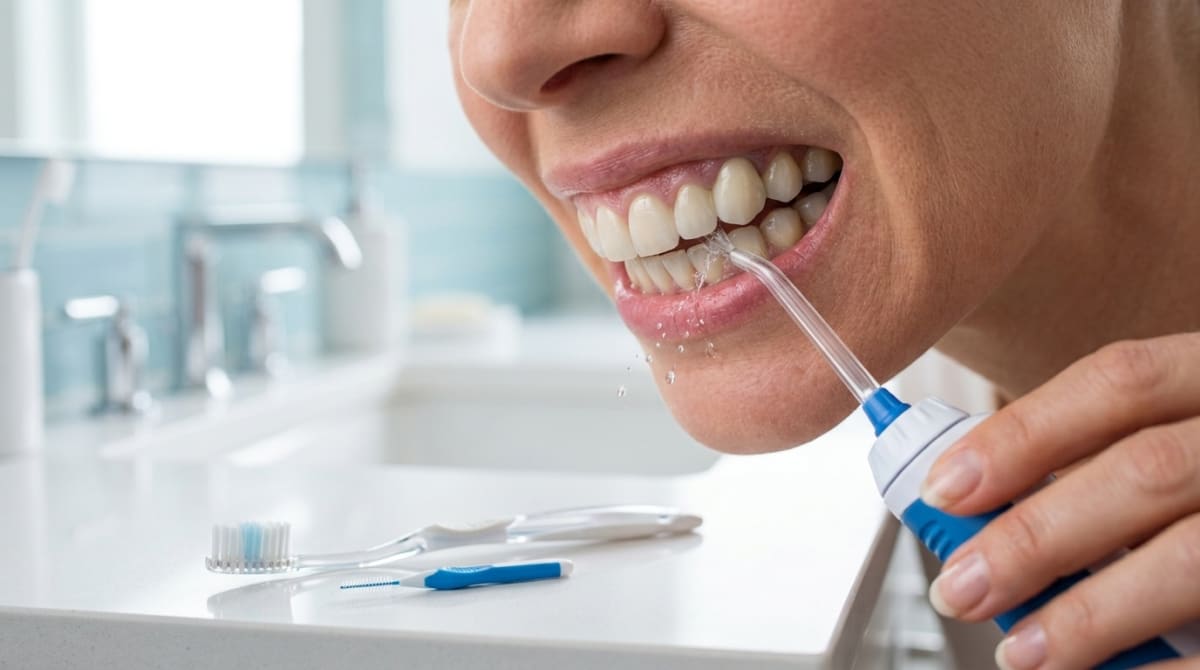
Step 4: Add a water flosser as an extra
A water flosser sends a stream of water under the bridge and flushes out loosened debris. It's a helpful extra, especially around a bridge. It is not a replacement for threading under the pontic, because the water doesn't scrub the underside the way floss does (Worthington et al., 2019). Use it after you've threaded, not instead.
Your daily routine
When | What to do |
Morning | Brush with low-abrasive fluoride toothpaste. |
During the day | Rinse with water, or use a water flosser if you have one (optional). |
Night | Brush, thread floss under the pontic, then interdental brushes. |
Your at-home kit
You can buy everything you need at an Australian pharmacy or supermarket: a soft toothbrush, low-abrasive fluoride toothpaste, superfloss or floss threaders, a pack of interdental brushes in a couple of sizes, and a water flosser if you'd like one. No particular brand is needed, just the right tool for the job.
Common mistakes and myths
A few beliefs trip people up, so it's worth clearing them up.
"A water flosser replaces flossing." It doesn't. It's an adjunct that flushes debris, but it won't scrub the underside of the false tooth the way threaded floss does.
"Brushing alone is enough." Brushing is half the routine. It misses the underside of the pontic and the spaces a brush can't reach, which is exactly where plaque builds up around a bridge.
"If it doesn't hurt, it's fine." Decay forming under a crown margin is usually silent until it's well advanced. By the time it aches, the problem is often bigger. Daily cleaning is your early defence.
"Any interdental brush size works." Sizing genuinely matters. A brush that's too big hurts the gum, and one that's too small misses the plaque it's meant to remove.
Who needs to clean differently
If you've just had it fitted, follow your dentist's advice first and read our just had it fitted guide while the area settles. If you have gum recession (gums pulling back) or larger gaps, slightly bigger interdental brushes may suit you better. If your hands are less steady, a water flosser and pre-loaded floss threaders make the daily routine far easier to manage. And if you have a longer multi-unit bridge spanning several teeth, allow a little extra time, since there are more margins and more underside to clean each night.
When to see a dentist
Book an appointment if you notice any of these:
The bridge feels loose or moves when you bite.
Food keeps trapping in the same spot.
A bad taste or smell coming from under it.
Bleeding or swollen gums around the bridge.
An ache or sensitivity at an anchor tooth, which can signal decay at the margin.
A piece chips or breaks off.
For sudden pain, swelling, or a bridge that comes loose, see our emergency dental care page. For anything else, an assessment at ArtSmiles will sort out what's going on, and you can read more on our crowns and bridges page. In some cases a bridge can be removed and recemented after a dentist checks it, so catching a problem early often saves the bridge.
References
Worthington, H. V., MacDonald, L., Poklepovic Pericic, T., Sambunjak, D., Johnson, T. M., Imai, P., & Clarkson, J. E. (2019). Home use of interdental cleaning devices, in addition to toothbrushing, for preventing and controlling periodontal diseases and dental caries. Cochrane Database of Systematic Reviews, (4), CD012018. https://www.cochrane.org/CD012018/
Pjetursson, B. E., Bragger, U., Lang, N. P., & Zwahlen, M. (2007). Comparison of survival and complication rates of tooth-supported fixed dental prostheses (FDPs) and implant-supported FDPs and single crowns (SCs). Clinical Oral Implants Research, 18(Suppl 3), 97-113. https://pubmed.ncbi.nlm.nih.gov/17594374/
Alenezi, A., Alkhudhayri, O., Altowaijri, F., et al. (2022). Secondary caries in fixed dental prostheses: Long-term clinical evaluation. Clinical and Experimental Dental Research, 9(1), 11-18. https://pmc.ncbi.nlm.nih.gov/articles/PMC9932257/
Australian Dental Association. (n.d.). Cleaning between the teeth. teeth.org.au. https://www.teeth.org.au/flossing
A note on this article
This article is for educational purposes only and does not constitute a clinical diagnosis. Please consult a registered dental practitioner for assessment and treatment advice.
The image accompanying this article is AI-generated and provided for illustration only. It is not a clinical photograph of a patient or of a specific dental result.
Frequently asked questions
How do you clean under a dental bridge?
Use superfloss or a floss threader once a day. Pass the stiff tip through the gap beneath the false tooth, then draw the spongy or floss section along the underside that faces your gum. Move it back and forth gently to lift the plaque sitting there. Finish by wrapping the floss around each anchor tooth in a C-shape to wipe the edge where the crown meets the tooth. A water flosser afterwards helps flush out what you've loosened, but the threading is what actually cleans the surface.
Can you floss a dental bridge?
Yes, and you should, just not with ordinary floss alone. A normal strand can't get under the false tooth because the bridge is one solid piece. You need superfloss, which has a stiff end and a spongy middle, or a floss threader that carries regular floss under the bridge for you. Once it's through, you clean the underside of the false tooth and the natural teeth either side. Cleaning between the teeth daily, alongside brushing, is recommended by the ADA.
What can I use to clean under a dental bridge?
A few simple tools cover it: superfloss, floss threaders, interdental brushes in the right size, and a water flosser as an extra. Superfloss or a threader does the main job of clearing the underside of the false tooth. Interdental brushes handle the open spaces beside the bridge. A water flosser flushes out loosened debris but doesn't replace the others. You'll find all of these at any Australian pharmacy or supermarket, and no particular brand is needed. If you're unsure about brush sizing, ask at your next check-up.
How do you remove plaque from a bridge?
Brush twice a day with a low-abrasive fluoride toothpaste, angling the bristles at the gumline and along each crown edge. Then thread floss under the false tooth once a day to scrub the underside, and use an interdental brush in the gaps either side. That combination physically wipes plaque off the surfaces a brush can't reach. A water flosser can follow as a rinse. Plaque rebuilds every day, so the key is doing this routine consistently rather than perfectly, especially the nightly thread under the bridge.
How long does a dental bridge last?
Lifespan varies with the bridge, the teeth supporting it, and how well it's cared for. Research following tooth-supported bridges found the most frequent biological complications were decay and loss of the tooth's nerve at the anchor teeth (Pjetursson et al., 2007), and that hygiene strongly affects new decay rates (Alenezi et al., 2022). In other words, daily cleaning under and around the bridge is one of the biggest things within your control. Regular dental check-ups catch small problems early, before they threaten the bridge.
Written by Dr. Cristian Dunker, BDSc, MBA.
Medically reviewed by Dr. Cristian Dunker.