A water flosser is a small countertop or handheld device that fires a pulsed stream of water along the gumline (the edge where your gums meet your teeth) and between the teeth. It is not a replacement for brushing. For most people the real question is whether their technique suits their mouth and their device. Used well, a water flosser can be very effective; used poorly, it leaves the gums sore and the bathroom soaked. This article covers what a water flosser is doing when you use it, who tends to get the most benefit from one, and the step-by-step technique that gets you clean teeth and calm gums.
What a water flosser actually does
A water flosser sends pulsed jets of water along the gumline and into the spaces between the teeth. The combination of pressure and pulsation flushes loose food, disrupts the soft, sticky film of bacteria (plaque) sitting at the gumline, and rinses the gum sulcus, the tiny groove where the gum tucks against the tooth. The important point for technique is that it is a flushing tool rather than a scrubbing tool. A toothbrush bristle physically scrapes plaque off the tooth surface. A length of floss does the same between teeth. A water flosser instead lifts and rinses, which is why it is so effective at the gumline (where bacteria sit loosely and inflammation builds up) and why brushing remains the foundation of any home routine.
Who tends to get the most out of a water flosser
A water flosser is not a one-size tool. The people who notice the clearest benefit are usually in one of these situations.
People with braces, retainers, or aligners with bonded attachments. Bonded attachments are small bumps glued to certain teeth that help clear aligners grip and move them properly. Wires, brackets (the small metal or ceramic squares glued to each tooth that the wire threads through), and bonded buttons make string floss slow and fiddly. The evidence for adding a water flosser to brushing is most consistent in patients having orthodontic treatment, with measurable improvements in gum health.
People with implants, bridges, or crowns. These are common dental restorations: an implant is a small titanium post placed in the jawbone to support a replacement tooth, a bridge fills a gap by anchoring to the teeth either side, and a crown is a tooth-shaped cap that covers a damaged tooth. The angles around them are often awkward, and a soft-rubber implant tip on a low pressure setting flushes the gum sulcus without disturbing the surrounding tissue.
People with periodontal pockets after gum disease treatment. Periodontal pockets are deeper-than-normal gaps where the gum has pulled away from the tooth root because of long-standing gum infection. Once a pocket has been professionally deep-cleaned (a thorough clean below the gumline that removes hardened plaque and bacteria), keeping plaque out of it is a daily home job. A water flosser at mid to intense pressure reaches further into the back-tooth pockets than string floss usually does.
People with arthritis, hand tremors, or limited grip. A water flosser is held like a thick toothbrush handle and does not need the two-handed coordination that conventional flossing does.
People with gum recession or wider spaces between teeth. Gum recession is when the gum has pulled back from the tooth, exposing more of the root. The larger gap between teeth (the interdental space) is then harder to clean with floss alone. A water flosser flushes more of the exposed surface. If your gums are healthy, your teeth sit closely together, and string floss is comfortable for you to do daily, a water flosser is a reasonable addition rather than a clear necessity. The Cochrane reviewers were honest about this in their 2019 review: where starting gum health is already good, the additional benefit is small and short-term.
How to use a water flosser correctly
Most people who tell us a water flosser "didn't work" or "made my gums sore" had it on maximum pressure with the tip pointing the wrong way. Used properly, it should feel firm but not painful, and your gums should not bleed unusually after a few sessions. Work through these steps in order.
Fill the reservoir with lukewarm water. Cold water is uncomfortable on sensitive teeth. Plain water is fine for daily use. Adding mouthwash is optional and is not required for the cleaning effect.
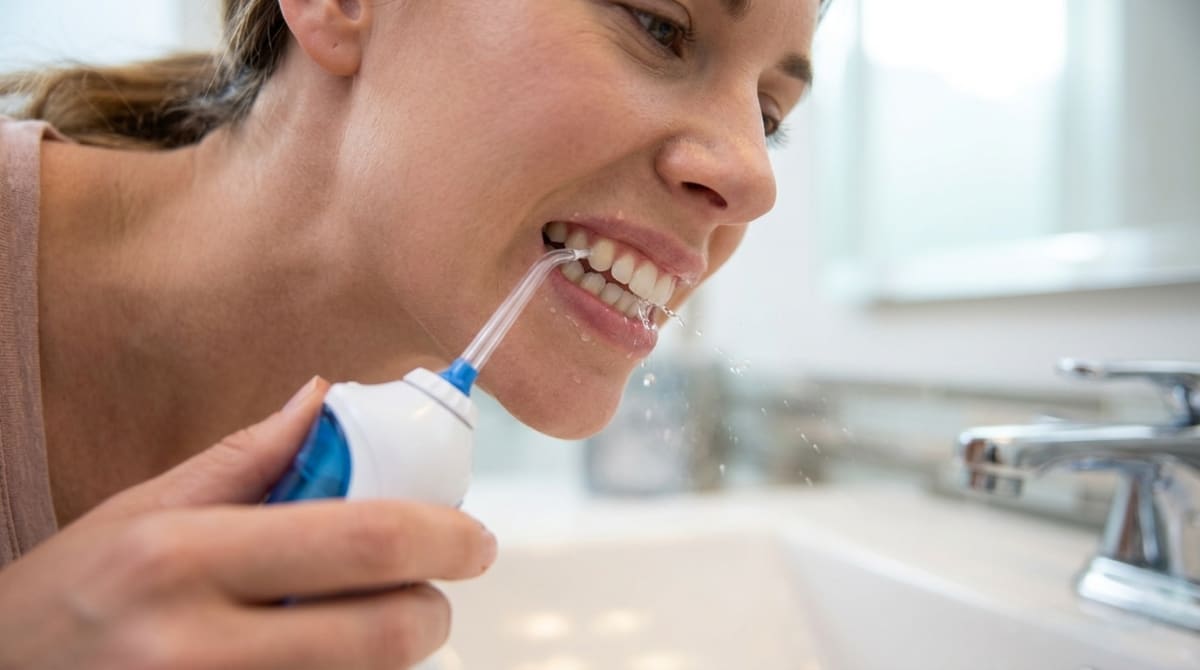
Lean over the sink and close your lips loosely around the tip. Lips slightly parted, not fully sealed. This stops splashes without trapping water and pressure inside the mouth.
Build the pressure up to a strong but comfortable level. Start slow, then increase the pressure one step at a time until it just begins to feel uncomfortable on the gum. Back off one notch from there. That setting is the sweet spot, strong enough to flush plaque properly, gentle enough that your gums aren’t sore afterwards. Very low pressure feels safe but does not shift plaque well, so most people end up in the medium to high range once they have worked out what their mouth tolerates. After a few weeks of daily use, your gums usually become less sensitive, and you can step the pressure up another notch or two without discomfort.
Aim the tip at a 90 degree angle to the gumline, not down the long axis of the tooth. The water should hit where the gum meets the tooth, not the chewing surface.
Pause briefly between each tooth. Spend about a second on each interdental space. Work systematically from the back of one side to the back of the other, on both the cheek-side and the tongue-side.
Let the water drain out as you go, rather than holding it in your mouth. The whole routine takes about a minute to ninety seconds for most people.
Empty and dry the reservoir between uses. Standing water in the tank and tubing can grow biofilm, a thin sticky layer of bacteria.
Disclaimer:
A note on the video above. ArtSmiles is not affiliated with Waterpik and is not endorsing the brand. We have included the clip because it clearly shows the technique we have just described. When you are choosing a water flosser, look for a model with an adjustable pressure dial so you can find the right setting for your mouth. Portable handheld models are convenient for travelling, but a countertop unit with a larger reservoir is usually the more practical choice for everyday home use.
Common mistakes to avoid
A few patterns turn up repeatedly when patients bring their water flossers in to ask why they are not happy with them.
Pressure too high. If the gums sting or bleed unusually, the pressure is too high or the angle is wrong. This happens most with handheld water flossers, which often have only three settings, one too strong and two too weak. A countertop unit with a continuous dial gives you finer control.
Pressure too low. A jet that feels gentle and barely splashes does not shift plaque. The lowest setting is fine for the first few sessions while your gums adjust, but it is not the long-term cleaning setting for most people.
Treating it as a replacement for brushing. It is not. The water flosser flushes the gumline; the toothbrush scrubs the tooth surface. Both jobs need doing.
Skipping the back teeth. As with flossing, the back of the mouth is where most people short-cut, and it is where decay and gum disease tend to start.
Closing the lips fully. This is the classic reason for soaked bathrooms and for people abandoning the device after the first week.
Using it weekly rather than daily. Every trial that has measured a gum-health benefit has measured daily use. If you only use it occasionally, your gums bleed each time you pick it up because they never get the chance to settle.
Pointing the jet straight at the gum tissue. The target is the gumline crease, not the gum itself.
If you have followed the steps and your gums still bleed after a couple of weeks of daily use, that is a signal to be looked at, not pushed through. Persistent bleeding often points to plaque sitting at or below the gumline that needs a professional clean before home tools can take over.
Choosing the right tip and pressure for your mouth
Most water flossers come with a standard tip and a few specialised tips for orthodontics, implants, or gum pockets. Our experience at ArtSmiles is that the standard tip handles every situation well, and we prefer it for most patients.
Specialised tips look tempting on the packaging, but each one has a trade-off. Tips with a larger end reduce the water pressure where it lands on the tooth, which is less effective at lifting plaque. Tips that are very thin concentrate the jet into a narrow stream that can damage the gum if you turn the pressure up.
The safer routine for almost everyone is simple: standard tip, the highest pressure you find comfortable, and run the tip around the gumline on both the outside and inside of the teeth. That covers daily cleaning, orthodontic appliances, implants, and recovering gum pockets without juggling tips.
Safety notes
Used correctly, a water flosser is safe on healthy gum tissue. A 2025 randomised trial measured gum abrasion (small scrape-like injuries to the gum surface) specifically and found no increase compared with an interdental brush (a small, bottlebrush-style cleaner that pushes between teeth) over four weeks of daily use. The published cases of tissue trauma almost always involve maximum pressure, the wrong tip, or the jet aimed directly at the gum tissue rather than along the gumline. Children old enough to brush thoroughly under supervision can usually use a water flosser with adult guidance on pressure and angle. For very young children, a toothbrush and supervised brushing is the priority. If you have had a recent extraction (tooth removal), recent oral surgery, or an active mouth ulcer, hold off using the water flosser in that area until the tissue has healed. Your dentist will tell you when it is safe to resume.
When to talk to your dentist about adding one
Bring it up at your next appointment if you are in any of these situations:
You have braces, aligners with bonded attachments, retainers, or implants.
Your gums bleed when you brush or clean between your teeth, and you would like to manage this at home alongside professional care.
You have been told you have gum pockets or have had deep cleaning in the past.
You find flossing painful or impractical because of arthritis, tremor, reduced grip, or limited mouth opening.
You have wide interdental spaces or gum recession that floss does not fully clean.
A short appointment lets the dentist or hygienist watch your technique and help you find the comfortable pressure that actually shifts plaque. For people in periodontal maintenance after gum disease treatment, that small piece of calibration is often what keeps the pockets stable between visits.
Bottom line
A water flosser is a useful daily tool for cleaning the gumline and the spaces between teeth. The strongest case for one is in patients with braces, implants, periodontal pockets, recession, or limited dexterity. Use it daily at low pressure, with the tip aimed at the gumline rather than the gum, the lips parted, and the head tilted over the sink. It complements brushing and works alongside the rest of your home routine rather than replacing it. If you would like a hands-on check of your technique, our team at ArtSmiles can review your gum health and walk you through the right method for your mouth. If you have ongoing bleeding, sore gums, or a history of gum disease, please book an assessment rather than self-managing.
What the science says about water flossers
Water flossers are among the more studied home cleaning tools, but the research is uneven. Some uses are well supported, others rest on small or industry-funded trials, and a couple are barely studied at all. Here is what the evidence actually shows, area by area, including where it is thin.
Gum bleeding and gingivitis: the strongest case
The clearest benefit is less gum bleeding. A 2025 systematic review and meta-analysis (a study that pools the results of many trials) found that adding a water flosser to brushing lowered bleeding and gum inflammation scores compared with brushing alone, with the bleeding result rated as moderate certainty (Badahdah et al., 2025). A separate 2025 randomised controlled trial (a study that randomly assigns people to compare two approaches) in people with moderate gingivitis (the early, reversible stage of gum disease) found a water flosser reduced bleeding at the gumline more than an interdental brush over four weeks (Mancinelli-Lyle et al., 2025). The independent Cochrane review is more cautious. It concluded that oral irrigators may reduce gingivitis at one month, but rated the certainty very low and did not find a clear benefit at three or six months (Worthington et al., 2019).
Plaque: the weaker side of the evidence
For removing plaque (the soft, sticky film of bacteria), the case is much weaker. The Cochrane review found no clear difference in plaque between adding an oral irrigator and brushing alone (Worthington et al., 2019). An earlier systematic review reached the same conclusion: as an add-on to brushing, the oral irrigator did not reduce visible plaque, although it did show a positive trend for gum health (Husseini et al., 2008). In short, a water flosser flushes and soothes the gumline better than it scrubs plaque off the tooth, which is why brushing stays the foundation.
Braces and orthodontic appliances: the most consistent benefit
The evidence is most favourable in people wearing fixed braces. A four-week trial in adolescents with braces found a water jet reduced whole-mouth bleeding more than brushing or flossing (Sharma et al., 2008). A 2024 systematic review of orthodontic patients found water flossing added to brushing reduced plaque and bleeding, though it did not significantly change the gingival index, and the authors called for higher-quality studies (AlMoharib et al., 2024). The 2025 meta-analysis singled out orthodontic patients as the group with the clearest bleeding benefit, at moderate certainty (Badahdah et al., 2025).
Dental implants
Around implants the evidence is promising but limited. A small randomised trial found an oral irrigator was as good as, or better than, an interdental brush for settling peri-implant mucositis (reversible gum inflammation around an implant) (Tütüncüoğlu et al., 2022). A 2025 systematic review agreed the signal looks positive but rated the overall quality of the implant evidence as low, with few studies to pool (Bishti et al., 2025).
Gum disease and periodontal pockets
For established gum disease, direct evidence is thin. Reviews favour oral irrigation for reducing gum inflammation rather than for changing pocket depth, and most trials were short and enrolled people with only mild inflammation to start (Worthington et al., 2019; Husseini et al., 2008). One small trial in people with both diabetes and gum disease found that adding daily irrigation alongside a professional clean improved gum measurements and lowered markers of inflammation over twelve weeks (Al-Mubarak et al., 2002). This fits the idea that a water flosser helps most as part of ongoing maintenance, not as a standalone treatment.
Water flosser versus string floss
Head-to-head against string floss, water flossers tend to win on bleeding but not clearly on plaque. Trials report larger reductions in bleeding for the water flosser (Sharma et al., 2008; Mancinelli-Lyle et al., 2023), while the 2025 meta-analysis found the plaque and gum-index differences versus flossing were not statistically significant, with only bleeding favouring the jet (Badahdah et al., 2025). Worth noting: several of the trials showing the largest wins for water flossers were funded by or authored by people connected to a water flosser manufacturer, which is a reason to read the biggest numbers with some caution.
Water flosser versus interdental brushes
The newest head-to-head found a water flosser was more effective than an interdental brush (a small bottlebrush-style cleaner) for marginal gum bleeding at four weeks, with no difference in gum abrasion (small scrape-like injuries) between the two (Mancinelli-Lyle et al., 2025). That said, the Cochrane review rated interdental brushes as the strongest interdental tool for plaque where the gaps are wide enough to fit one (Worthington et al., 2019). Many people end up using both.
Does it prevent cavities?
This is a genuine gap. The Cochrane review found no trials at all testing whether oral irrigators prevent decay between the teeth (Worthington et al., 2019). So while a water flosser can help keep gums healthier, there is no good evidence that it prevents cavities, and any claim that it does goes beyond what the science supports.
How strong is the evidence overall?
Honest summary: the best-supported benefit is less gum bleeding, which is modest and measured mostly over weeks rather than years. The case is reasonable for braces and around implants, weak for plaque removal, and absent for preventing cavities. Across the board the independent reviews rate the certainty as low to very low, follow-up is short, many participants started with healthy gums, and several of the most positive trials were industry funded (Worthington et al., 2019). None of that makes a water flosser a bad choice. It means a water flosser is a useful daily tool for the gumline, especially if string floss is hard for you, rather than a proven replacement for everything else.
Frequently asked questions
Can a water flosser damage my gums?
At appropriate pressure and angle, no. The 2025 Mancinelli-Lyle trial measured gum abrasion specifically and found no difference between a water flosser and an interdental brush over four weeks. Pressure that is too high, or aiming the jet directly at the gum tissue rather than along the gumline, can cause tenderness or minor bleeding, which is a signal to check the technique.
Will a water flosser fix bleeding gums?
Often it will reduce them, especially when bleeding is from gingivitis (the early, reversible stage of gum disease where the gums are inflamed but no permanent damage has happened yet). Persistent bleeding usually points to plaque or tartar (the hardened, calcified version of plaque) sitting at or below the gumline that needs a professional clean before home tools can fully take over. If your gums have been bleeding for more than two weeks, please book an assessment.
How long does a water flosser session take?
About a minute to ninety seconds once you are used to it. The whole routine, brushing plus water flossing, runs to roughly three to four minutes. A practical check we use at ArtSmiles: if you have a full set of teeth, the reservoir of a countertop water flosser should be empty by the time you finish. If it is still halfway full, you went too quickly and the cleaning probably wasn’t thorough enough.
Can children use water flossers?
Children old enough to brush thoroughly under supervision can usually use a water flosser, with adult guidance on pressure and angle. Specific paediatric tips and lower pressures help. For very young children, a toothbrush and supervised brushing is the priority.
Are water flossers good for braces?
Yes. The evidence in orthodontic patients is the most consistently positive, and water flossers are often easier than threading floss under wires. If you wear braces and your gums tend to puff up around the brackets, a water flosser is one of the clearer wins available.
Can I use mouthwash in the reservoir?
You can, but plain lukewarm water works for daily cleaning. If you do use a mouthwash, rinse the device with plain water afterwards to keep the tubing clear and the seals in good condition.
Written by Dr. Cristian Dunker, BDSc, MBA.
Medically reviewed by Dr. Cristian Dunker.
References
Badahdah, A., Hariri, M. A., Aljohani, M. S., Alshehri, L. S., & Natto, Z. S. (2025). Alleviation of plaque and gingivitis with dental water jet in regular and orthodontic patients: A systematic review and meta-analysis. Healthcare (Basel), 13(4), 396. https://pmc.ncbi.nlm.nih.gov/articles/PMC11855567/
Worthington, H. V., MacDonald, L., Poklepovic Pericic, T., Sambunjak, D., Johnson, T. M., Imai, P., & Clarkson, J. E. (2019). Home use of interdental cleaning devices, in addition to toothbrushing, for preventing and controlling periodontal diseases and dental caries. Cochrane Database of Systematic Reviews, 4, CD012018. https://www.cochrane.org/CD012018/
Mancinelli-Lyle, D., Van der Weijden, F. G. A., & Slot, D. E. (2025). Efficacy of a water flosser compared to an interdental brush on gingival bleeding and gingival abrasion: A 4 week randomized controlled trial. International Journal of Dental Hygiene, 23(1), 176-185. https://pmc.ncbi.nlm.nih.gov/articles/PMC11717974/
Husseini, A., Slot, D. E., & Van der Weijden, G. A. (2008). The efficacy of oral irrigation in addition to a toothbrush on plaque and the clinical parameters of periodontal inflammation: A systematic review. International Journal of Dental Hygiene, 6(4), 304-314. https://pubmed.ncbi.nlm.nih.gov/19138181/
Sharma, N. C., Lyle, D. M., Qaqish, J. G., Galustians, J., & Schuller, R. (2008). Effect of a dental water jet with orthodontic tip on plaque and bleeding in adolescent patients with fixed orthodontic appliances. American Journal of Orthodontics and Dentofacial Orthopedics, 133(4), 565-571. https://pubmed.ncbi.nlm.nih.gov/18405821/
AlMoharib, H. S., AlAskar, M. H., AlShabib, A. N., Almadhoon, H. W., & AlMohareb, T. S. (2024). The effectiveness of dental water jet in reducing dental plaque and gingival bleeding in orthodontic patients: A systematic review and meta-analysis of randomized clinical trials. International Journal of Dental Hygiene, 22(1), 56-64. https://pubmed.ncbi.nlm.nih.gov/37694518/
Mancinelli-Lyle, D., Qaqish, J. G., Goyal, C. R., & Schuller, R. (2023). Efficacy of water flossing on clinical parameters of inflammation and plaque: A 4-week randomized controlled trial. International Journal of Dental Hygiene, 21(4), 659-668. https://pubmed.ncbi.nlm.nih.gov/37753575/
Bishti, S., Wolfart, S., & Tuna, T. (2025). Optimizing implant hygiene: The added value of interproximal cleaning devices around implant-supported restorations: A systematic review and meta-analysis. International Journal of Implant Dentistry, 11, 64. https://pmc.ncbi.nlm.nih.gov/articles/PMC12537638/
Tütüncüoğlu, S., Cetinkaya, B. O., Pamuk, F., Avci, B., Keles, G. C., Kurt-Bayrakdar, S., & Lütfioğlu, M. (2022). Clinical and biochemical evaluation of oral irrigation in patients with peri-implant mucositis: A randomized clinical trial. Clinical Oral Investigations, 26(1), 659-671. https://pubmed.ncbi.nlm.nih.gov/34251534/
Al-Mubarak, S., Ciancio, S., Aljada, A., Mohanty, P., Ross, C., & Dandona, P. (2002). Comparative evaluation of adjunctive oral irrigation in diabetics. Journal of Clinical Periodontology, 29(4), 295-300. https://pubmed.ncbi.nlm.nih.gov/11966926/