This article is general educational information from the ArtSmiles Dental Library. It is not individual clinical advice and isn't a substitute for an in-person assessment.
The toothbrush cleans the smooth front, back, and chewing surfaces of every tooth, but the spaces between the teeth (the interdental spaces) are too narrow for the bristles to reach. That is where dental floss and interdental brushes do the work. The choice between them is not really a competition. It is a question of which tool fits the gaps in your mouth and the way you actually clean. This article walks through what each tool does, what the evidence says about effectiveness, how to decide which fits your mouth, and when adding a second tool genuinely helps. It also covers where a water flosser fits alongside the two.
The basics of each tool
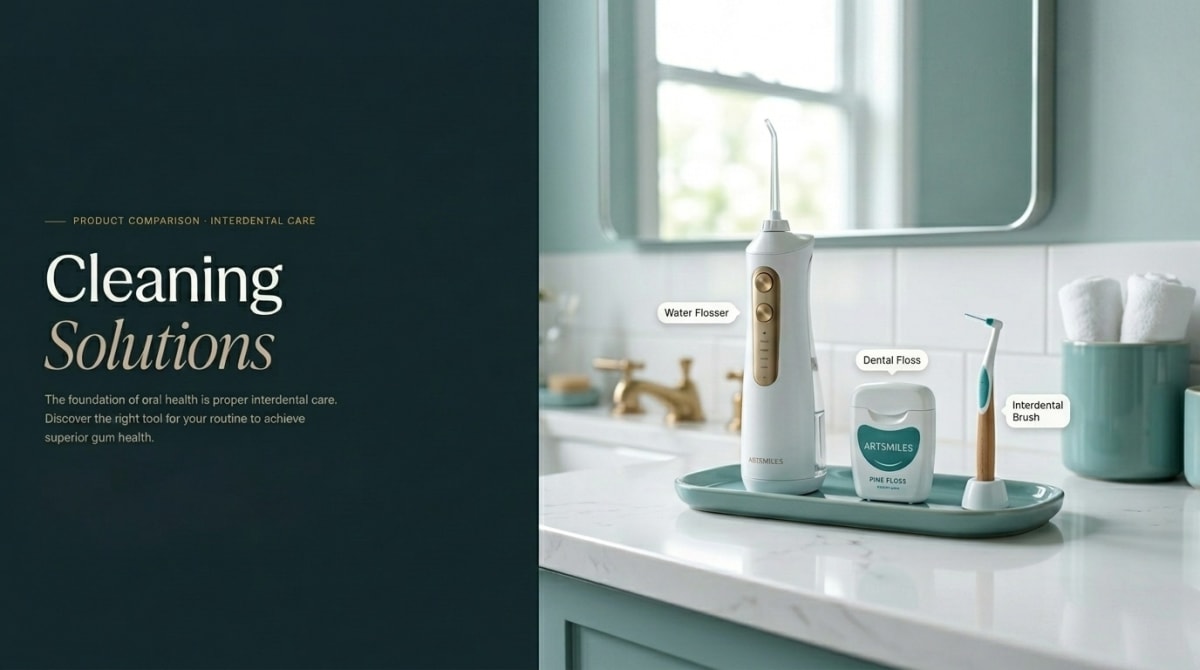
Dental floss is a thin nylon or PTFE strand, sometimes coated with wax or a flavour, that slides between two adjacent teeth and curves around each one to scrape the side surface. It works in spaces where the teeth touch closely, and it remains the most familiar interdental cleaning tool. Variants include flossettes (a short piece of floss held in a plastic Y or F frame), floss tape (wider and softer), and unflavoured PTFE floss for tight contacts.
Interdental brushes are small, cone- or cylinder-shaped brushes on a fine wire, designed to push between two teeth and rotate or slide back and forth. They come in graded sizes from very fine (around 0.4 mm) up to coarse (around 1.5 mm or more). The size needs to match the size of the gap. Used in the right size, they cover much more of the side surface of the tooth in a single pass than floss does. Both are added to brushing, not used instead of brushing. The toothbrush still does most of the work; floss and interdental brushes finish the spaces the brush misses.
Water flossers (a device that cleans between the teeth with a pulsed jet of water), also called oral irrigators, are a third option. Instead of a physical strand or brush, a water flosser sends a stream of water between the teeth and along the gumline to flush out food and loosen plaque. It does not scrub the tooth surface the way floss or an interdental brush does, so it works best as a flushing tool rather than a like-for-like swap. It suits some mouths much better than others, which the sections below explain. Our dedicated guide to water flossers walks through technique and pressure settings in detail.
What the evidence shows
The most authoritative summary is the 2019 Cochrane review on home-use interdental cleaning devices, which pooled 35 trials covering nearly 4,000 adults. The headline findings are quite specific.
Adding either floss or interdental brushes to brushing reduces gingivitis (the early, reversible inflammation of the gums) more than brushing alone, in the short and medium term.
For people whose interdental gaps are wide enough to accommodate them, interdental brushes appear to be more effective than floss for reducing gingivitis at one and three months.
The evidence on plaque (the soft, sticky film of bacteria on the tooth surface) is more mixed, with both methods showing inconsistent results.
Water flossers reduce gum bleeding, particularly for people with braces or implants, but are less effective than floss or interdental brushes at physically removing plaque, and the certainty of this evidence is low.
Overall certainty of evidence is rated low to very low, mostly because trials are short and outcome measures vary.
A 2018 network meta-analysis comparing several interdental methods reached a similar conclusion: interdental brushing tends to come out narrowly ahead on inflammation indices, with floss, water flossing, and toothpicks all clinically useful where interdental brushes do not fit. The practical reading of all this evidence is: where an interdental brush physically fits, it is usually the better choice. Where teeth touch tightly enough that no interdental brush size will fit without forcing, floss is the right tool. For many adults, the answer is "both" because different gaps in the same mouth have different widths.
How to choose for your mouth
A short decision aid covers most situations.
Use floss if:
The teeth are crowded or touch tightly along their full contact area.
There is no visible gap between the two teeth at the gumline (the edge where your gums meet your teeth).
An interdental brush will not fit without forcing, even in the smallest size.
You are comfortable with the technique and your gums are healthy.
Use interdental brushes if:
There is a visible gap or "black triangle" at the gumline between two teeth.
You have orthodontic appliances, implants, bridges, or wider-than-average spaces.
Your dexterity (the fine hand control needed for cleaning) makes flossing difficult, since interdental brushes are easier to hold and manoeuvre.
Your gums bleed when you brush despite a good technique, particularly between teeth.
Consider a water flosser if:
You wear braces, or have implants, bridges, or crowns where floss and brushes are awkward to manoeuvre.
You have deeper gum pockets that have been professionally cleaned and need daily flushing.
Arthritis, tremor, or limited grip make floss and interdental brushes hard to manage.
You want to add a flushing step on top of brushing rather than replace floss or a brush.
Use both, or all three, if your mouth has tight contacts in some places and visible gaps in others. This is common in adults over forty as the gum tissue thins and the contact points wear.
How to use floss correctly
A useful flossing session looks like this.
Take about 45 cm (18 inches) of floss and wrap most of it around your middle fingers, leaving a short working length between the index fingers and thumbs.
Slide the floss gently between two teeth. Do not snap it in. Snapping floss into the gum is the most common cause of bleeding.
Curve the floss into a C-shape against one tooth, then slide it up and down the side of that tooth, gently slipping under the gum margin a millimetre or two.
Repeat against the neighbouring tooth. Each gap takes two motions, one for each tooth touching it.
Move to a fresh section of floss for each new gap.
Cover every gap, including behind the back teeth. Floss the inside of the very last molar by wrapping the floss around the back of the tooth and sliding up and down.
A flossette or floss pick is a reasonable alternative if you find string floss awkward, although flossettes can be slightly less efficient at the C-shape against each tooth.
How to use interdental brushes correctly
The technique is short and forgiving, which is part of why they work for so many people.
Pick the right size. Your dentist or hygienist can recommend the size for each gap. Several gap widths in the same mouth often need two sizes. Cone-shaped brushes adapt to a small range of sizes; cylindrical brushes are more specific.
Insert the brush horizontally between two teeth, just above the gumline. It should slide in with mild resistance. If it forces or bleeds heavily, the size is too big for that gap.
Push and pull two or three times, then move to the next gap.
Use a fresh brush every five to seven days, or sooner if it visibly splays.
Most adults find interdental brushes faster than flossing once they are used to the right size. The first week sometimes brings a little bleeding from previously inflamed tissue, which usually settles within a week or two.
When neither is enough
Some situations call for a water flosser instead of, or alongside, floss and interdental brushes. As covered above, a water flosser is particularly useful for braces, implants with awkward angles, deep periodontal pockets (deeper-than-normal gaps where the gum has pulled away from the tooth root), and reduced dexterity from arthritis or tremor. For most adults, brushing twice daily plus one consistent interdental method, used every day rather than occasionally, will keep the gums healthy. Inconsistent flossing once or twice a week is far less effective than daily interdental brushing or daily flossing.
Common mistakes
Snapping floss into the gum rather than sliding it gently. Causes bleeding and discourages people from continuing.
Using too small an interdental brush. A brush that does not contact the side surfaces of both teeth is not cleaning. Sizing up usually solves this.
Forcing too large an interdental brush. Pushing a brush that does not fit causes recession (where the gum has pulled back from the tooth, exposing more of the root) over time. Size down or switch to floss for that gap.
Cleaning only the front teeth. The molars at the back are where most decay and gum disease starts.
Skipping the inside surfaces. Cleaning only the cheek-side leaves the tongue-side untouched.
Using the same length of floss for the whole mouth. Plaque collected on the floss is then redistributed back to other teeth. Move along to a fresh section every gap or two.
When to talk to your dentist
A short conversation is worth booking if:
Your gums bleed every time you floss or use a brush, despite gentle technique, for more than two weeks.
You are unsure which interdental brush size matches each of your gaps.
You have braces, aligners with bonded attachments (small bumps glued to certain teeth that aligners grip), implants, bridges, or crowns and want a routine that fits the new mouth.
You have been told you have early gum disease and want a clearer home plan.
The dentist or hygienist can match brush sizes to your specific gaps and walk through technique on the spot.
Bottom line
Interdental brushes tend to outperform floss where the gap is wide enough for them to fit, and floss is the right tool where teeth touch tightly. A water flosser is a useful third option that flushes rather than scrubs, and it earns its place for braces, implants, deeper pockets, and limited dexterity. Use a combination in mouths that have a mix. The biggest single predictor of whether your gums stay healthy is daily, consistent use of one of these tools rather than the choice between them. If you would like a hands-on size match for interdental brushes, or a technique check, our team at ArtSmiles can help. If your gums bleed regularly despite cleaning carefully, please book an assessment, since persistent bleeding usually points to early gum disease that benefits from a professional clean.
Written by Dr. Cristian Dunker, BDSc, MBA.
Medically reviewed by Dr. Cristian Dunker.
Frequently asked questions
Are interdental brushes really better than floss?
For gingivitis, the 2019 Cochrane review found a modest advantage to interdental brushes where they fit. For plaque, the evidence is more mixed. Where the gap is too tight for any interdental brush, floss is the right tool.
Where does a water flosser fit in?
A water flosser is best thought of as an addition rather than a straight replacement. It flushes between the teeth and along the gumline with a jet of water, which suits braces, implants, and people who find floss or interdental brushes hard to manage. It is good at reducing gum bleeding but less effective than floss or a brush at scraping plaque off the tooth, so most people use it alongside one of the other two. Our water flossers guide covers technique and pressure settings.
How often do I need to floss or use an interdental brush?
Once a day, every day. Inconsistent use a few times a week is much less effective than daily use.
Will my gums bleed when I start?
Possibly, for the first week or two if the gums are already inflamed. Persistent bleeding beyond two weeks is a signal to be assessed rather than pushed through.
Should I floss before or after brushing?
Either is fine. The Australian Dental Association suggests flossing or interdental cleaning before brushing, so the toothbrush can sweep loosened debris away. The order matters less than the consistency.
Are floss picks as good as string floss?
Reasonably good for most adults, particularly if string floss feels awkward. They are slightly less efficient at the C-shape against each tooth and may not reach the very back teeth as easily.
How do I know which size interdental brush I need?
A dentist or hygienist can recommend a size for each gap. Some kits include a sample pack of sizes; the right brush feels firm but not forced when it slides in.
References
Worthington, H. V., MacDonald, L., Poklepovic Pericic, T., Sambunjak, D., Johnson, T. M., Imai, P., & Clarkson, J. E. (2019). Home use of interdental cleaning devices, in addition to toothbrushing, for preventing and controlling periodontal diseases and dental caries. Cochrane Database of Systematic Reviews, 4, CD012018.
Kotsakis, G. A., Lian, Q., Ioannou, A. L., Michalowicz, B. S., John, M. T., & Chu, H. (2018). A network meta-analysis of interproximal oral hygiene methods in the reduction of clinical indices of inflammation. Journal of Periodontology, 89(5), 558-570.