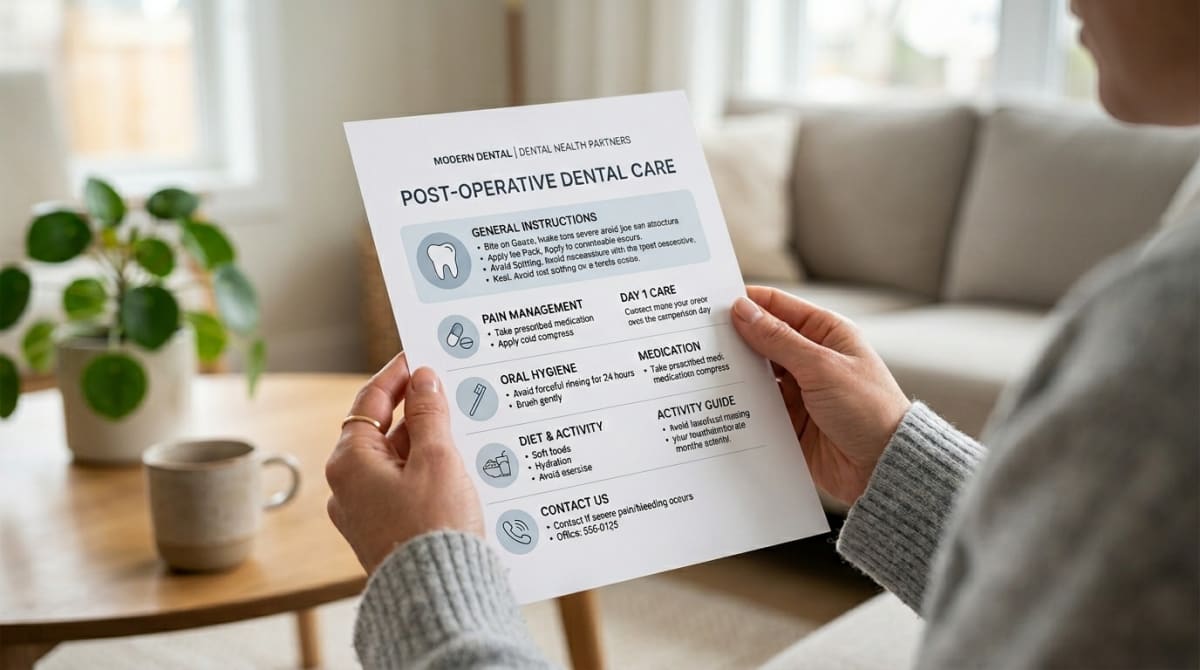
What to Expect Immediately After Placement
Your implant crown or bridge has been fitted and secured. Proper aftercare protects the implant, surrounding bone, and soft tissue during the initial healing phase.
If local anaesthesia was used, avoid eating until numbness has completely worn off to prevent accidental biting.
Mild tenderness or pressure around the gum is normal and usually resolves within a few days.
Your bite may feel slightly different, especially if adjustments were made during fitting.
Minor speech changes may occur with multi-unit bridges. These typically resolve within a week as your tongue adapts.
Eating and Function After Implant Crown Placement
Your new restoration needs a short adjustment period before handling full chewing forces.
Avoid chewing directly on the implant restoration for the first 24 hours.
Start with softer foods while your bite adapts over the first few days.
Distribute chewing evenly across both sides of your mouth.
To protect the restoration long term, avoid:
Ice, bones, and hard lollies
Unpopped popcorn kernels
Biting into very hard foods with excessive force
Using teeth to open packaging or bottles
Excessive force can fracture the ceramic material or overload the implant connection.
Oral Hygiene Around Implant Restorations
Consistent daily cleaning is critical to prevent peri-implant mucositis and peri-implantitis, the implant equivalent of gum disease (Berglundh et al., 2018).
Brush twice daily with a soft-bristled toothbrush and non-abrasive toothpaste.
Floss carefully around the implant crown using implant-specific floss where possible.
For bridges, use superfloss, interdental brushes, or a water flosser to clean underneath the pontic area.
A water flosser is strongly recommended for implant maintenance as it effectively removes biofilm below the gumline.
If gums are tender in the first few days, rinse gently with warm salt water (half a teaspoon of salt in a glass of warm water).
Important Notes About Your Restoration
Your implant crown may be screw-retained or cemented depending on clinical requirements. It should feel stable and secure once placed.
Do not ignore any movement, clicking, or shifting of the crown or bridge.
Multi-unit bridges require careful cleaning underneath to prevent bacterial accumulation and infection.
Night Protection for Implant Crowns
If you grind or clench your teeth (bruxism), wearing your prescribed night guard is essential. Bruxism increases the risk of ceramic fracture and mechanical overload on the implant fixture. Studies show that parafunctional habits are a leading cause of implant prosthetic complications (Chrcanovic et al., 2017).
Ongoing Maintenance and Review
Attend professional hygiene and review appointments every six months, or as recommended by your dentist.
Periodic X-rays may be required to monitor bone levels around the implant.
Early detection of inflammation significantly improves long-term implant outcomes.
When to Contact Your Dentist
Reach out to our team if you notice any of the following:
Pain, swelling, or redness around the implant site
Persistent bleeding when cleaning around the restoration
Clicking or movement of the crown or bridge
A visible gap forming between the gum and restoration
Difficulty cleaning underneath a bridge
Signs of infection such as pus, a bad taste, or fever
If you have any concerns about your implant crown or bridge, contact ArtSmiles on the Gold Coast. Early assessment helps prevent complications and protects your investment in long-term oral health.