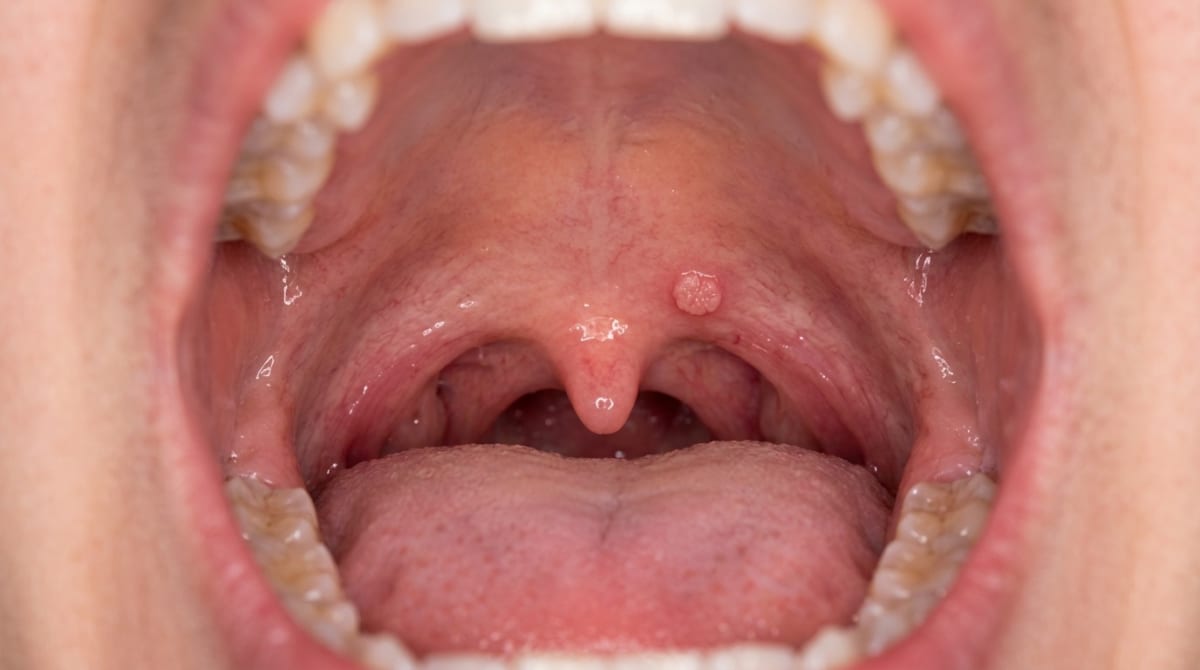
Compiled from clinical pathology references. Medically reviewed by Dr Cristian Dunker , Principal Dentist, ArtSmiles Cosmetic Dentistry.
Quick summary
Also called | Oral squamous papilloma, oral verruca vulgaris, oral condyloma (genital wart) acuminatum, multifocal (focal) epithelial hyperplasia (Heck disease) |
How urgent? | 🟡 Worth checking, most are benign, but should be examined to rule out other conditions and to discuss any links to genital HPV or HPV-related cancer prevention |
Common or rare? | Squamous papillomas are common (about 3% of all biopsied oral lesions); other HPV oral lesions are less common |
Who it affects | People of any age, with squamous papillomas peaking in the 30s-50s, condyloma acuminatum in teenagers and young adults, and multifocal epithelial hyperplasia in some indigenous populations |
Who treats it | General dentist for examination and excision; referral to a sexual health clinic, GP or specialist may be appropriate for condylomas |
Based on | Neville, Cawson, with cross-references in Regezi |
What is it?
Human papillomavirus (HPV) is a family of viruses that can cause a range of growths on skin and mucous membranes, including the mouth. The textbooks describe four main types of HPV oral lesion:
Squamous papilloma, a small cauliflower-like growth, the most common HPV-related oral lesion. Usually associated with low-risk HPV types 6 and 11.
Verruca vulgaris (common wart), typically a skin wart, but occasionally appears on the lips or mouth, usually associated with HPV type 2.
Condyloma acuminatum (oral genital wart), a sexually transmitted lesion that can appear in the mouth, usually associated with HPV types 6 and 11.
Multifocal (focal) epithelial hyperplasia (Heck disease), multiple flat or slightly raised pale lesions, associated with HPV types 13 and 32 and seen particularly in some Indigenous populations.
A few HPV types (especially 16 and 18) are linked to oropharyngeal squamous cell carcinoma, a different and more serious condition that is now an important focus of HPV vaccination programmes worldwide.
Who tends to get it?
Each type has its own typical population:
Squamous papillomas are most often diagnosed in people aged 30-50, with no strong sex predilection. They make up around 3% of all oral lesions submitted for biopsy (a small tissue sample taken for laboratory examination) and an even higher proportion of lesions in children.
Verruca vulgaris mainly affects children, who often have warts on the hands; the mouth is involved when a wart is autoinoculated by a finger or thumb.
Condyloma acuminatum is most often diagnosed in teenagers and young adults and is sexually transmitted, although it can also be passed from mother to child during birth or, rarely, by other routes.
Multifocal epithelial hyperplasia (Heck disease) is seen particularly in Indigenous communities and in some isolated populations, with rates varying widely between regions.
What causes it?
The textbooks describe HPV oral lesions as the result of HPV infection of the oral mucosa (the soft tissue lining of the mouth), with the specific lesion type depending largely on the HPV strain and the route of infection:
Squamous papillomas, HPV 6 and 11. The virus is acquired through contact with infected skin or mucosa, often years before the lesion develops. Incubation may range from weeks to years.
Verruca vulgaris, HPV 2. Spread is by direct contact, often by autoinoculation (spreading the virus from one part of the body to another by touch) when a child with a finger or thumb wart sucks the digit.
Condyloma acuminatum, HPV 6 and 11 most often, sometimes with co-infection by high-risk types such as 16 and 18. Spread is most commonly sexual but can also occur perinatally or through environmental contact.
Multifocal epithelial hyperplasia, HPV 13 and 32, with a probable genetic predisposition in affected populations.
A small proportion of oral and (more importantly) oropharyngeal HPV infections involve high-risk types (16, 18, 31, 33, 45, 52, 58). Persistent infection with these types is a major cause of oropharyngeal cancer, the prevention of which is now a key reason for the HPV vaccination programmes recommended for adolescents in Australia and many other countries.
How does it develop?
HPV enters the surface cells of the mucosa and inserts its DNA into them. The infected cells then multiply at an increased rate, producing the characteristic papillary or warty growth. Microscopically, the textbooks describe koilocytes (HPV-altered surface cells with a characteristic halo around the nucleus), cells that have been altered by the virus, with shrunken dark nuclei surrounded by a clear halo of cytoplasm. Different HPV types produce slightly different appearances, but all share the underlying mechanism of viral takeover of the epithelium (the surface layer of the lining)'s growth control. In benign oral HPV lesions the growth is local and self-limited; in high-risk infections of the oropharynx (the area of the throat behind the mouth, including the tonsils and base of the tongue), the same machinery can drive cancer development over years.
What might you notice?
What it looks like
The four main HPV oral lesions look slightly different:
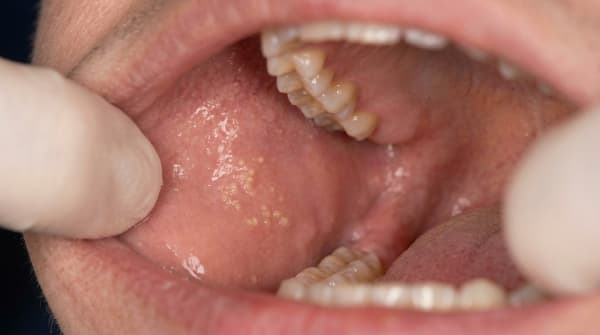
Squamous papilloma: a soft, painless, often pedunculated (attached by a narrow stalk) bump with multiple fingerlike or "cauliflower" projections. Usually solitary, white or pink, less than 1 cm. Common on the soft palate, tongue and lips.
Verruca vulgaris: a small, rough, white, papular growth on the lip or mouth, often with cuticle-like surface ridges. May be associated with similar lesions on the fingers.
Condyloma acuminatum: a pink, sessile (sitting on a broad base, without a stalk), "blunt-fingered" lesion, often clustered with other condylomas. Most common on the labial mucosa, lingual frenum and soft palate. Larger than papillomas, typically 1-1.5 cm.
Multifocal epithelial hyperplasia (Heck disease): numerous small, flat or slightly raised, pale or pink papules or plaques, often clustered, on the lower lip, upper lip and inside of the cheeks.
What it feels like
Most HPV oral lesions cause no symptoms. When they do, symptoms include:
A small, painless lump noticed by the patient with the tongue.
Mild discomfort if the lesion is repeatedly bitten.
A rough, scratchy sensation with verrucous lesions.
No bleeding in most cases, bleeding suggests the lesion is being traumatised or is something else.
Multiple lesions in condyloma and Heck disease.
What an X-ray might show
HPV oral lesions are confined to the surface mucosa, so X-rays are not useful for diagnosis.
What happens at the dentist?
HPV oral lesions are usually picked up at a routine dental check-up and clean at ArtSmiles or when the patient mentions a lump they have noticed. The dentist will typically:
Examine the lesion carefully, noting its location, surface texture, colour and number of lesions.
Take a careful history, when the lesion was first noticed, whether it has grown, whether there are similar lesions elsewhere on the body or in close contacts, and any sexual history when condyloma is suspected.
Distinguish among the HPV lesion types based on appearance.
Recommend excision and biopsy in most cases, since the diagnosis is best confirmed on histopathology (microscopic examination of a tissue sample) and other lookalike conditions can be ruled out.
Discuss HPV vaccination when relevant, particularly for younger patients or family members who have not yet been vaccinated.
Refer to a sexual health clinic, GP or specialist when condyloma acuminatum is suspected, since concurrent anogenital lesions and partner notification matter.
Reassure when the lesion is benign.
Is this serious?
🟡 The four common benign HPV oral lesions described above are not cancerous and do not progress to cancer. The bigger picture, however, is that persistent infection with high-risk HPV types in the oropharynx is a recognised cause of oropharyngeal squamous cell carcinoma. The textbooks specifically note that HPV vaccination, introduced in many countries in the mid-2000s, prevents not only genital warts and cervical cancer but also a significant proportion of oropharyngeal cancers. So while the immediate lump is harmless, finding an HPV lesion is a good prompt to discuss vaccination and overall oral health.
If you have noticed a warty or cauliflower-like lump in your mouth that has been there for more than a couple of weeks, or several small pale lumps clustered in one area, it is worth booking an assessment so the appearance can be confirmed and removal can be planned if needed.
Could it be something else?
Several conditions can produce a similar bump in the mouth. The textbooks list these as the main differentials:
Traumatic fibroma, a smooth, dome-shaped fibrous nodule from chronic biting, more common along the bite line.
Oral lichen planus, usually has lacy white lines or red atrophic areas, symmetrical and bilateral.
Mucocele, a soft, fluctuant, often bluish cyst from a damaged minor salivary gland, particularly common on the lower lip.
Salivary gland tumour, a slowly growing, persistent mass that does not have the cauliflower or warty surface of papilloma; particularly important to rule out on the palate.
Oral squamous cell carcinoma, must be considered in any persistent lump that ulcerates, bleeds, has irregular edges, or grows rapidly, particularly in older smokers or alcohol users.
Verruciform xanthoma, a rare benign yellowish papillary lesion that resembles a papilloma, typically on the gum.
Giant cell fibroma, a rare fibrous lump with similar surface to a small papilloma.
How is it treated?
Treatment depends on the type of lesion, the size, the location and any associated infection.
At-home measures and habits:
Maintain excellent oral hygiene to keep the surrounding tissue healthy.
Avoid biting or rubbing the lesion while you wait for an appointment.
Don't pick at the lesion, this can spread HPV to other parts of the mouth or fingers.
Discuss HPV vaccination with your GP, Australia includes HPV vaccination in the National Immunisation Programme for adolescents, and catch-up vaccination is available for people up to about age 26 (with consideration up to 45 in selected cases).
Professional steps your dentist may consider:
Conservative surgical excision, the standard treatment for benign HPV oral lesions, with the entire base of the lesion removed under local anaesthetic. Recurrence is uncommon for solitary papillomas.
Laser ablation, cryotherapy (freezing treatment) or electrosurgery (removal using a fine heated tip) as alternative treatments, particularly for multiple lesions. Some authorities raise concern about laser plumes potentially exposing staff to airborne HPV, so safety precautions are important.
Histopathological examination of the removed tissue to confirm the diagnosis.
Referral for sexual health assessment when condyloma acuminatum is identified, including discussion of testing, partner notification and management of any anogenital lesions.
Long-term review for multifocal epithelial hyperplasia, since lesions can recur and new ones develop over months and years.
HPV vaccination discussion for the patient and any unvaccinated family members.
A patient-centred approach matters here, particularly for patients who are surprised or distressed by a diagnosis of "warts in the mouth" or who associate HPV only with cervical cancer. Calm, factual explanation of what HPV is, how it spreads, what it does and does not cause, and how vaccination helps is itself part of effective care, values that sit at the heart of our clinical philosophy.
What's the long-term outlook?
The outlook for benign HPV oral lesions is excellent. Most squamous papillomas are removed in a single procedure with little chance of recurrence. Verruca vulgaris and condyloma acuminatum are both treatable, although recurrence and new lesions are more common, particularly when the underlying habit (autoinoculation, sexual exposure) continues. Multifocal epithelial hyperplasia tends to follow a long course but is not life-threatening and often improves with time and treatment. The much larger long-term opportunity is prevention, HPV vaccination has dramatically reduced rates of HPV-related cancers in vaccinated populations, and continues to be one of the most important steps in protecting future oral and general health.
A note on this article
This article is for educational purposes only and does not constitute a clinical diagnosis. Please consult a registered dental practitioner for assessment and treatment advice.
The cover image above is an AI-generated illustration based on the most common visible features of this condition described in clinical pathology references. It is not a photograph of a real case and should not be used to diagnose or rule out the condition in your own situation. If you are concerned about something you have noticed, please book an assessment with a registered dental practitioner.
References
Neville, B. W., Damm, D. D., Allen, C. M., & Chi, A. C. (2023). Oral and maxillofacial pathology (5th ed.). Elsevier. Chapter 10, Epithelial Pathology: Squamous Papilloma (pp. 355 to 357), Verruca Vulgaris (pp. 357 to 358), Condyloma Acuminatum (pp. 358 to 360), and Multifocal Epithelial Hyperplasia (Heck disease) (pp. 360 to 361), with HPV vaccination programme information.
Cawson, R. A., & Odell, E. W. (2017). Cawson's essentials of oral pathology and oral medicine (8th ed.). Elsevier. Chapter 19, Common Benign Mucosal Swellings: Squamous cell papilloma, Infective warts (verruca vulgaris) and Focal epithelial hyperplasia, pp. 317 to 318.
Regezi, J. A., Sciubba, J. J., & Jordan, R. C. K. (2017). Oral pathology: Clinical pathologic correlations (7th ed.). Elsevier. Chapter 4, Connective Tissue Lesions: cross-reference for HPV-related oral lesions and oral squamous papilloma.
Frequently asked questions
Are oral HPV lesions sexually transmitted?
Not all of them. Common oral squamous papillomas in adults are usually HPV-related but rarely linked to sexual contact, and they are typically caused by low-risk HPV types. Oral condylomas, on the other hand, are more often associated with the same HPV types that affect the genital area. Your dentist can talk you through the appearance of your lesion and what it most likely means in your case.
Can an oral HPV wart turn into cancer?
The common oral papillomas, warts and condylomas seen in the mouth are caused by low-risk HPV types and very rarely turn into cancer. The high-risk HPV types linked to oropharyngeal cancer (such as HPV-16) usually live at the back of the throat and tonsils rather than producing a visible wart. Any lump that grows quickly, ulcerates or feels hard always deserves a careful look.
Do oral HPV lesions need to be removed?
Most are removed by a simple surgical excision under local anaesthetic. Removing the lesion both confirms the diagnosis under the microscope and clears the lump so it stops catching on teeth or appliances. Smaller lesions can sometimes also be treated by laser, cryotherapy or electrosurgery.
Will an oral HPV wart come back after removal?
Recurrence after complete excision is uncommon for solitary lesions. People with weakened immune systems, or those with multifocal condylomas, have a higher chance of new lesions appearing elsewhere in the mouth, so periodic check-ups are recommended.