Reviewed by Dr Cristian Dunker, BDSc.
This article is general educational information from the ArtSmiles Dental Library. It is not individual clinical advice and isn't a substitute for an in-person assessment.
The mouth is the first part of the body that smoking touches. Decades of evidence link smoking to gum disease, slower healing, tooth loss, and oral cancer. Vaping is newer, the evidence base is smaller, and the long-term oral consequences are still being characterised, but the early signals are not reassuring. The honest summary is that not smoking and not vaping is better for the mouth than either, that quitting reverses some changes within weeks, and that smokers and vapers benefit from closer dental monitoring while they are using. This article covers what these habits do to the gums, teeth, breath, and soft tissues, what changes when you stop, and where to get support if you decide to quit.
What smoking does to the mouth
Smoking affects the mouth through several mechanisms at once.
Gum disease. Smokers have substantially higher rates of periodontitis (advanced gum disease, where the bone supporting the tooth is being lost). The blood supply to the gums is reduced, the immune response to plaque is suppressed, and healing after professional cleaning is slower. Smoking is the single strongest modifiable risk factor for losing teeth to gum disease.
Reduced bleeding signal. A counterintuitive effect of nicotine is that smokers' gums often bleed less than non-smokers' gums, even when periodontal disease is more advanced. The reduced bleeding can hide the disease until it has become severe. Smokers should not interpret "my gums never bleed" as a sign that gum health is fine.
Slower healing. Recovery after extractions, implants, periodontal surgery, and even routine cleaning is delayed in smokers. Implant failure rates are higher in smokers, and many practices discuss reducing or stopping smoking around the time of implant placement for the best outcome.
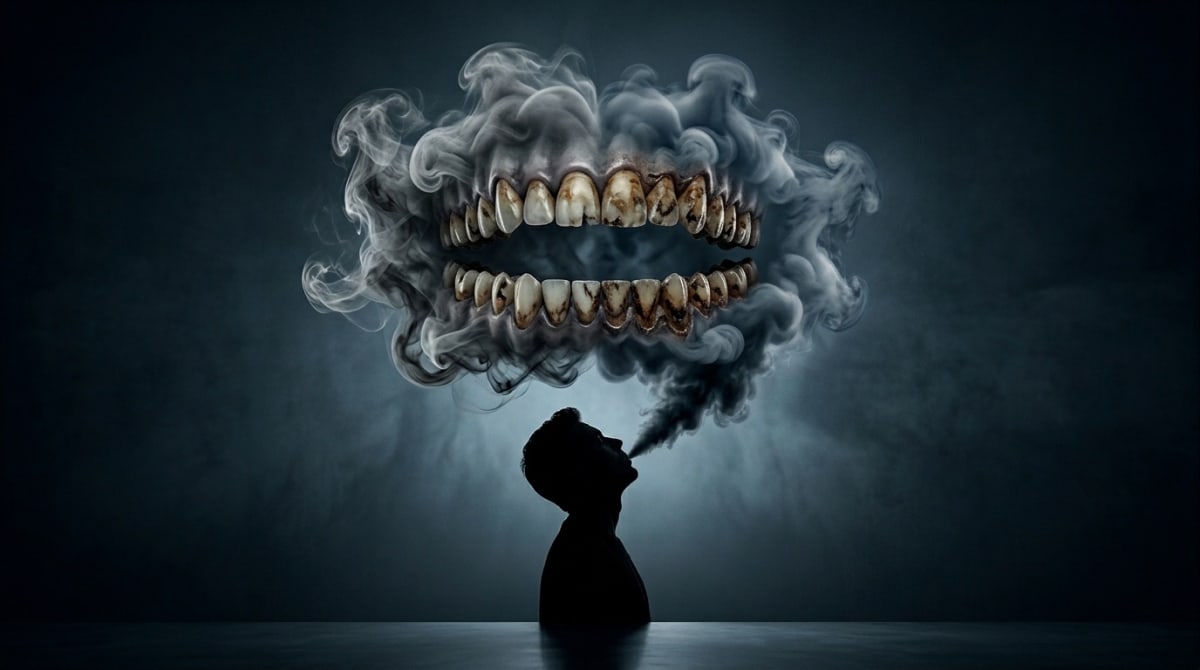
Staining. Tar deposits on tooth surfaces produce the characteristic yellow-brown staining that is hard to remove with regular brushing. Professional cleaning removes most of it; new staining begins again as soon as smoking resumes.
Bad breath (halitosis). A combination of residual smoke compounds, drier mouth, and altered oral bacterial populations.
Reduced sense of taste and smell. Often partial and reversible after quitting.
Oral cancer. Smoking is the most important preventable cause of cancers of the lip, tongue, floor of mouth, and oropharynx (the back of the throat behind the soft palate). The risk increases with the number of years smoking, the number of cigarettes a day, and combined alcohol use. Soft-tissue screening at every dental visit is central for any smoker.
Pre-cancerous changes. Persistent white patches (oral leukoplakia, a white patch that cannot be wiped off), red patches (erythroplakia), and mixed red-and-white patches in smokers all warrant assessment, as a small proportion progress to oral cancer if not managed.
What vaping appears to do, so far
The evidence on vaping is less mature than the evidence on smoking, but a few patterns have emerged.
Probable lower carcinogen exposure than combustible tobacco. Vaping does not produce the same combustion products as cigarettes, and several heavy carcinogens are absent or reduced in e-liquid aerosols.
Effects on the gums. Several short-term clinical studies and laboratory studies suggest that e-cigarette aerosols disrupt the gum tissue and the oral microbiome, contributing to inflammation. Long-term clinical outcomes (decade-scale tooth loss data) are not yet available because the products themselves are too new.
Dry mouth. Propylene glycol, a common e-liquid base, is hygroscopic and pulls moisture from oral tissues. Many vapers report dry mouth, which itself raises decay risk.
Caries risk. Sweetened e-liquids, frequent inhalation, and dry mouth combine to raise the risk of new cavities, particularly on smooth surfaces of the teeth at the gumline.
Soft-tissue irritation. Vapers more frequently report mouth ulcers, sore throat, and altered taste than non-users.
Children and young adults. Australian regulators introduced new restrictions on personal vape importation and retail sale in 2024. Vaping among teenagers is a particular concern because nicotine exposure during adolescent brain development carries different risks than in adults. The honest current reading: vaping is likely lower risk than combustible tobacco for many endpoints, but it is not without risk, and "swap smoking for vaping" is best treated as a step on the way to stopping both rather than a destination.
What changes when you stop
Many of the oral effects of smoking and vaping reverse, though not always quickly.
Within days to weeks. Sense of taste and smell start to return. Breath improves. Saliva flow increases.
Within weeks to months. Gum bleeding may temporarily increase as blood flow to the gums returns to normal. This is not a sign that things are getting worse; it is a sign that the immune response is recalibrating. Within three to six months, the gum response usually settles.
Within months to years. The risk of new gum disease drops. Healing after dental procedures returns toward non-smoker rates. The risk of tooth loss falls.
Over years. The risk of oral cancer reduces, gradually, but does not return to never-smoker baseline for at least a decade. Continued screening at every dental visit remains important. People who have quit are generally easier to treat dentally and respond better to gum disease management than they did while still smoking.
Where to get help to quit
Australia has free or subsidised support that genuinely helps. The combination of medication and counselling roughly doubles or triples quit success compared with going alone.
Quitline (13 78 48) provides free phone counselling and a callback service tailored to your situation. Available in many languages.
My QuitBuddy is a free app from the Australian government with structured tools and reminders.
Your GP can prescribe nicotine replacement (patches, gum, lozenges, mouth spray), varenicline, or other cessation medications. Pharmacy access to several products is also available.
Your dentist can discuss the oral effects, provide intra-oral motivation through photos and probing measurements, and time treatment around a planned quit date.
Vaping cessation increasingly has dedicated pathways. Talk to your GP if you would like support specifically for stopping vaping.
What dental care looks like for a current smoker or vaper
A few practical points. More frequent visits. Three- to four-monthly check-ups and cleans are reasonable for active smokers, given the higher gum disease risk and the importance of soft-tissue screening. Soft-tissue examination. Take seriously any persistent ulcer, lump, white or red patch in the mouth, or change in the lining of the cheek. Two weeks is the threshold for assessment. Periodontal monitoring. Probing depths are tracked over time. Smokers' gums often look deceptively healthy on the surface; the depth measurements tell the real story. Implant decisions. Implant placement in smokers carries higher failure rates. Many clinicians ask for a temporary stop around the surgical and healing window. Dry mouth management. Where vaping or smoking has caused dry mouth, fluoride toothpaste, frequent sips of water, sugar-free gum or lozenges, and saliva substitutes can reduce the secondary decay risk.
When to book an assessment
Sooner rather than later if any of the following apply.
A new patch (white, red, or mixed) in the mouth that has not gone away in two weeks.
A persistent ulcer that does not heal in two weeks.
A lump or swelling in the mouth, jaw, or neck.
Loose adult teeth, or teeth that have visibly drifted.
Pain or bleeding when brushing or eating.
A planned quit date, and a wish to coordinate dental care around it.
A short examination is unintrusive and is far more useful at the early stage of any of these signs.
Bottom line
Smoking is the most important modifiable risk factor for gum disease and oral cancer. Vaping is not risk-free; the early evidence on gums, microbiome, and dry mouth is concerning, and the long-term picture is not yet clear. Stopping reverses many oral effects within months, with gum disease risk falling steadily and oral cancer risk falling slowly over years. Help is available through Quitline, your GP, and your dentist. If you smoke or vape, our team at ArtSmiles can complete a soft-tissue and gum check, manage any gum disease that is present, and discuss cessation support. If you have a patch, ulcer, or lump in the mouth that has not gone away in two weeks, please book an assessment without waiting.
Frequently asked questions
Is vaping safer for my mouth than smoking?
Likely lower risk than combustible tobacco for many endpoints, but not without risk. Vaping reduces some carcinogen exposure but introduces other compounds whose long-term effects on the mouth are still being studied. The clearer recommendation is to stop both.
How long does it take for the gums to recover after quitting?
Some recovery starts within weeks. Bleeding tendency, however, often increases temporarily as the gums regain their normal blood flow. Most of the long-term gain happens in the first year.
Will the staining on my teeth go away if I quit?
Existing surface staining can usually be removed by professional cleaning. Deeper intrinsic discolouration may not fully reverse. Once smoking has stopped, new staining slows dramatically.
Are dental implants safe in smokers?
Possible, but with higher failure rates than in non-smokers. Many practices discuss reducing or stopping smoking around implant placement for the best healing outcome.
What can my GP do to help me quit?
GPs can prescribe nicotine replacement, varenicline, or other cessation medications that double or triple the success rate of quit attempts. Quitline (13 78 48) provides free counselling support that pairs well with medication.
How often should smokers see the dentist?
Three- to four-monthly visits are reasonable for current smokers, given higher gum disease risk and the importance of soft-tissue cancer screening at every visit.
References
Cancer Council Australia. (2024). Tobacco use and oral health.
Australian Institute of Health and Welfare. (2023). Tobacco smoking in Australia. AIHW.