Compiled from clinical pathology references. Medically reviewed by Dr Cristian Dunker, Principal Dentist, ArtSmiles Cosmetic Dentistry.
Quick summary
Also called | Chickenpox (varicella), shingles (herpes zoster), human herpesvirus 3 (HHV-3) |
How urgent? | 🟡 Manageable with antiviral medicines started within 72 hours; 🔴 urgent when shingles affects the eye or facial nerve |
Common or rare? | Chickenpox now uncommon in vaccinated populations; shingles common in adults over 50 |
Who it affects | Children for chickenpox; adults aged 50 and over for shingles; both more severe in immunocompromised patients |
Who treats it | GP or specialist for diagnosis and antiviral therapy; dentist supports comfort and reviews oral involvement |
Based on | Neville, Cawson, with cross-references in Regezi |
What is it?
Varicella-zoster virus (VZV, also known as human herpesvirus 3) is a member of the herpes virus family. It causes two distinct illnesses: chickenpox at first infection, usually in childhood, and shingles (herpes zoster) when the virus reactivates from nerve cells later in life. In dentistry, the most important pattern is shingles affecting the trigeminal nerve, which produces one-sided rash and ulcers in the face and mouth on the affected side, often with severe pain.
Who tends to get it?
The textbooks describe two distinct risk groups:
Chickenpox, mostly in children before vaccination. Rates are now much lower in countries with childhood VZV vaccination.
Shingles, in adults aged 50 and over, with risk rising with age.
Immunocompromised patients, at higher risk of severe disease at any age, including those on chemotherapy, after organ transplant, with HIV or on long-term steroids.
Stress, illness or recent surgery can trigger shingles in susceptible adults whose immunity has dipped temporarily.
Pregnant women and newborns, particularly vulnerable to severe chickenpox if they were not immune.
What causes it?
VZV is highly contagious by airborne droplets and direct contact with blister fluid. Once chickenpox has resolved, the virus settles dormant in nerve ganglia (clusters of nerve cell bodies in the spine and skull base). Reactivation, usually decades later, produces shingles in the territory of one nerve. Triggers include declining immunity with age, illness, stress, immunosuppressive medicines and certain cancers. Shingles is not caught from another person, but the blister fluid is contagious to non-immune contacts.
How does it develop?
Chickenpox:
Incubation, 10 to 21 days after exposure.
Prodrome, fever, malaise and headache for a day or two.
Rash, small red spots that turn into fluid-filled blisters and then crust over, in successive crops for 4 to 7 days.
Resolution, crusting and healing over 1 to 2 weeks.
Shingles:
Prodrome, pain, burning or tingling in the nerve territory for 1 to 4 days before any rash.
Rash, red base with fluid-filled blisters on one side of the body, never crossing the midline.
Crusting, new blisters appear for several days, then dry up.
Resolution, over 2 to 4 weeks in most cases.
Post-herpetic neuralgia, long-lasting nerve pain after the rash has healed, more common in older adults.
What might you notice?
What it looks like
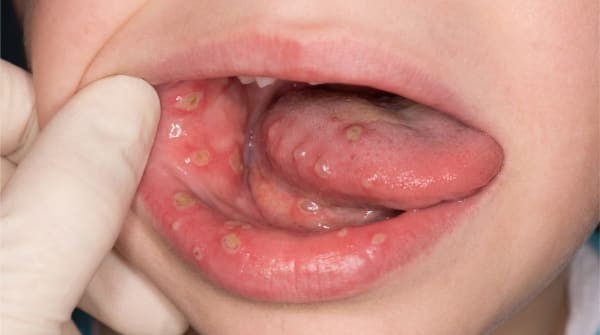
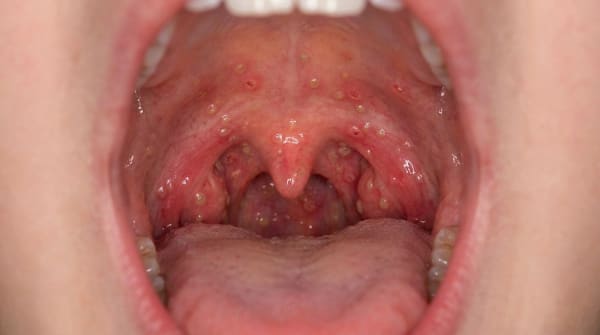
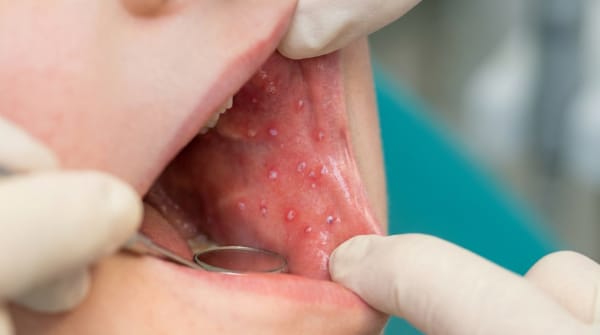
Chickenpox in the mouth:
Small, painful, shallow ulcers, usually 2 to 3 mm across.
Often on the palate, cheek lining and lips, alongside the more obvious skin rash.
Together with whole-body symptoms, including fever, malaise and an itchy rash on the trunk and face.
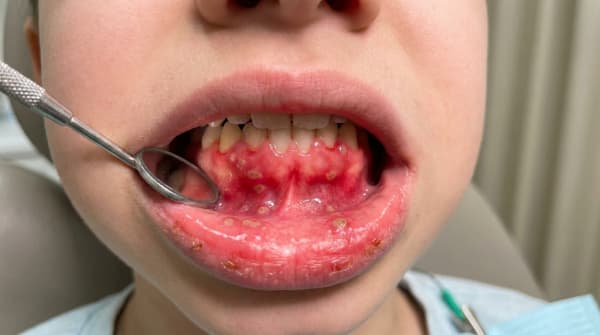
Shingles in the mouth:
Pain or burning on one side of the face for a few days before any rash appears.
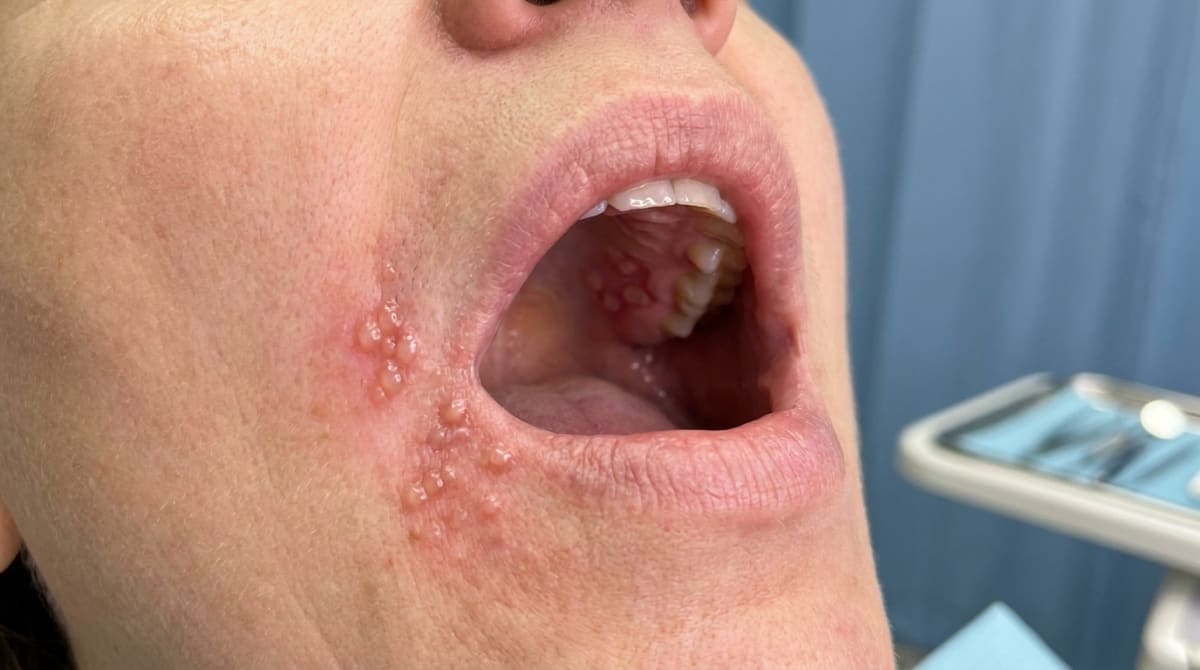
A unilateral rash on the skin that does not cross the midline, in the territory of one division of the trigeminal nerve.
Mouth ulcers on one side of the palate, gum or tongue depending on the affected division.
Severe pain often out of proportion to what is visible in the mouth.
Lymph node swelling on the same side of the neck.
Possible eye involvement (Hutchinson sign) when the ophthalmic division is affected, which is a medical emergency.
What it feels like
Pain is the dominant symptom. Patients describe burning, stabbing or aching pain that can be severe and is often present before the rash appears. Eating, drinking, brushing and smiling on the affected side become uncomfortable. Some patients have mild fever and feel generally unwell.
What an X-ray might show
X-rays are not relevant to diagnosing chickenpox or shingles, which are confined to the soft tissue and nerves. X-rays may be used to rule out a dental cause of one-sided face pain (for example a dental abscess) when the rash has not yet appeared and the diagnosis is unclear.
What happens at the dentist?
Most VZV is managed by the GP rather than the dentist. A dentist at ArtSmiles typically:
Recognises the unilateral pattern of facial pain and rash and arranges urgent GP review for antiviral treatment.
Avoids routine dental procedures during active shingles in the affected area to reduce viral spread and unnecessary discomfort.
Reassures the patient that one-sided mouth ulcers in this context are part of the shingles, not a separate problem.
Supports comfort, with soft, bland diet, gentle hygiene and topical anaesthetics where appropriate.
Reviews post-shingles for persistent oral symptoms, post-herpetic neuralgia or limited mouth opening.
Discusses vaccination for older adults regarding the shingles vaccine (Shingrix), which substantially reduces the risk and severity of shingles.
Is this serious?
🟡 Chickenpox is usually a mild childhood illness in healthy children but can be severe in adults, pregnant women, newborns and immunocompromised patients. 🔴 Shingles can be more serious, particularly when the eye is involved or in immunocompromised patients. Concerns include:
Post-herpetic neuralgia, long-lasting pain after the rash resolves.
Eye involvement, sight-threatening when the ophthalmic division is affected.
Ramsay Hunt syndrome, shingles affecting the facial nerve, causing facial weakness, ear pain and rash in the ear canal.
Disseminated zoster, widespread rash in immunocompromised patients.
Bacterial superinfection of the rash when not kept clean.
Prompt antiviral therapy started within 72 hours of rash onset reduces severity and the risk of post-herpetic neuralgia.
Could it be something else?
Mouth ulcers and facial pain can have other causes:
Recurrent herpes simplex, recurrent painful blisters on the lip, usually crossing the midline.
Recurrent aphthous stomatitis, single or multiple ulcers without rash.
Erythema multiforme, target lesions and widespread mouth ulceration.
Trigeminal neuralgia, severe lightning pain without rash.
Dental abscess, localised pain related to a specific tooth.
Sinusitis, pain and congestion related to a sinus.
The unilateral, dermatomal pattern with rash is highly suggestive of shingles.
How is it treated?
Treatment is medical, with the dentist supporting oral care:
Medical treatment from your GP:
Antiviral medicines such as aciclovir, valaciclovir or famciclovir, started within 72 hours of rash onset for the best effect on severity and post-herpetic neuralgia risk.
Pain relief with paracetamol, NSAIDs or stronger medicines as needed; gabapentin or amitriptyline for nerve pain.
Urgent ophthalmology review when the eye is involved.
Vaccination with the chickenpox vaccine in childhood and the shingles vaccine (Shingrix) for adults aged 50 and over.
Dental support:
Soft, bland diet while the mouth ulcers are healing.
Gentle oral hygiene with a soft-bristled toothbrush and an alcohol-free mouth rinse.
Topical anaesthetic gels before meals to make eating more comfortable.
Hydration with cool, soothing fluids; avoid hot, acidic and spicy foods.
Follow-up review for any persistent oral symptoms once the acute infection has settled.
A patient-centred approach matters here. Shingles is painful and worrying, particularly when it affects the face. Calm, clear explanation, prompt referral for antivirals and considered follow-up are themselves part of effective care, values that sit at the heart of our clinical philosophy.
What's the long-term outlook?
For most patients, both chickenpox and shingles resolve completely. Some patients experience long-lasting post-herpetic neuralgia, particularly older adults. The shingles vaccine substantially reduces the chance of getting shingles in the first place and the severity of any episode that does occur. The single most important factor in a good outcome is early recognition and antiviral therapy within 72 hours of rash onset.
A note on this article
This article is for educational purposes only and does not constitute a clinical diagnosis. Please consult a registered dental practitioner for assessment and treatment advice.
The cover image above is an AI-generated illustration based on the most common visible features of this condition described in clinical pathology references. It is not a photograph of a real case and should not be used to diagnose or rule out the condition in your own situation. If you are concerned about something you have noticed, please book an assessment with a registered dental practitioner.
References
Neville, B. W., Damm, D. D., Allen, C. M., & Chi, A. C. (2023). Oral and maxillofacial pathology (5th ed.). Elsevier. Chapter 7, Viral Infections: Varicella-Zoster Virus Infection, with clinical features of chickenpox, shingles and oral involvement.
Cawson, R. A., & Odell, E. W. (2017). Cawson's essentials of oral pathology and oral medicine (8th ed.). Elsevier. Chapter 17, Viral Infections: varicella-zoster virus and herpes zoster.
Regezi, J. A., Sciubba, J. J., & Jordan, R. C. K. (2017). Oral pathology: Clinical pathologic correlations (7th ed.). Elsevier. Chapter 1, Vesiculobullous Diseases: cross-reference for varicella-zoster.
Frequently asked questions
What's the difference between chickenpox and shingles?
Both are caused by the varicella-zoster virus. Chickenpox is the first (primary) infection, usually in children, causing widespread itchy blisters across the body. Shingles (zoster) is reactivation later in life of the same virus that has been dormant in nerve cells, producing a painful blister rash in the area supplied by a single nerve.
How does shingles affect the mouth?
When shingles affects the trigeminal nerve, it can produce a unilateral (one-sided) painful blister rash on the face, with ulcers in the mouth that strictly stop at the midline. The classic feature is that the lesions follow the distribution of one branch of the nerve and do not cross the centre line of the face or mouth.
How is varicella-zoster treated?
Mild chickenpox in healthy children is usually managed with rest, fluids, paracetamol and itch relief. Shingles is treated with oral antivirals (aciclovir, valaciclovir or famciclovir) started ideally within 72 hours of the rash, which reduce pain and risk of long-term nerve pain (postherpetic neuralgia). Vaccination is available for chickenpox and shingles in eligible groups.
Is shingles in the mouth contagious?
The fluid in shingles blisters contains varicella-zoster virus. People who have never had chickenpox or the vaccine can catch chickenpox (not shingles) through direct contact with the blister fluid. Cover the lesions, avoid sharing utensils, and stay away from pregnant women, newborns and immunocompromised people until the lesions have crusted.