Compiled from clinical pathology references. Medically reviewed by Dr Cristian Dunker , Principal Dentist, ArtSmiles Cosmetic Dentistry.
Quick summary
Also called | HFMD, Coxsackie hand foot and mouth disease |
How urgent? | 🟢 Usually mild, most cases settle on their own within a week. Rare strains can cause more serious complications and warrant medical attention. |
Common or rare? | Very common, one of the most frequent childhood viral illnesses; epidemics every 2-3 years |
Who it affects | Most often children aged 1-4, with a smaller number of older children and adults; atypical Coxsackie A6 disease can affect a broader age range and be more severe |
Who treats it | GP for most cases; general dentist may help confirm the oral diagnosis and provide comfort advice |
Based on | Neville, with cross-references in Cawson and Regezi |
What is it?
Hand foot and mouth disease (HFMD) is a common childhood viral illness caused by enterovirus (a viral family that includes coxsackievirus and enterovirus 71)es, most often coxsackievirus A16 or enterovirus 71. The textbooks describe a typical pattern of mild systemic illness, painful mouth ulcers, and a vesicular rash on the hands and feet. Despite its rather alarming name, the great majority of cases are self-limiting and settle within a week or so without specific treatment. The reason it matters is that it is highly contagious, can keep children out of childcare or school for a few days, and a small number of cases, particularly those caused by enterovirus 71 in the Asia-Pacific region, can produce serious neurological complications that warrant medical care.
Who tends to get it?
The textbooks describe a fairly recognisable profile:
Children aged 1-4 years are most often affected, particularly during epidemic outbreaks.
Older children and adults can also be affected, especially during atypical Coxsackie A6 outbreaks where the age range is wider.
Both sexes affected equally.
Outbreaks every 2-3 years in many populations as new groups of susceptible children emerge.
Childcare and school settings are common sources of spread.
Pregnant women affected by Coxsackie B during pregnancy carry a small additional risk to the fetus.
What causes it?
The textbooks identify the main viral causes:
Coxsackievirus (the family of viruses, mainly A16 and A6, that cause most hand, foot and mouth disease) A16, historically the most common single cause.
Enterovirus 71, particularly important in the Asia-Pacific region; associated with more severe outbreaks and neurological complications.
Coxsackievirus A6, has emerged as a major cause of recent atypical outbreaks worldwide, with more severe and widespread skin lesions and a longer disease course.
Other Coxsackie strains, A5, A9, A10 and others can produce similar illness.
The viruses spread by:
Respiratory droplets from coughing or sneezing.
Direct contact with the fluid in skin or mouth blisters.
Faecal-oral spread from inadequate handwashing after toileting.
Contaminated surfaces and objects, particularly in childcare settings.
How does it develop?
After exposure, the virus replicates in the lining of the throat and intestine, then spreads through the bloodstream. The textbooks describe an incubation period of about 3-6 days, during which the patient is typically well. The illness then develops in three overlapping stages:
Prodromal stage, sore throat, mild fever, anorexia, occasional cough or runny nose.
Mucocutaneous stage, mouth ulcers and the typical hand/foot rash appear.
Resolution, fever settles within 2-3 days and skin and oral lesions heal within about a week.
Microscopically, the affected mucosa shows intracellular and intercellular oedema that forms a vesicle, which then ruptures through the basal cell layer to leave an ulcer. Inclusion bodies and multinucleated cells are not features, distinguishing HFMD histologically from herpes infections.
What might you notice?
What it looks like
Mouth:
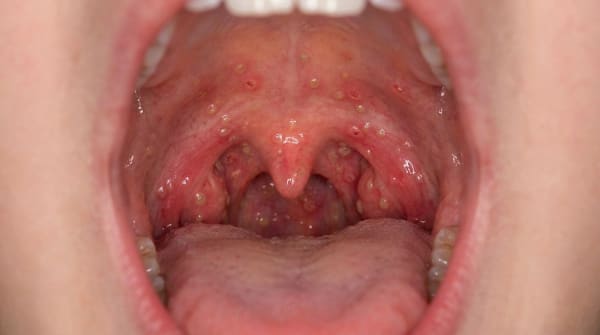
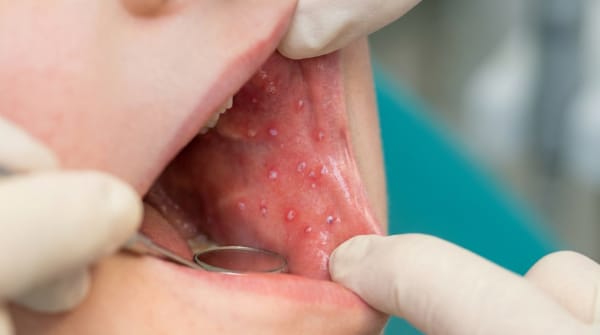
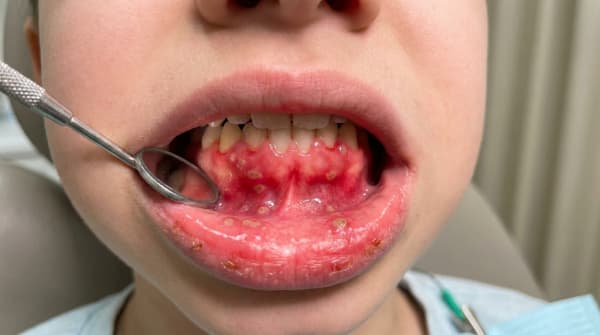
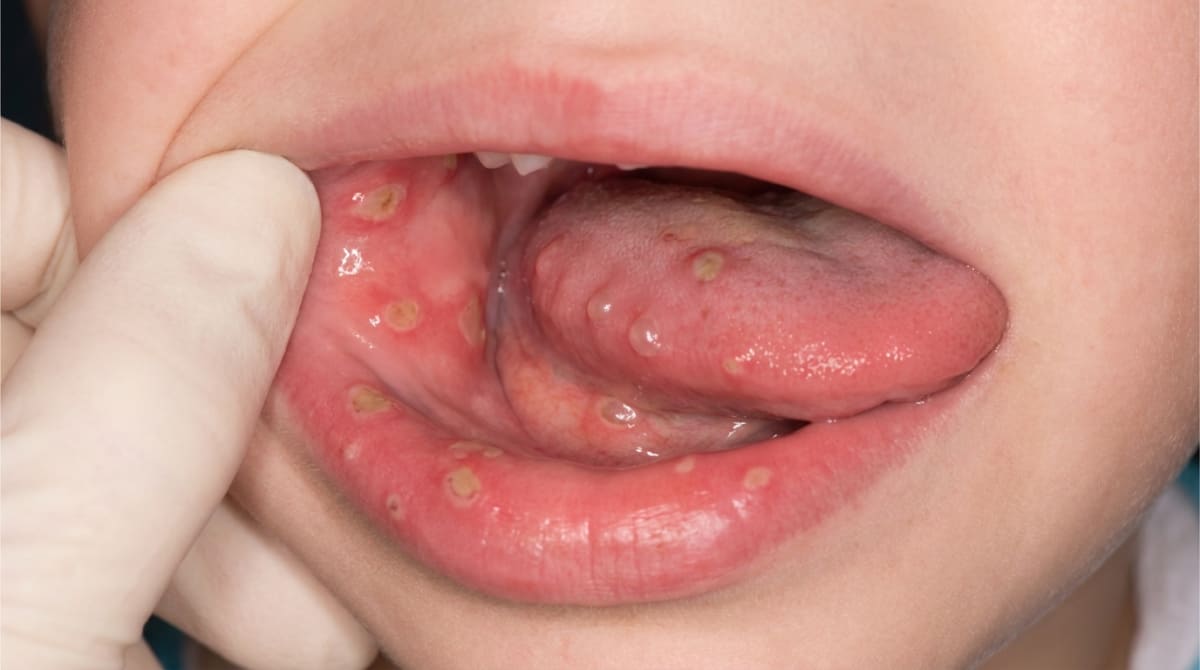
Multiple small ulcers typically on the inside of the cheeks (buccal mucosa), lips and tongue, with possible involvement of any oral surface.
The number of lesions ranges from 1 to about 30, larger than in herpangina (a viral illness with ulcers at the back of the mouth, related to hand, foot and mouth disease but without the skin rash).
Each ulcer is typically 2-7 mm across, occasionally up to 1 cm.
The ulcers begin as red macules (small flat spots of changed colour, without raising the skin), develop into fragile vesicles (small fluid-filled blisters), and rapidly ulcerate.
Hands and feet:
Small vesicles on the borders of the palms and soles, the ventral surfaces and sides of the fingers and toes.
The vesicles begin as red macules with central blisters, and heal without crusting.
Lesions may also appear on the buttocks, external genitals or legs, particularly in atypical Coxsackie A6 disease.
Other features:
Mild fever, cough, runny nose in many cases.
Sore throat and difficulty swallowing.
Occasionally nail loss or Beau lines (transverse ridges) several weeks after recovery.
What it feels like
Symptoms typically include:
Fever, usually mild but occasionally over 39°C.
Sore mouth with painful ulcers, often the most distressing symptom.
Difficulty eating or drinking because of mouth pain.
Tiredness and irritability.
Occasionally vomiting, diarrhoea or muscle aches.
No symptoms at all in the many subclinical infections that pass unnoticed.
What an X-ray might show
X-rays are not used for HFMD, the diagnosis is made on the typical clinical picture.
What happens at the dentist?
Most cases of HFMD are managed by the GP rather than the dentist. However, parents sometimes bring children to a dental check-up at ArtSmiles when oral ulcers are the most prominent symptom. The dentist will typically:
Examine the mouth carefully, identifying the typical multiple painful ulcers.
Look for the hand and foot rash to confirm the diagnosis.
Take a history of recent exposure to other affected children, fever and onset.
Distinguish from primary herpetic gingivostomatitis (the first infection with the cold sore virus, with widespread mouth ulcers), which typically causes more widespread gingival inflammation and involves the gums prominently.
Reassure that the illness is usually mild and self-limiting.
Refer to a GP if there are concerning features such as high persistent fever, severe dehydration, drowsiness, neck stiffness, breathing difficulty or unusual rash.
Reschedule any non-urgent dental treatment until the patient has fully recovered, both for comfort and to limit spread.
Is this serious?
🟢 In the great majority of cases, hand foot and mouth disease is mild and self-limiting. The most common reason for medical attention is dehydration from poor oral intake during the painful phase. A small minority of cases, particularly those caused by enterovirus 71, can produce more serious complications including pneumonia, pulmonary oedema, carditis, encephalitis, meningitis and acute flaccid myelitis. Coxsackie B infection during pregnancy has been linked to fetal complications. Atypical Coxsackie A6 disease can be more severe in older children and adults.
If a child has high or persistent fever, marked drowsiness, neck stiffness, breathing difficulty, severe dehydration or a rapidly worsening rash, urgent medical assessment is warranted.
Could it be something else?
Several other oral and viral conditions can resemble HFMD. The textbooks list these as the main differentials:
Primary herpetic gingivostomatitis, produces widespread oral ulcers and prominent gingival inflammation, usually without skin lesions on the hands and feet.
Recurrent aphthous stomatitis, single or several oral ulcers without systemic illness or skin involvement.
Herpangina, caused by similar enteroviruses but with lesions confined to the soft palate and tonsillar pillars and no skin rash.
Varicella (chickenpox), produces widespread skin vesicles in different stages of healing, distributed over the trunk rather than confined to hands and feet.
Erythema multiforme, target lesions of the skin and oral ulceration, often after medications or herpes.
Bacterial impetigo, golden-crusted skin lesions, more localised, no oral ulcers.
How is it treated?
Treatment is supportive in most cases.
At-home measures and habits:
Rest and reduced activity during the acute illness.
Plenty of cool fluids, cold water, milk, ice blocks, to keep up hydration despite the painful mouth.
Soft, bland foods for a few days; avoid acidic, spicy or salty foods that sting.
Paracetamol or ibuprofen for fever and pain, in line with paediatric dosing advice (avoid aspirin in children).
Topical anaesthetic gels or sprays specifically formulated for mouth ulcers, used sparingly and as directed.
Excellent hand hygiene to limit spread within the household.
Avoid sharing cups, utensils, toothbrushes during the contagious period.
Keep affected children home from childcare or school until lesions have healed, fever has settled and they are well enough to participate.
Professional steps your dentist or GP may consider:
Confirming the diagnosis clinically; laboratory testing with reverse-transcription PCR is reserved for atypical or severe cases.
Pain control with appropriate topical or systemic analgesics.
Hydration support, including admission for intravenous fluids in rare severe cases.
Monitoring for complications, particularly in enterovirus 71 outbreaks or in atypical Coxsackie A6 disease.
Public health notification in outbreak settings, in line with local guidelines.
Reassurance that most children recover fully within a week.
A patient-centred approach matters here. Parents are often understandably worried by sudden mouth ulcers, fever and a rash in a young child. Calm, clear explanation of what HFMD is, how it spreads, when to worry and how long it usually lasts is itself part of effective care, values that sit at the heart of our clinical philosophy.
What's the long-term outlook?
The outlook for most cases of hand foot and mouth disease is excellent. Children typically make a full recovery within 7-10 days and develop lifelong immunity to the specific viral strain, although they remain susceptible to other strains, so a child can sometimes get HFMD more than once. Complications are rare and most often associated with enterovirus 71 in the Asia-Pacific region. There is no long-term effect on dental or oral health, and the child's appetite, sleep and energy usually return to normal within a couple of weeks.
A note on this article
This article is for educational purposes only and does not constitute a clinical diagnosis. Please consult a registered dental practitioner for assessment and treatment advice.
The cover image above is an AI-generated illustration based on the most common visible features of this condition described in clinical pathology references. It is not a photograph of a real case and should not be used to diagnose or rule out the condition in your own situation. If you are concerned about something you have noticed, please book an assessment with a registered dental practitioner.
References
Neville, B. W., Damm, D. D., Allen, C. M., & Chi, A. C. (2023). Oral and maxillofacial pathology (5th ed.). Elsevier. Chapter 7, Viral Infections: Hand-Foot-and-Mouth Disease, with coxsackievirus A16 and enterovirus 71 as the main causes, atypical Coxsackie A6 form, and the related conditions herpangina and acute lymphonodular pharyngitis, pp. 244 to 246.
Cawson, R. A., & Odell, E. W. (2017). Cawson's essentials of oral pathology and oral medicine (8th ed.). Elsevier. Chapter 13, Viral diseases of the mouth: cross-reference for hand-foot-and-mouth disease.
Regezi, J. A., Sciubba, J. J., & Jordan, R. C. K. (2017). Oral pathology: Clinical pathologic correlations (7th ed.). Elsevier. Cross-reference for hand-foot-and-mouth disease and related enteroviral infections.
Frequently asked questions
How is hand-foot-and-mouth disease spread?
It spreads easily by close contact, respiratory droplets, contact with blister fluid, and from contaminated surfaces. Outbreaks are common in childcare and preschool settings. Most children are contagious for around a week from when symptoms start, although the virus can shed in stool for several weeks.
What does hand-foot-and-mouth disease look like in the mouth?
In the mouth it produces small painful ulcers, often on the tongue, gums, palate and inside of the cheeks. Outside the mouth there are usually red spots and small blisters on the palms, soles and sometimes the buttocks. The illness lasts about a week and is more common in children under 5.
How is it treated?
There is no specific antiviral. Care is supportive: paracetamol or ibuprofen for fever and discomfort, soft cool foods, fluids to prevent dehydration, and good hand hygiene to limit spread. Children should stay home from childcare or school until they feel well and the blisters have dried.
When should I see a doctor or dentist?
See a doctor if your child cannot drink, looks dehydrated, is very unwell, has a stiff neck, persistent high fever, or if the rash is severe. See your dentist if mouth ulcers persist beyond 10-14 days, or if you are unsure whether the ulcers are from hand-foot-and-mouth disease or something else, so the diagnosis can be confirmed.