Compiled from clinical pathology references. Medically reviewed by Dr Cristian Dunker , Principal Dentist, ArtSmiles Cosmetic Dentistry.
Quick summary
Also called | Cold sore, fever blister, herpes labialis, secondary herpes, recurrent herpetic stomatitis, recurrent intraoral herpes (RIH) |
How urgent? | 🟡 Worth a check-up, usually self-limiting in 7 to 10 days, but antiviral treatment works best when started at the first tingle |
Common or rare? | Very common, between 15% and 45% of adults experience recurrent cold sores at some point |
Who it affects | Adults and adolescents who carry the herpes simplex virus from a previous (often childhood) infection |
Who treats it | General dentist or general practitioner; specialist referral only if recurrences are severe, frequent or in an immunocompromised person |
Based on | Regezi, Neville, Cawson, Laskaris |
What is it?
A recurrent herpes simplex outbreak is the reappearance of small clusters of blisters on the lip or inside the mouth, caused by the same virus that produced the original infection (often a mild childhood illness people don't remember). After that first infection, the herpes simplex virus type 1 (HSV-1) settles into a nerve cluster near the face and stays quiet for years. Every now and then it travels back along the nerve to the skin or lining of the mouth and produces a fresh crop of blisters in the same spot.
When the outbreak appears on the lip border it's usually called a cold sore (herpes labialis). When it appears inside the mouth it's called recurrent intraoral herpes, and the location is very specific, only on tissue that's firmly attached to bone, like the hard palate or the gums around the teeth.
Who tends to get it?
Recurrent herpes is one of the most common viral conditions in the population. Studies cited in the textbooks suggest somewhere between 15% and 45% of adults have a history of cold sores. After a primary HSV-1 infection, around 20% to 40% of carriers will experience recurrent outbreaks after their initial infection. Most people first encounter the virus in childhood through close contact with an infected family member, often without ever developing noticeable symptoms.
Adults from any background can be affected, but recurrences tend to be more frequent and more troublesome in people whose immune system is under pressure, for example during cancer treatment, after organ or bone marrow transplantation, or in people living with HIV. Some sources note that herpes labialis affects women slightly more often than men. The frequency of recurrence usually decreases with age. Most people who get recurrent cold sores experience two to four episodes a year, though a small group has outbreaks every month or even more often.
What causes it?
The direct cause is reactivation of latent HSV-1 already living in the trigeminal ganglion, a cluster of nerve cells deep in the face. The virus doesn't come from a new infection, it travels back down the same nerve fibres to the area where it first set up camp.
A wide range of triggers can wake the virus up. The textbooks consistently list the following:
Sunlight or strong ultraviolet (UV) exposure, this is why outbreaks are sometimes called "sun blisters"
Cold weather, the common cold or other febrile illness, hence the name "fever blister"
Emotional stress, fatigue and run-down periods
The hormonal changes around menstruation
Local trauma, including dental injections, tooth extractions and other dental treatment
Immunosuppression, whether from medication, chemotherapy or systemic illness
Neutralising antibodies produced after the first infection don't fully prevent these recurrences. The trigger essentially tips the local balance and lets the virus replicate again.
How does it develop?
Think of HSV-1 as a long-term tenant living quietly in a nerve junction box near the cheekbone. It pays no rent and causes no problems most of the time. But when something disturbs the building, sunburn, a fever, stress, a needle for a dental procedure, the virus packs up and travels down the nerve cable back to the patch of skin or mucosa it originally infected. There it multiplies inside the surface skin cells, makes them swell up and burst, and produces the familiar cluster of blisters.
Because the virus always uses the same nerve route, the outbreak nearly always appears in the same spot from one episode to the next. That same-site recurrence is one of the strongest clues that you're dealing with herpes rather than another type of ulcer.
What might you notice?
What it looks like
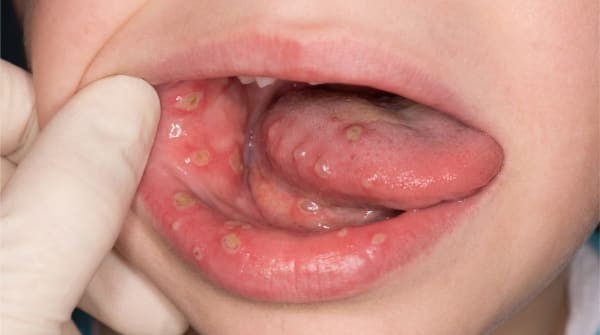
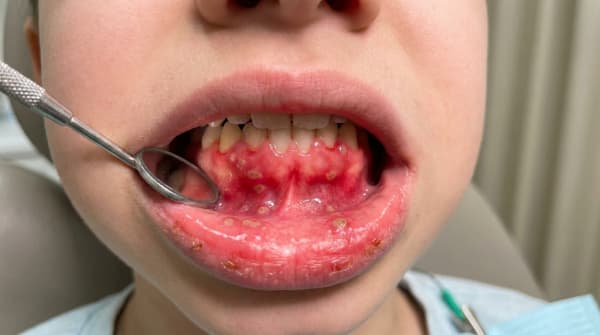
A cold sore on the lip typically begins as a small patch of redness or a few tiny raised spots along the border between the lip and the skin. Within a few hours these turn into a tight cluster of small fluid-filled blisters. The blisters often join together, then break and weep clear or yellowish fluid, and finally crust over with a yellow-brown scab. Healing usually takes 7 to 10 days, and the skin returns to normal without a scar.
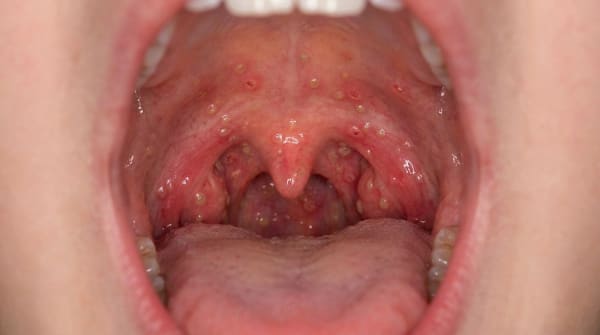
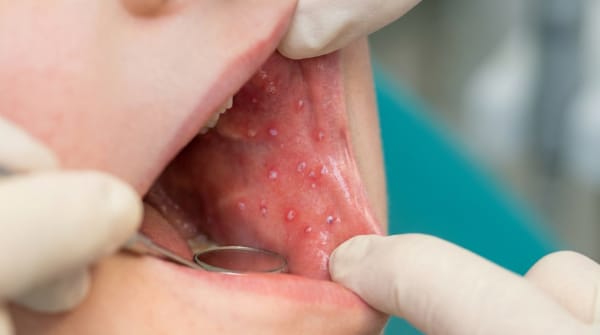
Intraoral recurrent herpes looks different. The blisters are tiny (one to three millimetres), rupture almost immediately and leave behind a cluster of small pinpoint ulcers or red spots that may join up into a single irregular patch. The location is the giveaway, these lesions appear only on keratinised mucosa firmly attached to bone, which means the hard palate (the bony roof of the mouth) and the gums around the teeth. They do not appear on the inside of the cheek, the floor of the mouth, the underside of the tongue or the soft palate.
What it feels like
Most people describe a clear warning phase before anything is visible, a tingling, burning, itching or prickly sensation, sometimes a feeling of localised warmth or a dull ache, in the spot where the lesion will appear. This early warning symptom (prodrome) typically arrives 6 to 24 hours before the blisters and is the ideal moment to start antiviral treatment.
Once the blisters appear, the lip lesion is usually tender and most painful in the first 8 hours, settling as it crusts. Intraoral recurrences are often surprisingly mild, many people only notice a slightly raw or tingly patch on the palate or gums, and some don't realise they have anything until a dentist points it out. Eating spicy or acidic food can sting.
What an X-ray might show
Recurrent herpes simplex is a soft-tissue, viral condition. X-rays play no role in diagnosis or management.
What happens at the dentist?
For most patients with a typical cold sore, no test is needed, the appearance, the prodromal tingle and the history of repeat outbreaks in the same place tell the story. A dentist at ArtSmiles may simply confirm the diagnosis by looking at the lesion and asking about previous episodes.
If an intraoral lesion looks unusual, persists longer than expected, or appears in someone who is unwell or immunocompromised, a dentist may take a swab or a small smear from the edge of an early lesion. Cytology can show the characteristic ballooning, multinucleated virus-infected cells. Where confirmation matters more, polymerase chain reaction (PCR) testing, immunohistochemistry (a stain that detects viral proteins in tissue), viral culture or blood antibody testing can be arranged. Biopsy is occasionally needed when an ulcer doesn't behave like a typical herpes lesion.
A dentist will also ask about triggers, recent illness, dental work, sun exposure, stress, medications, and will usually defer non-urgent dental treatment until an active lip lesion has scabbed over, both to protect the patient and to reduce the risk of spreading the virus to staff or other patients.
Specialist referral (to an oral medicine specialist, dermatologist or infectious diseases physician) is appropriate when outbreaks are very frequent, unusually severe, slow to heal, or occur in someone with compromised immunity.
Is this serious?
🟡 In a healthy person, a recurrent cold sore is a nuisance rather than a danger. The lesions heal on their own within a week or two and rarely cause complications. The main practical issues are discomfort, social or cosmetic concern, and the fact that the blister fluid is contagious, so kissing, sharing drink bottles or sharing lip balm during an outbreak can pass the virus on to others or to other parts of the body (most importantly the eyes and the genitals).
The situation changes if the immune system is compromised. In people on chemotherapy, transplant medication or with advanced HIV, recurrent herpes can become extensive, persistent and occasionally serious. Lesions may spread beyond their usual site, take much longer to heal and develop secondary bacterial or fungal infection. A herpes ulcer that lasts longer than a month is, in fact, recognised as an AIDS-defining condition (one of several findings used to confirm a diagnosis of advanced HIV).
If you've noticed any of these signs for more than two weeks, it's worth booking an assessment.
Could it be something else?
Several conditions can mimic recurrent herpes, and a careful look at the location, pattern and history is what usually sorts them out.
Recurrent aphthous ulcers (canker sores), these can look very similar inside the mouth, but they appear on the soft, movable mucosa (cheek, floor of mouth, underside of tongue, soft palate), are not preceded by blisters and are not in clusters. Recurrent intraoral herpes, by contrast, sticks to keratinised mucosa bound to bone.
Herpes zoster (shingles) of the trigeminal nerve, produces small fluid-filled blisters (vesicles) and ulcers that look like herpes simplex but are strictly one-sided, stop sharply at the midline, are usually preceded by deep pain or paraesthesia (altered sensation, often tingling or pins-and-needles) and tend to occur in older adults. Recurrent zoster is very rare, whereas recurrent herpes simplex by definition repeats.
Hand-foot-and-mouth disease, small oral ulcers, but with an accompanying rash on the hands and feet and usually in children during a local outbreak.
Herpangina, vesicles and ulcers on the soft palate and tonsil region (not the hard palate or gums), usually with sore throat and fever, mostly in children.
Erythema multiforme, larger irregular ulcers, usually with target-shaped skin lesions and crusted lips, typically without a preceding tingling prodrome.
Acute necrotising ulcerative gingivitis (ANUG), gum ulcers and bad breath, but no preceding vesicles and pain confined to the gum margins.
Pemphigus vulgaris, chronic, painful, slow-healing oral blisters that don't follow the same-site cluster pattern and don't heal in a week.
Traumatic ulcer of the lip, can mimic herpes labialis, but follows a single bite or knock, isn't preceded by a tingling prodrome and doesn't recur in cycles.
Impetigo, a bacterial skin infection around the lips that produces honey-coloured crusts; lacks the clear vesicle stage and the prodrome.
Primary or secondary syphilis, can occasionally produce lip lesions; usually solitary, painless and persistent rather than recurrent and self-limiting.
Contact allergy or chapped lips, diffuse redness and scaling rather than discrete clustered vesicles.
How is it treated?
For mild, infrequent outbreaks, no treatment is strictly necessary, the lesion will heal on its own in 7 to 10 days. Helpful self-care includes keeping the area clean and moisturised, avoiding picking the scab, using lip sunscreen as a preventive measure, and being careful not to spread the virus by touching the lesion and then the eyes, genitals or other people.
When treatment is desired, the most important factor is timing. Antivirals work by blocking viral replication, so they are most effective when started during the prodromal tingle, before blisters appear. Once a lesion is fully formed, antivirals shorten the episode by only about a day.
Professional treatment options that may be discussed include:
Topical antiviral creams, aciclovir, penciclovir or over-the-counter docosanol applied at the first prodromal sensation. Penciclovir generally produces the best symptomatic effect among the topicals.
Oral antiviral tablets, aciclovir, valaciclovir or famciclovir, taken at the first sign of an outbreak. A short course (sometimes a single high dose at the prodrome followed by another dose 12 hours later) can shorten or even abort an attack.
Suppressive antiviral therapy, a low daily dose taken for months at a time, usually reserved for people with more than six recurrences a year, herpes-triggered erythema multiforme or compromised immunity.
Procedure-related prophylaxis, for people whose outbreaks reliably follow dental treatment or planned sun exposure, a short prophylactic course of antiviral starting just before the trigger.
Symptom relief, bland mouth rinses, soft diet, paracetamol or non-steroidal anti-inflammatory pain relief, and lip balm with sunscreen for prevention.
Intravenous antiviral therapy, reserved for severely immunocompromised patients with extensive disease.
A dentist will also recommend deferring elective dental work until the lesion has crusted, both to limit spread and to avoid aerosolising the virus (spreading virus particles in fine droplets in the air).
What's the long-term outlook?
Recurrent herpes simplex is a lifelong condition in the sense that the virus stays in the nerve ganglion permanently, but its clinical impact is usually limited and tends to ease with age. Most people settle into a predictable pattern of two to four mild episodes a year, each healing in 7 to 10 days without scarring. The same-site nature of the recurrences means people generally come to recognise their own trigger pattern and learn when to act.
There is currently no cure that eradicates the virus and no vaccine in routine use, but well-timed antiviral therapy can shorten outbreaks, reduce frequency and prevent some attacks altogether. Frequency typically decreases over the years. In healthy people, long-term complications are rare. In immunocompromised people, recurrences need closer monitoring and a lower threshold for systemic antiviral treatment, but with appropriate care the outlook remains good.
A note on this article
This article is for educational purposes only and does not constitute a clinical diagnosis. Please consult a registered dental practitioner for assessment and treatment advice.
The cover image above is an AI-generated illustration based on the most common visible features of this condition described in clinical pathology references. It is not a photograph of a real case and should not be used to diagnose or rule out the condition in your own situation. If you are concerned about something you have noticed, please book an assessment with a registered dental practitioner.
References
Regezi, J. A., Sciubba, J. J., & Jordan, R. C. K. (2017). Oral pathology: Clinical pathologic correlations (7th ed.). Elsevier. Chapter 1, Vesiculobullous Diseases (Herpes Simplex Infection), pp. 1 to 6.
Neville, B. W., Damm, D. D., Allen, C. M., & Chi, A. C. (2023). Oral and maxillofacial pathology (5th ed.). Elsevier. Chapter 7, Viral Infections (Herpes Simplex Virus / Recurrent Herpes Labialis / Recurrent Intraoral Herpes), pp. 231 to 235.
Cawson, R. A., & Odell, E. W. (2017). Cawson's essentials of oral pathology and oral medicine (8th ed.). Elsevier. Chapter 12, Diseases of the Oral Mucosa: Introduction and Mucosal Infections (Primary Herpetic Stomatitis and Herpes Labialis), pp. 206 to 209.
Laskaris, G. (2003). Color atlas of oral diseases (3rd ed.). Thieme. Chapter 15, Viral Infections (Secondary Herpetic Stomatitis and Herpes Labialis), pp. 116 to 119.