Compiled from clinical pathology references. Medically reviewed by Dr Cristian Dunker , Principal Dentist, ArtSmiles Cosmetic Dentistry.
Quick summary
Also called | Primary herpes simplex infection, primary herpetic stomatitis, acute herpetic inflammation of gums and mouth (gingivostomatitis) (AHGS), primary HSV-1 infection |
How urgent? | 🟡 Worth a check-up, most cases settle on their own, but a dentist or GP can confirm the diagnosis and consider antiviral medication if seen within the first 72 hours |
Common or rare? | Common, the most frequent symptomatic primary viral infection of the mouth, although most first exposures to the virus cause no symptoms at all |
Who it affects | Mostly children aged 6 months to 5 years; can also affect adolescents and young adults, sometimes more severely |
Who treats it | General dentist or GP; specialist referral only if the patient is immunocompromised or symptoms are severe |
Based on | Regezi, Neville, Cawson, Laskaris |
What is it?
Primary herpetic gingivostomatitis is the mouth's first encounter with the herpes simplex virus, almost always type 1 (HSV-1), the same virus that later causes cold sores. The first time the virus enters the body, it can trigger a sudden, painful illness with fever, swollen red gums and clusters of small ulcers throughout the mouth.
It is the most common symptomatic primary viral infection of the oral mucosa, and the gum involvement is its hallmark, the gingiva is always swollen and inflamed, even when ulcers are sparse. Once the illness resolves (usually within 10 to 14 days), the virus retreats into a nerve and stays there for life, occasionally reactivating later as a cold sore.
Who tends to get it?
The textbooks describe a clear age pattern. The peak occurs between 2 and 3 years of age, with most affected individuals between 6 months and 5 years old. Cases below 6 months are rare because protective antibodies passed from the mother are still circulating.
While children are by far the most common patients, primary infection can also strike adolescents and young adults who escaped childhood exposure, and in this older group, the illness tends to be more severe and prolonged. Adults may present with sore throat, fever and tonsil involvement (pharyngotonsillitis) rather than the classic gingival picture seen in toddlers.
Around 67% of people under the age of 50 worldwide carry HSV-1, but only a small minority experience symptomatic primary disease, most first infections pass quietly, leaving only antibodies behind. Crowded living conditions and earlier childhood exposure increase the chance of catching it.
What causes it?
The cause is herpes simplex virus type 1 (HSV-1) in more than 90% of cases. A small proportion of cases are caused by HSV-2, the virus more usually associated with genital infection, through oral-genital contact.
The virus spreads through direct contact with infected saliva, blister fluid or skin lesions. Common routes include kissing (including affectionate kisses from a parent or relative with an active or asymptomatic cold sore), sharing utensils, drink bottles or dummies, and contact with droplets of saliva. The virus does not survive well on inanimate surfaces or travel through air, so transmission almost always involves direct contact.
A person without prior antibodies (seronegative) is susceptible. After exposure, the incubation period (silent stretch before symptoms appear) is typically 3 to 9 days before symptoms appear.
How does it develop?
When the virus enters through a small break in the skin or mucosa, it slips into surface cells and starts copying itself. It hijacks the cell's machinery, causing the cell to swell and burst, and as more and more cells are infected, tiny fluid-filled blisters (vesicles), small fluid-filled blisters form just under the surface of the mucosa.
Think of it like a row of water balloons forming under cling film: the blisters are fragile, and within hours they pop, leaving small round ulcers behind. Because the virus spreads cell-to-cell across the mucosa, multiple blisters and ulcers appear at once, often coalescing into larger irregular sores.
While the infection is active on the surface, the virus also travels back along sensory nerve fibres to the trigeminal ganglion, a cluster of nerve cell bodies near the base of the skull, where it goes dormant for life. From this hideout it may later reactivate as a cold sore, but during latency it produces no symptoms and cannot be cleared by the immune system.
What might you notice?
What it looks like
The illness usually begins abruptly. A child may become irritable and feverish (often 39 to 40°C), refuse food and drink, drool more than usual, and complain of a sore mouth. Within a day or two, the mouth shows the classic picture:
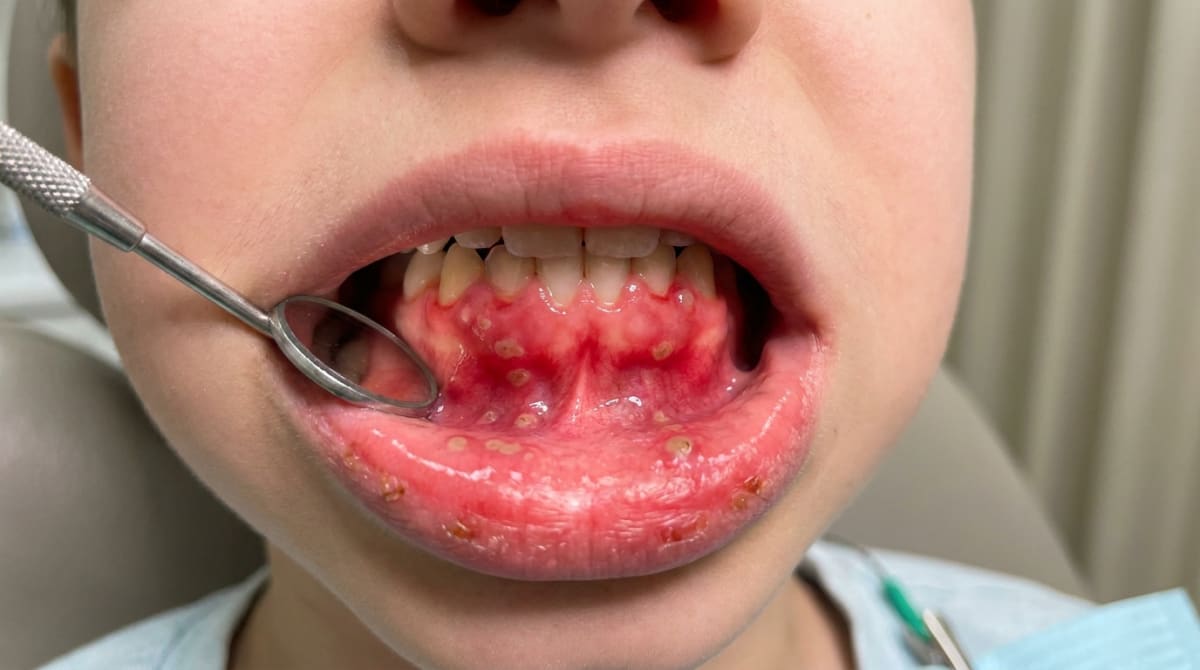
Bright red, swollen gums, this is the hallmark feature. The gingiva is always involved, often with small punched-out erosions along the gum margins. Even before ulcers appear elsewhere, the gums look angry and inflamed.
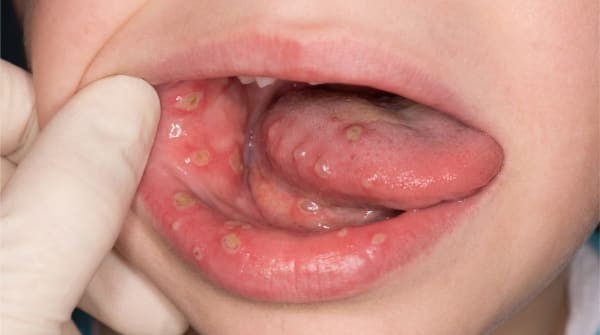
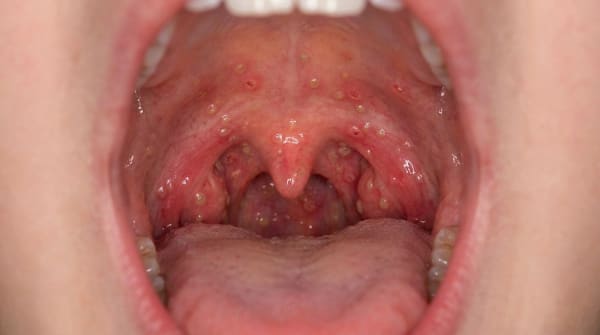
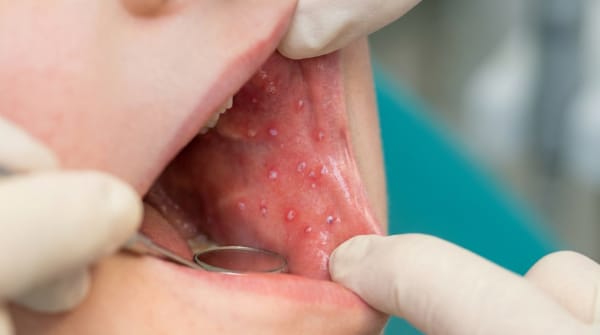
Multiple small ulcers scattered across any mucosal surface, tongue, palate, inside the cheeks, lips and gums. They start as pinhead-sized blisters that quickly burst, leaving shallow ulcers covered by a yellowish or greyish film and ringed by a red halo.
Coalescing larger ulcers as adjacent sores merge into bigger, irregular shapes.
Crusted lesions on the lips and sometimes small blisters on the perioral skin.
Tender, swollen lymph nodes under the jaw and in the neck.
What it feels like
The mouth is genuinely painful. Eating, drinking, and even talking can be uncomfortable, and dehydration is a real concern in young children who refuse fluids. Fever, headache, malaise, irritability and loss of appetite typically appear before or alongside the ulcers. In adults the systemic symptoms, fever, fatigue, sore throat, can be debilitating and may take weeks to fully resolve.
A key distinguishing feature: unlike recurrent cold sores, primary herpetic gingivostomatitis affects the entire mouth, not just the lips, and is accompanied by significant fever and feeling unwell.
What an X-ray might show
Primary herpetic gingivostomatitis is a soft-tissue, viral condition. X-rays play no role in diagnosis or management.
What happens at the dentist?
The diagnosis is usually clinical, the combination of fever, swollen red gums, widespread oral ulcers and tender lymph nodes in a child or young adult is fairly distinctive. At ArtSmiles, a dentist or GP may:
Take a careful history, recent exposure to someone with a cold sore, age of onset, time since symptoms started.
Examine the mouth, looking for the characteristic gingival inflammation alongside vesicles or ulcers across multiple surfaces, including keratinised mucosa (gums, hard palate) which rules out aphthous ulcers.
Check the lymph nodes and temperature.
Order laboratory tests only if the diagnosis is uncertain, viral swab for PCR is the most sensitive method, although a Tzanck cytology smear (a quick microscope test on cells from a fresh blister) from a fresh blister can show characteristic multinucleated giant cells. Viral culture and serology (blood tests for antibodies) are less commonly used in routine practice.
Consider biopsy only in atypical or persistent cases, particularly in immunocompromised patients where lesions can become chronic.
Referral to a paediatrician or specialist may be appropriate if the patient is severely dehydrated, immunocompromised, or if the illness is not following the expected course.
Is this serious?
🟡 In a healthy child or adult, primary herpetic gingivostomatitis is uncomfortable but self-limiting. Mild cases resolve within 5 to 7 days; more severe cases take up to 2 weeks. Healing occurs without scarring.
The main concerns are:
Dehydration, the most common complication, particularly in small children who refuse to drink because of mouth pain. This is occasionally severe enough to require admission for intravenous fluids.
Spread to other sites, the virus can be inadvertently transferred to the eyes (causing a painful eye infection that can damage vision), fingers (herpetic whitlow, a herpes blister on a fingertip), or genitals by touching the mouth and then another body site.
Severe disease in immunocompromised patients, those on chemotherapy, with HIV, or after organ transplant can develop extensive, prolonged or even disseminated infection (spread widely through the body).
Rare complications, including encephalitis (brain inflammation), meningitis, pneumonitis (lung inflammation) or, very occasionally, spread to the facial nerve causing a brief weakness on one side of the face (similar to Bell's palsy).
Once the primary infection resolves, the virus remains latent for life. Approximately 20 to 40% of people who have had a primary infection will go on to experience recurrent cold sores (herpes labialis).
If a child or adult has widespread mouth ulcers with high fever, struggles to drink, or symptoms have lasted more than two weeks, it's worth booking an assessment.
Could it be something else?
Several conditions can produce mouth ulcers and fever, and a careful clinical examination usually distinguishes them. The textbooks list the following differentials:
Recurrent (secondary) herpes simplex / cold sores, caused by the same virus, but reactivation rather than first exposure. Lesions are confined to the lips, hard palate and attached gingiva, occur without significant fever or feeling unwell, and the gums are not diffusely inflamed.
Recurrent aphthous stomatitis (canker sores), a common cause of recurring mouth ulcers. Aphthae occur almost exclusively on non-keratinised, movable mucosa (cheeks, floor of mouth, soft palate), are not preceded by blisters, and do not involve the gingiva or cause fever.
Hand-foot-and-mouth disease, a Coxsackie virus infection that also causes fever and oral ulcers in young children. Distinguished by the characteristic vesicular rash on the hands, feet and buttocks, milder oral symptoms, and sparing of the gingiva.
Herpangina, another Coxsackie virus infection. Vesicles and ulcers are confined to the soft palate, tonsillar pillars and tonsils, the front of the mouth and gingiva are spared.
Chickenpox (varicella), can produce oral ulcers alongside its widespread skin rash. The cutaneous distribution and the relatively painless oral lesions help distinguish it.
Herpangina-like ulceration of streptococcal pharyngitis, bacterial throat infection can cause sore throat and fever, but does not produce vesicles preceding ulcers, does not involve the lips or perioral skin, and is confirmed on throat swab.
Acute necrotising ulcerative gingivitis (ANUG / Vincent's infection), also affects young adults with painful gum inflammation, but ulceration is restricted to the gingiva (particularly the tips of the interdental papillae), is not preceded by blisters, and has a characteristic foul odour.
Erythema multiforme, produces larger oral ulcers, usually without a clear vesicular stage, often with crusted, bleeding lips, and frequently involves target lesions on the skin. Less likely to affect the gingiva.
Pemphigus vulgaris, a more chronic blistering condition that can cause widespread oral erosions, but typically affects adults, lacks the acute fever and enlarged lymph nodes (lymphadenopathy), and shows characteristic features on biopsy.
Herpetiform aphthous ulcers, a less common variant of aphthous ulceration with multiple tiny ulcers that can mimic herpes, but again confined to non-keratinised mucosa and without systemic upset.
Streptococcal or gonococcal stomatitis, bacterial infections that can cause oral ulceration, distinguished on swab and clinical features.
How is it treated?
For most healthy patients, treatment is supportive, the body clears the virus on its own, and care focuses on relieving symptoms while the illness runs its course.
At home, supportive measures may include:
Plenty of fluids, cool water, milk, ice blocks or icy poles can be soothing and help maintain hydration. Acidic drinks (orange juice, soft drinks) tend to sting and are best avoided.
A soft, bland diet, yoghurt, custards, mashed potato, scrambled eggs.
Paracetamol (or ibuprofen, if appropriate) for fever and pain, dosed for age and weight.
Gentle oral hygiene, a soft toothbrush, with brushing continued as tolerated.
Bland mouth rinses (such as warm water with a small amount of bicarbonate of soda) for older children and adults.
Rest.
Antiviral medication may be considered if the patient is seen within the first 72 hours of symptoms. Aciclovir (also spelled acyclovir) suspension, used as a rinse-and-swallow, can shorten the illness, reduce viral shedding, ease pain and speed healing, but it must be started early to be effective. Once new lesions stop appearing, antiviral therapy offers little benefit. Newer agents such as valaciclovir and famciclovir are alternatives in adults. The decision to prescribe is made by a dentist, GP or paediatrician.
Topical anaesthetics (such as lidocaine gels) are sometimes used in adults but are generally avoided in young children because of the risk of toxicity if swallowed. Topical benzocaine is also not recommended for children.
Hospital admission is occasionally needed for intravenous fluids if a small child becomes dehydrated, and for intravenous aciclovir in severely immunocompromised patients.
Reducing spread to others is important during the active illness:
Avoid kissing, sharing utensils, cups, drink bottles, dummies, lip balm or toothbrushes.
Wash hands frequently, especially after touching the mouth.
Keep the patient away from newborns, immunocompromised individuals and people with eczema (where HSV can cause severe complications).
Children can usually return to school or childcare once the fever has settled and they can manage food and fluids comfortably.
What's the long-term outlook?
Primary herpetic gingivostomatitis resolves completely within 10 to 14 days for the vast majority of healthy patients. Healing leaves no scars, and the acute illness rarely returns, once you have had the primary infection, you have it for life and develop antibodies.
However, the virus is not eradicated. It travels to the trigeminal nerve ganglion and goes dormant. In around 20 to 40% of people, it will later reactivate as recurrent herpes labialis, the familiar cold sore on the lip, typically triggered by sunlight, stress, fatigue, illness, menstruation or local trauma. Recurrences tend to become less frequent with age.
For most people, the long-term picture is reassuring: a single uncomfortable episode in childhood, occasional cold sores later in life, and no lasting damage. For immunocompromised patients, ongoing antiviral therapy and close follow-up may be needed, as recurrences can be more severe and more frequent.
A note on this article
This article is for educational purposes only and does not constitute a clinical diagnosis. Please consult a registered dental practitioner for assessment and treatment advice.
The cover image above is an AI-generated illustration based on the most common visible features of this condition described in clinical pathology references. It is not a photograph of a real case and should not be used to diagnose or rule out the condition in your own situation. If you are concerned about something you have noticed, please book an assessment with a registered dental practitioner.
References
Regezi, J. A., Sciubba, J. J., & Jordan, R. C. K. (2017). Oral pathology: Clinical pathologic correlations (7th ed.). Elsevier. Chapter 1, Vesiculobullous Diseases (Herpes Simplex Infection), pp. 1 to 6.
Neville, B. W., Damm, D. D., Allen, C. M., & Chi, A. C. (2023). Oral and maxillofacial pathology (5th ed.). Elsevier. Chapter 7, Viral Infections (Herpes Simplex Virus / Acute Herpetic Gingivostomatitis), pp. 229 to 235.
Cawson, R. A., & Odell, E. W. (2017). Cawson's essentials of oral pathology and oral medicine (8th ed.). Elsevier. Chapter 12, Diseases of the Oral Mucosa: Introduction and Mucosal Infections (Primary Herpetic Stomatitis), pp. 206 to 208; and Chapter 5, Gingivitis and Periodontitis (Herpetic Gingivostomatitis), p. 94.
Laskaris, G. (2003). Color atlas of oral diseases (3rd ed.). Thieme. Chapter 15, Viral Infections (Primary Herpetic Gingivostomatitis), pp. 116 to 117.
Frequently asked questions
What is primary herpetic gingivostomatitis?
It is the first encounter with herpes simplex virus type 1 (HSV-1), most often in young children (1-5 years). It causes fever, painful mouth ulcers, very inflamed bleeding gums and tender lymph nodes. The illness typically lasts 7-14 days and most cases resolve on their own.
How is it different from a cold sore?
A cold sore (herpes labialis) is a reactivation of a herpes infection in someone already exposed. It shows as a localised blister cluster on the lip or skin. Primary herpetic gingivostomatitis is the first widespread infection, with mouth ulcers, inflamed gums and systemic symptoms, usually in a young child.
Is it contagious?
Yes, highly. The virus spreads through saliva and direct contact, particularly during the active blister and ulcer phase. Affected children should not kiss others, share drink bottles, or attend childcare while unwell. Hand hygiene and avoiding contact with infants or immunocompromised people is important.
How is primary herpetic gingivostomatitis treated?
Care is mostly supportive: paracetamol, soft cool fluids, encouragement to keep drinking to prevent dehydration, and gentle oral hygiene. Antiviral medication (such as oral aciclovir) shortens the illness if started in the first 72 hours, particularly in children with severe disease, immune compromise or in adults.