Compiled from clinical pathology references. Medically reviewed by Dr Cristian Dunker, Principal Dentist, ArtSmiles Cosmetic Dentistry.
Quick summary
Also called | Measles (rubeola), Koplik spots, morbilli |
How urgent? | 🔴 Serious notifiable infectious disease; suspect measles needs urgent GP review and public health notification |
Common or rare? | Uncommon in countries with high MMR vaccination uptake; still common worldwide |
Who it affects | Mainly unvaccinated children, infants under 12 months, travellers and immunocompromised patients |
Who treats it | GP and public health teams; dentist supports comfort, infection control and vaccination conversations |
Based on | Neville, Cawson, with cross-references in Regezi |
What is it?
Measles (also called rubeola) is a viral illness caused by the measles virus, a member of the paramyxovirus family. It is one of the most contagious viral diseases known. The classic illness has three phases: a prodromal phase with fever, runny nose, cough and red eyes; an eruptive phase with the characteristic red blotchy skin rash starting on the face; and a recovery phase as the rash fades. The oral marker of measles is the appearance of Koplik spots, tiny white spots inside the cheeks that appear one to two days before the skin rash and are pathognomonic (almost diagnostic on their own) for measles.
Who tends to get it?
In Australia, measles is now uncommon thanks to widespread MMR vaccination, but cases continue to occur, particularly in:
Unvaccinated children, especially infants too young for their first MMR dose.
Travellers, returning from areas with active measles outbreaks.
Adults born after 1966 who have not had two documented doses of measles-containing vaccine.
Communities with low vaccination uptake, where outbreaks can spread quickly.
Immunocompromised patients, in whom the disease can be much more severe.
Globally, measles remains a significant cause of childhood illness and death in countries with limited vaccination access.
What causes it?
Measles is caused by the measles virus, transmitted through:
Airborne droplets, when an infected person coughs, sneezes or simply breathes.
Direct contact, with respiratory secretions.
Contaminated surfaces, where the virus can survive for up to two hours.
The virus enters the body through the lining of the airways and the conjunctiva of the eye, then spreads through the bloodstream to the rest of the body, including the lining of the mouth. A patient with measles is contagious from about four days before the rash appears to about four days after, which means many people are infectious before they realise they have measles. This is one reason Koplik spots are so useful: they appear before the rash and allow earlier isolation.
How does it develop?
The disease unfolds over about two weeks:
Day 0, virus is inhaled or otherwise transmitted.
Days 1 to 10, virus multiplies silently in the respiratory lining and lymph nodes (incubation period).
Days 10 to 11, fever, runny nose, dry cough and red eyes begin (the prodrome).
Days 11 to 13, Koplik spots appear inside the cheeks; the patient is highly contagious.
Days 13 to 17, the red blotchy skin rash starts on the face and spreads downward; Koplik spots fade.
Days 17 to 21, the rash fades and the patient gradually recovers.
Most patients recover fully. Complications can include ear infections, pneumonia, croup, diarrhoea and, rarely, encephalitis (inflammation of the brain).
What might you notice?
What it looks like
Common features of early measles include:
Fever, often 39 to 40 degrees Celsius.
Runny nose and dry cough.
Red, watery eyes, with sensitivity to light (conjunctivitis).
Tiredness and loss of appetite.
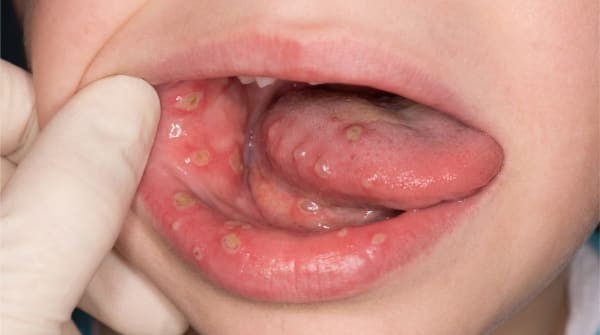
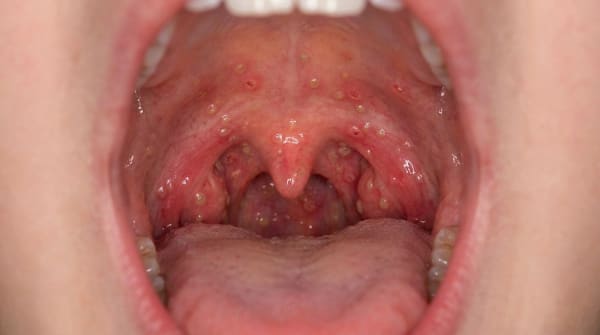
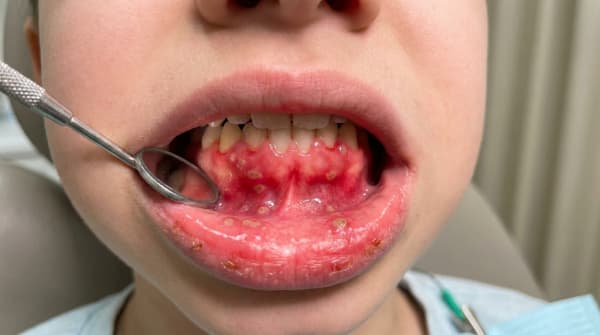
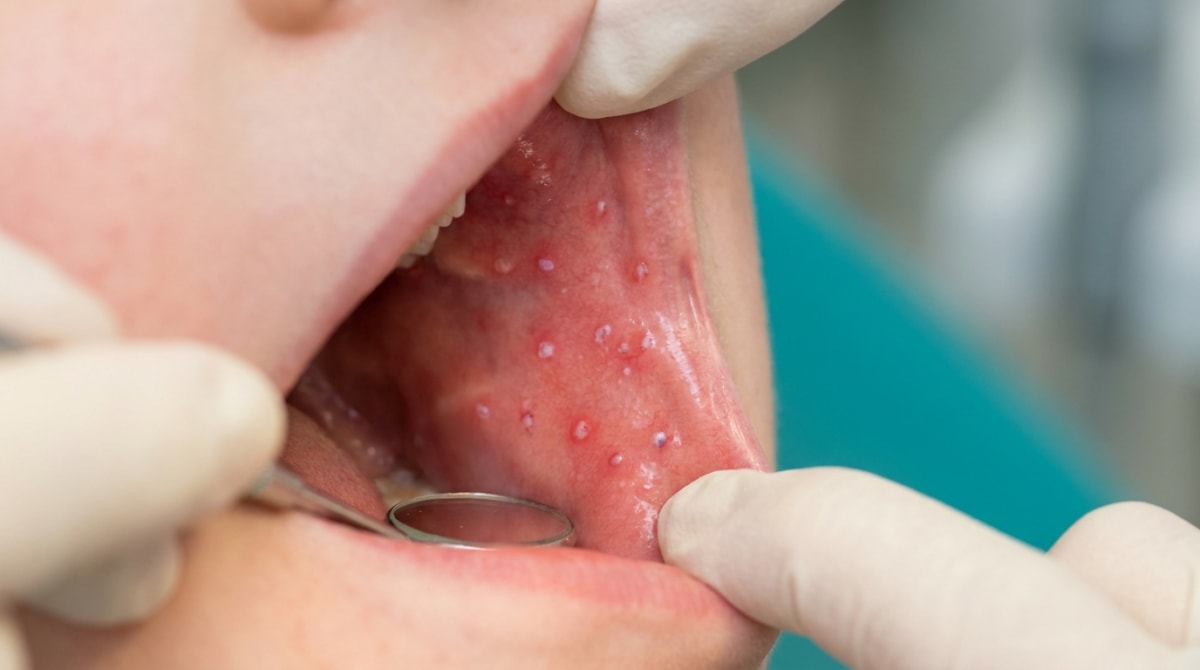
Tiny white spots inside the cheeks (Koplik spots), usually 1 to 2 mm across, with a red rim, best seen with a torch on the inner cheek opposite the lower molars.
A few days later, a red blotchy rash starting on the face and spreading downward.
What it feels like
A child with early measles feels unwell, with fever, sore eyes, blocked nose, dry cough and a general "off colour" appearance. Babies are typically irritable and feed less. The mouth ulcers themselves are not particularly painful, but the cough, fever and red eyes are uncomfortable. Once the rash appears, the patient often looks and feels worse before slowly recovering.
What an X-ray might show
Dental X-rays are not relevant to diagnosing measles. Hospital imaging is occasionally used to assess complications such as pneumonia, but this sits with the medical team.
What happens at the dentist?
Measles is diagnosed and treated by the GP and public health team, not the dentist. The dental role is mainly to recognise the warning signs and protect other patients:
Recognising the warning signs, a feverish child with red eyes, runny nose and unusual mouth spots needs to be triaged carefully and not seen in routine dental rooms.
Cancelling and redirecting, suspect cases should not be brought into the practice; they should contact their GP or the public health line by phone.
Infection control, measles is airborne, so additional precautions and isolation of suspect cases are needed.
Routine dental care during recovery, patients can return to regular dental visits once they are no longer infectious and feeling well, usually two to three weeks after the rash.
Vaccination support, we are happy to answer general questions about how illness affects dental care and encourage routine childhood and adult MMR vaccination through your GP.
Is this serious?
🔴 Yes. Measles is a serious viral illness, particularly for:
Babies under 12 months, who are too young for full vaccination.
Pregnant women, in whom infection can cause miscarriage or premature labour.
Immunocompromised patients, in whom the disease can progress rapidly.
People with malnutrition or vitamin A deficiency.
Complications can include pneumonia, ear infections, encephalitis (inflammation of the brain) and, very rarely, a delayed brain disease called subacute sclerosing panencephalitis (SSPE) appearing years after infection. Worldwide, measles still causes tens of thousands of deaths each year, mostly in children. In a vaccinated population, most cases recover well. Vaccination remains the most powerful tool to prevent serious illness in the community.
Could it be something else?
Other conditions can produce mouth spots or rashes that may be confused with early measles:
Hand, foot and mouth disease, small mouth ulcers with a rash on hands and feet, caused by Coxsackie virus.
Primary herpetic gingivostomatitis, extensive painful mouth ulcers and red gums, usually with high fever, in a young child.
Roseola, high fever followed by a pink rash, without Koplik spots.
Rubella (German measles), milder fever, pink rash and lymph node swelling, without Koplik spots.
Scarlet fever, sore throat, strawberry tongue, sandpaper-like rash.
Drug reaction, rash without preceding cough, runny nose or red eyes.
Aphthous ulcers, traumatic ulcers, or oral thrush, mouth findings without systemic illness.
A combination of clinical examination, vaccination history, exposure history and (when needed) blood tests confirms measles. Suspected cases must be notified to public health so contacts can be traced and protected.
How is it treated?
There is no specific antiviral cure for measles. Treatment is supportive and medical:
Medical and public health care:
Rest, fluids and paracetamol, to manage fever and discomfort.
Vitamin A supplementation, recommended by the World Health Organization, particularly in severe cases or where vitamin A deficiency is common.
Isolation, from non-immune contacts during the infectious period.
Treatment of complications, antibiotics for secondary ear or chest infections; hospitalisation for severe cases.
Public health measures, contact tracing and post-exposure vaccination or immunoglobulin for vulnerable contacts.
Vaccination, two doses of MMR vaccine give about 99% protection; first dose at 12 months in Australia and second at 18 months under the National Immunisation Program.
Dental support:
Soft, bland diet while the mouth is sore.
Gentle oral hygiene with a soft-bristled toothbrush.
Hydration with cool, soothing fluids.
Routine dental care once the infectious period has passed and the patient feels well again.
A patient-centred approach matters here. Suspected measles in a child is worrying for parents. Clear, calm guidance to contact the GP or public health line first, and a friendly door for routine dental care later, are themselves part of effective care, values that sit at the heart of our clinical philosophy.
What's the long-term outlook?
For most healthy people who recover from measles, the long-term outlook is good. Most patients develop lifelong immunity after infection. A small risk of complications persists for years in some patients, particularly the very rare SSPE. The community-level outlook depends on vaccination uptake: outbreaks in communities with low vaccination rates remain a public health concern, and any patient considering travel to an outbreak area should check that their vaccinations are up to date with their GP.
A note on this article
This article is for educational purposes only and does not constitute a clinical diagnosis. Please consult a registered dental practitioner for assessment and treatment advice.
The cover image above is an AI-generated illustration based on the most common visible features of this condition described in clinical pathology references. It is not a photograph of a real case and should not be used to diagnose or rule out the condition in your own situation. If you are concerned about something you have noticed, please book an assessment with a registered dental practitioner.
References
Neville, B. W., Damm, D. D., Allen, C. M., & Chi, A. C. (2023). Oral and maxillofacial pathology (5th ed.). Elsevier. Chapter 7, Viral Infections: Measles (Rubeola), including Koplik spots and oral involvement.
Cawson, R. A., & Odell, E. W. (2017). Cawson's essentials of oral pathology and oral medicine (8th ed.). Elsevier. Chapter 17, Viral Infections: cross-reference for measles and oral manifestations.
Regezi, J. A., Sciubba, J. J., & Jordan, R. C. K. (2017). Oral pathology: Clinical pathologic correlations (7th ed.). Elsevier. Chapter 1, Vesiculobullous Diseases: cross-reference for measles.
Frequently asked questions
What are Koplik spots?
Koplik spots are tiny blue-white spots on a bright red base that appear on the inside of the cheeks during the very early stage of measles. They are a pathognomonic sign, meaning that when present, they are highly specific for measles, often appearing a day or two before the characteristic skin rash.
Why are Koplik spots important to recognise?
Because they appear before the skin rash, Koplik spots allow measles to be diagnosed and isolation started during the most contagious phase. Identifying them early helps protect vulnerable contacts (unvaccinated infants, immunocompromised people, pregnant women) from exposure to a serious, highly contagious viral infection.
Is measles still a concern in Australia?
Yes. Although routine MMR vaccination has greatly reduced measles in Australia, sporadic cases continue to be imported, and outbreaks can occur in pockets of low vaccination coverage. Measles can cause serious complications including pneumonia, encephalitis and rare delayed neurological disease.
What should I do if I see white spots on the inside of my child's cheek with a fever?
See a doctor promptly, and let the clinic know in advance so they can isolate your child on arrival. Avoid public transport and crowded places. The doctor can confirm the diagnosis, arrange notification to public health authorities, and advise on care, isolation and contact tracing.