Compiled from clinical pathology references. Medically reviewed by Dr Cristian Dunker , Principal Dentist, ArtSmiles Cosmetic Dentistry.
Quick summary
Also called | Coxsackie viral pharyngitis, mouth-and-throat blister disease, Zahorsky's disease (historical) |
How urgent? | 🟡 Worth a check-up, usually self-limiting, but a clinician should confirm the diagnosis and rule out other causes of mouth ulcers in children |
Common or rare? | Common in children, especially in summer and early autumn |
Who it affects | Mostly children aged 3 to 10; occasionally young adults |
Who treats it | General dentist or GP; specialist referral rarely needed |
Based on | Regezi, Neville, Cawson and Laskaris |
What is it?
Herpangina is a short, viral illness that causes a crop of small, painful ulcers at the back of the mouth and throat. It mostly affects children, comes on suddenly with a fever and sore throat, and almost always settles by itself within about a week.
Despite the name, herpangina has nothing to do with the herpes virus or with angina (heart pain). It is caused by a different family of viruses called enteroviruses, most often a group known as Coxsackie A.
Who tends to get it?
Herpangina is largely a childhood illness. Most cases occur in children aged 3 to 10, though infants, teenagers and young adults can also be affected. The condition tends to appear in clusters, with small outbreaks in childcare centres, schools and households.
In Australia and other temperate climates, cases peak in the warmer months, summer and early autumn. Crowded settings and close contact between children help the virus spread, which is why nurseries and primary schools are common sites of outbreak.
Many infections are mild or even silent. Siblings and other close contacts of an affected child may catch the virus without ever developing the classic mouth ulcers.
What causes it?
Herpangina is caused by viruses in the enterovirus family. The most common cause is a group of viruses called Coxsackie A. A few other related enteroviruses (including some Coxsackie B types, certain echoviruses and enterovirus 71) can produce the same picture, but for everyday care the distinction rarely matters.
The virus spreads in three main ways:
Through saliva and respiratory droplets when a child coughs, sneezes, talks or shares cups and cutlery
Through the faecal-oral route, particularly in younger children still in nappies or learning hand-washing
Through contact with surfaces and toys that have been contaminated
Frequent hand-washing, especially after nappy changes and before meals, is the simplest way to slow the spread during an outbreak. Once a child has had a particular strain, they generally develop immunity to that strain, but they can still catch other enterovirus types in future seasons.
How does it develop?
After a child is exposed, there is a quiet incubation period (the silent stretch before symptoms appear) of around 4 to 7 days while the virus multiplies. The virus then targets cells lining the soft palate, tonsils and back of the throat.
A helpful way to picture it is to think of the lining of the mouth as a tiled wall. The virus slips inside the surface tiles (the epithelial cells) and uses them as factories to make more virus. As the cells fill up and burst, tiny blisters form. Those blisters are fragile and quickly break open, leaving small, shallow ulcers with a red rim.
At the same time, the immune system mounts a response. This is what produces the sudden fever, sore throat and feeling of being unwell that often appears before the parent ever sees the mouth lesions.
What might you notice?
What it looks like
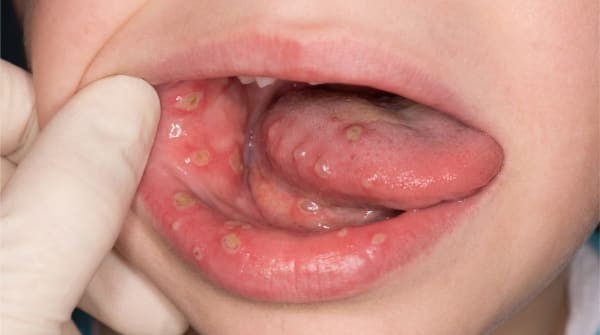
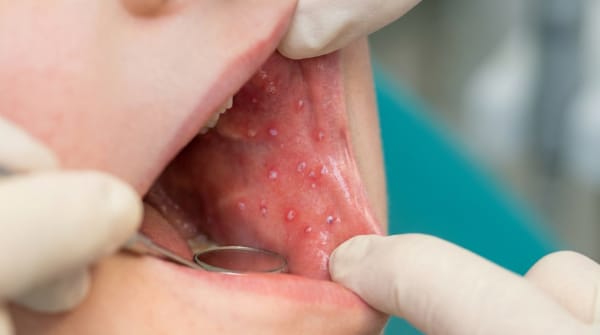
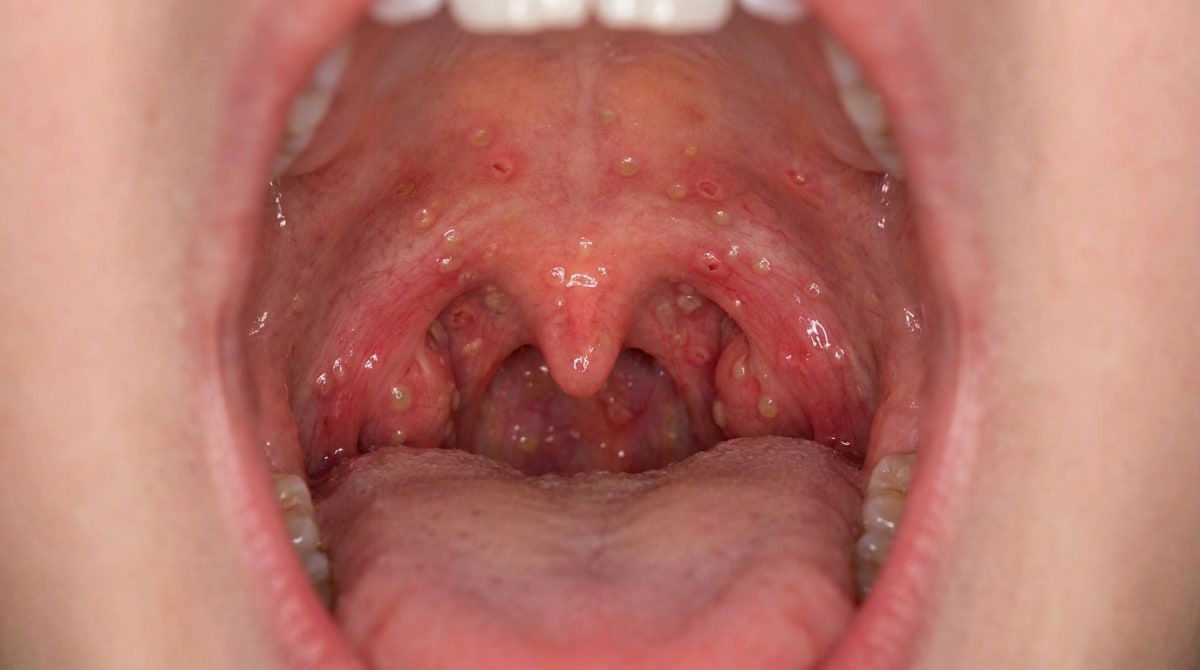
The most distinctive feature of herpangina is where the ulcers appear. They are confined to the back of the mouth, the soft palate, the uvula (the small tag of tissue hanging at the back), the tonsillar pillars (the tissue arches either side of the tonsils) and the back wall of the throat. The lips, gums, tongue tip and front of the cheeks are usually spared.
A parent peering inside is most likely to see:
A small number of lesions, typically two to six, sometimes more
Tiny red spots that quickly turn into fragile blisters
Shallow, round ulcers about 2 to 4 mm across, with a yellow or greyish base and a red halo
A diffusely red, inflamed-looking throat behind the ulcers
Unlike some other childhood mouth viruses, there is usually no rash on the body, hands or feet.
What it feels like
Herpangina tends to come on quickly. A previously well child may suddenly develop:
A high fever, often between 38°C and 40°C
A sore throat and pain on swallowing (dysphagia)
Headache, malaise and loss of appetite
Sometimes cough, a runny nose, tummy pain, vomiting or muscle aches
Younger children may simply seem off-colour and refuse food and drink because swallowing hurts. Drooling, irritability and reluctance to eat are common. The systemic symptoms usually settle within a few days, while the ulcers may take 7 to 10 days to heal completely.
What an X-ray might show
Herpangina is a soft-tissue, viral condition. X-rays play no role in diagnosis or management.
What happens at the dentist?
Most children with herpangina are seen by their GP, but dentists at ArtSmiles also encounter it, particularly when a parent rings worried about mouth ulcers or refusal to eat.
Diagnosis is almost always made on history and a simple visual examination. Your dentist or doctor may:
Ask about the timing of the fever and sore throat, recent contact with other unwell children, and the season
Look carefully inside the mouth with a good light, focusing on the soft palate, uvula and tonsillar area
Check the lips, gums and tongue tip, these are typically clear in herpangina, which is an important clue
Examine the hands and feet to look for any rash that might suggest hand-foot-and-mouth disease instead
Feel the lymph nodes in the neck
Laboratory testing is rarely needed. In atypical or severe cases, a throat swab can be sent for reverse transcription PCR (a sensitive lab test for viruses), which is the most sensitive test for enteroviruses. Specialist referral is only considered if the child is very unwell, dehydrated, or if there are unusual neurological or cardiac symptoms.
Is this serious?
🟡 Usually mild and self-limiting. For the vast majority of children, herpangina is an unpleasant week followed by full recovery, with no long-term consequences.
The main practical risks come from the soreness itself. Children who refuse to drink because swallowing hurts can become dehydrated quite quickly, particularly in warm weather. Keeping fluids up is the single most important thing parents can do.
Very rarely, certain enterovirus strains, most notably enterovirus 71, have been linked to more serious complications such as meningitis, encephalitis (brain inflammation), inflammation of the heart muscle, or sudden muscle weakness or paralysis. Warning signs that warrant urgent medical review include a fever above 39°C that won't settle, fever lasting more than three days, persistent vomiting, marked drowsiness or lethargy, signs of dehydration, or any new muscle weakness or stiffness in the arms, legs or neck.
If your child has had mouth ulcers, fever or refusal to drink for more than two weeks, or seems to be getting worse rather than better, it's worth booking an assessment.
Could it be something else?
Several other conditions can cause mouth ulcers and a sore throat in children. The pattern of where the ulcers sit and what else is going on usually allows a clinician to tell them apart.
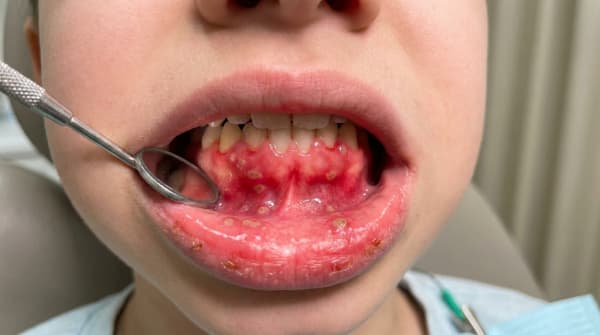
Primary herpetic gingivostomatitis, the first encounter with the herpes simplex virus, also common in young children. Like herpangina, it produces fever, malaise and small ulcers, but the gums are typically swollen, red and bleed easily, and ulcers spread across the whole mouth, including the lips, tongue tip and front of the cheeks. Herpangina spares these areas.
Hand-foot-and-mouth disease, caused by closely related Coxsackie A viruses (most often A16) and enterovirus 71. The mouth ulcers can look identical, but children also develop a vesicular rash on the hands, feet, and sometimes buttocks. Herpangina has no skin rash.
Acute lymphonodular pharyngitis, considered by many to be a variant of herpangina, with the same viruses and the same location. It causes small yellow-pink lumps (lymphoid nodules) at the back of the throat instead of ulcers, and these resolve without ever blistering.
Recurrent aphthous ulcers (canker sores), small painful ulcers that recur over months or years. Unlike herpangina, they tend to occur on movable, non-keratinised mucosa (lip, cheek, floor of mouth), are not associated with fever, and come and go in episodes.
Herpetiform aphthous ulcers, a less common form of recurrent ulcer that produces clusters of tiny ulcers. They lack the seasonal pattern, fever and posterior-mouth distribution of herpangina.
Streptococcal pharyngitis (strep throat), also produces a sudden sore throat and fever, but typically without the small palate ulcers, and often with white tonsillar exudate. A throat swab settles the question.
Varicella (chickenpox), can cause a few mouth ulcers, but the diagnosis is usually obvious from the widespread itchy skin rash with small fluid-filled blisters (vesicles) at different stages.
Measles (rubeola), produces fever and oral changes (Koplik spots, tiny blue-white grains on the cheek lining), but is followed within days by the classic head-to-toe rash. Measles is now uncommon where vaccination uptake is good.
Erythema multiforme, causes crusted, bleeding lips and target-shaped lesions on the skin, which are not features of herpangina.
How is it treated?
There is no specific antiviral treatment for herpangina, and none is usually needed. Care is aimed at keeping the child comfortable and well-hydrated while the body clears the virus.
At home, helpful measures may include:
Plenty of cool, soothing fluids, water, milk, ice blocks or icy poles can be easier than warm drinks
Soft, bland foods such as yoghurt, custard, mashed potato or smooth soup; avoiding salty, acidic or spicy foods that sting
Paracetamol or ibuprofen at age-appropriate doses to bring down the fever and ease throat pain (aspirin should not be used in children). Please discuss with the doctor before medicating your child, for proper diagnosis.
Bland mouth rinses such as warm saltwater or a sodium bicarbonate rinse, in older children who can spit
Rest, and keeping the child away from other children, childcare and school until the fever has settled and they feel well enough to return
A dentist or GP may recommend:
Topical anaesthetic gels to numb the most painful ulcers before meals, in selected cases
Review if pain prevents drinking, as occasional children need short admission for rehydration
Reassurance and a clear explanation, particularly for first-time parents
Antibiotics do not help, because herpangina is viral. They are only considered if a separate bacterial infection develops on top.
What's the long-term outlook?
The outlook is excellent. Herpangina is self-limiting: the systemic symptoms usually fade within a few days, and the ulcers heal in 7 to 10 days without scarring. Once the immune system has dealt with the particular strain, lifelong immunity to that strain generally follows.
Because there are many enterovirus types, a child can occasionally have herpangina again in a later season, caused by a different strain. Each episode tends to follow the same mild pattern. Long-term complications are rare, and most children are back at school and eating normally within one to two weeks.
A note on this article
This article is for educational purposes only and does not constitute a clinical diagnosis. Please consult a registered dental practitioner or doctor for assessment and treatment advice.
The cover image above is an AI-generated illustration based on the most common visible features of this condition described in clinical pathology references. It is not a photograph of a real case and should not be used to diagnose or rule out the condition in your own situation. If you are concerned about something you have noticed, please book an assessment with a registered dental practitioner.
References
Regezi, J. A., Sciubba, J. J., & Jordan, R. C. K. (2017). Oral pathology: Clinical pathologic correlations (7th ed.). Elsevier. Chapter 1, Vesiculobullous Diseases (Herpangina), pp. 9 to 10.
Neville, B. W., Damm, D. D., Allen, C. M., & Chi, A. C. (2023). Oral and maxillofacial pathology (5th ed.). Elsevier. Chapter 7, Viral Infections (Enteroviruses: Herpangina, Hand-Foot-and-Mouth Disease, Acute Lymphonodular Pharyngitis), pp. 244 to 246.
Cawson, R. A., & Odell, E. W. (2017). Cawson's essentials of oral pathology and oral medicine (8th ed.). Elsevier. Chapter 12, Diseases of the Oral Mucosa: Mucosal Infections, pp. 209 to 210, 219.
Laskaris, G. (2003). Color atlas of oral diseases (3rd ed.). Thieme. Chapter 15, Viral Infections (Herpangina), pp. 120 to 121.