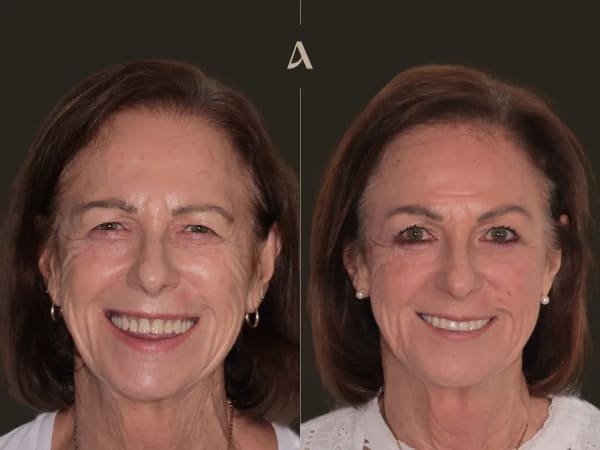
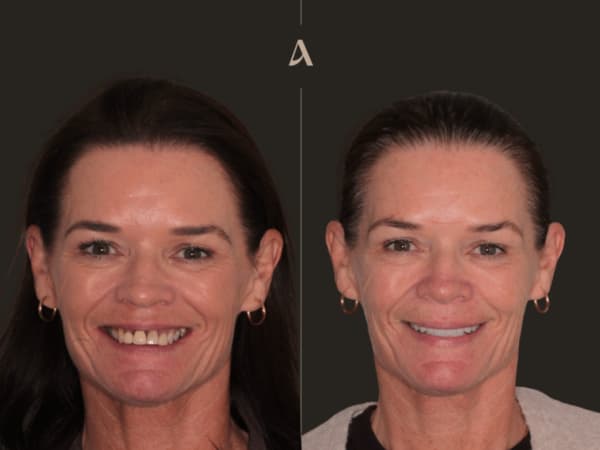
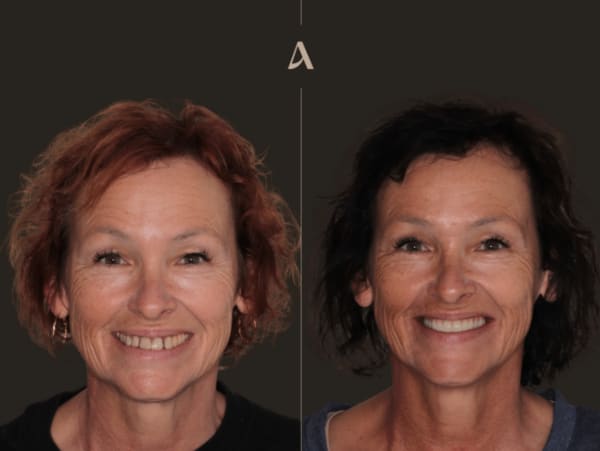
When people look at a before and after photo of a full mouth rehabilitation, they usually notice the teeth first. What they are actually reacting to is the face. The lower third of the face has changed height, the lips sit differently, the corners of the mouth have lifted, and the chin no longer crowds up towards the nose. Almost none of that comes from the colour of the ceramic. It comes from a single planning decision made long before any tooth was prepared: where to set the vertical dimension.
Vertical dimension of occlusion, usually shortened to VDO, is the height of the lower face when the back teeth are together. It is not a fixed number you are born with and keep. Years of grinding, acid wear, broken down back teeth or long term denture wear can quietly take millimetres off it. Because the loss happens slowly, most patients never connect the way their face has changed with what their teeth have been doing.
This article explains why we sometimes rebuild a bite at a greater height, when that decision is justified and when it is not, and what the research says about how safe it is. Then we walk through three real cases treated at ArtSmiles in Southport, each solved with a completely different set of restorations, all sharing the same underlying move. All three patients gave consent for their photographs to be published.
What Vertical Dimension Actually Means
Think of the lower jaw as hanging from the skull on a hinge. The teeth decide how far it can close. When your back teeth meet, the jaw stops, and that stopping point sets the distance between your nose and your chin. That distance is the occlusal vertical dimension.
There is also a resting position, where the jaw muscles are relaxed and the teeth are slightly apart. The small gap between resting position and the closed position is called freeway space, and it is normally around 2 to 4 mm. When teeth wear down or back teeth are lost, the jaw closes further before it meets resistance. Freeway space increases, the lower face shortens, and the whole facial balance shifts.
The important part is that teeth do not simply get shorter and leave a gap. As enamel wears, the teeth and the bone that holds them often drift upwards to keep contact, a process called compensatory eruption. That is why a heavily worn dentition can still bite together perfectly well while the crowns look like stubs. It also explains why there is often very little room left to restore anything. Rebuilding those teeth at their original height without opening the bite would mean either aggressive tooth reduction or restorations too thin to survive.
Why the Bite Loses Height
Grinding and tooth wear
Tooth wear is common and it accumulates with age. A systematic review by Van't Spijker and colleagues found the predicted proportion of adults with severe tooth wear rises from about 3% at age 20 to about 17% at age 70, with men affected more often than women. Grinding, known clinically as bruxism, accelerates it. Acid from reflux, diet or vomiting softens enamel so that normal chewing wears it away faster. Most patients with significant wear have more than one cause running at the same time.
Losing back teeth
Molars and premolars carry the load and hold the bite open. When several are lost or broken down and are not replaced, the remaining teeth take a force they were not designed for. The front teeth get pushed forward and worn, and the jaw closes further. This pattern is often called posterior bite collapse, and it is one of the clearest situations where the vertical dimension has genuinely been lost rather than simply looking low.
Long term denture wear
Dentures wear too. Acrylic teeth abrade, the ridge underneath resorbs, and the prosthesis settles. A denture that was correct at delivery can be several millimetres short a decade later, and patients adapt to the change without noticing it. This is one of the reasons the facial change in long term denture wearers can be so pronounced.
What a Collapsed Bite Does to the Face
The soft tissue of the lower face is draped over the teeth and jaws. Change the underlying height and the drape changes with it. The pattern is consistent enough that it is recognisable across patients:
The chin appears closer to the nose and the lower face looks compressed
The lips lose the support behind them and look thinner, particularly the upper lip
Folds from the nose to the corners of the mouth deepen
The corners of the mouth turn down and can crease, which sometimes leads to persistent cracking and irritation at the corners
The chin rotates forward and upward, giving a stronger, more prominent chin profile
Very little tooth shows when smiling, because there is very little tooth left to show
This is not just clinical impression. A 2025 study in the Journal of Oral Rehabilitation by Kim and colleagues tested it directly. Forty participants had their vertical dimension raised in 2, 4, 6 and 8 mm increments, with 3D facial scans taken at each level and sixty evaluators judging the results. Total face height, lower face height and nasolabial angle all increased measurably, while lip width and lip height decreased. A 4 mm increase was the point at which the change became most clearly perceptible to observers.
That gives a useful sense of scale. The facial change patients notice in a rehabilitation photograph is usually the product of a few millimetres, not a dramatic reconstruction.
When We Decide to Increase the Vertical Dimension
Increasing the bite is not a cosmetic add-on and it is not something to do because a face looks short. It is a restorative decision with specific triggers. Calamita, Coachman, Sesma and Kois set out the three that matter: creating space for the planned restorations, harmonising the relationship between the teeth and the face, and improving the way the bite functions.
In practice, the space argument does most of the work. If a patient has 2 mm of worn down tooth structure and needs a crown that requires 1.5 mm of material thickness, the material has to come from somewhere. Opening the bite creates that room without destroying what is left of the tooth. This is exactly the situation in a full mouth rehabilitation, where the same decision has to work across every tooth in both arches at once.
How much can the bite be opened
Abduo and Lyons, writing in the Australian Dental Journal, reviewed this question and concluded that the increase should always be the minimum that solves the restorative problem, though an increase of up to 5 mm can be justified when that is what the restorative material genuinely requires. They also make a point worth repeating to patients: the various techniques described for measuring how much height has been lost lack consistency and reliability, so the decision is driven by what the restorations need rather than by a formula.
Is it safe
This is the question patients ask most, usually phrased as a worry about jaw joints. The evidence is reassuring. A systematic review by Abduo in Quintessence International screened 902 studies and concluded that where it is indicated, a permanent increase in vertical dimension is a safe and predictable procedure. Some patients report mild symptoms during the adjustment period, but these were self limiting. Fixed restorations produced more predictable adaptation than removable ones.
Moreno-Hay and Okeson reviewed the specific question of whether changing the vertical dimension causes temporomandibular disorders. Their conclusion was that the chewing system adapts rapidly to moderate changes, and there is no indication that a permanent change in vertical dimension produces long lasting jaw joint problems. Where symptoms do appear they tend to be mild, transient and self resolving.
Testing the new bite before committing to it
None of the above means the height should be guessed and then cemented in porcelain. The height is planned from facial photographs, records of the jaw relationship and a wax up, then trialled. Depending on the case, that trial takes the form of a removable splint, bonded temporary restorations, or a set of provisional crowns and bridges the patient wears while everything is assessed. Speech, comfort, chewing and appearance are all reviewed at the trial height, and the height is adjusted if it needs to be. Only then is it transferred into the definitive restorations. For patients who grind, a protective night splint is made at the end so the new restorations are not exposed to the same forces that destroyed the original teeth. That is part of ongoing bruxism management, not an optional extra.
Case 1: Zirconia Veneers, Crowns and Bridges with an Increased Vertical Dimension
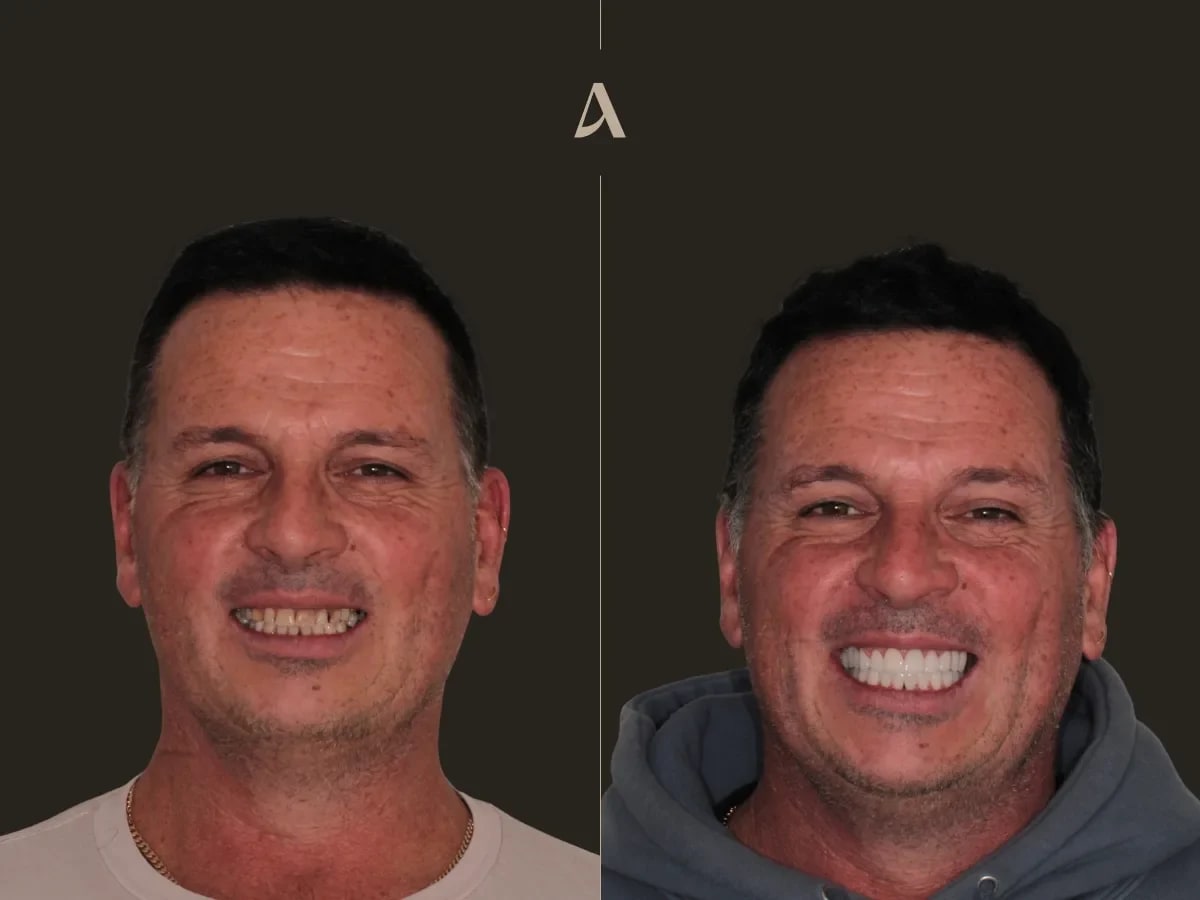
Before and after full mouth rehabilitation with zirconia veneers, crowns and bridges at an increased vertical dimension. Total treatment time one month. Published with patient consent. Individual results vary.
This patient presented with the classic picture of long standing grinding. The teeth were short and squared off, the edges had lost their natural contour, and the smile showed a narrow band of tooth with dark corridors at the sides. Look at the lower face in the before photograph and you can see how little vertical room the smile has to work with. The lips are close together, the upper lip is flat, and the whole lower third looks compressed against the rest of the face.
The wear itself was the reason there was no space to restore. Rebuilding those teeth to a natural length at the existing bite height was not possible without removing sound tooth structure to create room, which would have made the problem worse.
The plan. The bite was reopened at a planned height to create restorative space in both arches at once. From there the arches were rebuilt with a combination of zirconia veneers on teeth where enough structure remained, and crowns and bridges where teeth were more heavily broken down or missing. Zirconia was chosen deliberately for a patient with this grinding history, because the restorations had to tolerate heavy loading over time.
The result. The most obvious change is the smile itself, which is now broad and full and shows a proper display of tooth. The change worth pointing out is above and around it. The lower face is longer, the upper lip has support behind it and sits fuller, and the smile now reaches out to the corners of the mouth instead of stopping short. The face reads as more relaxed, and that is a consequence of geometry rather than expression.
Case 2: Upper and Lower Overdentures for a Severe Grinder
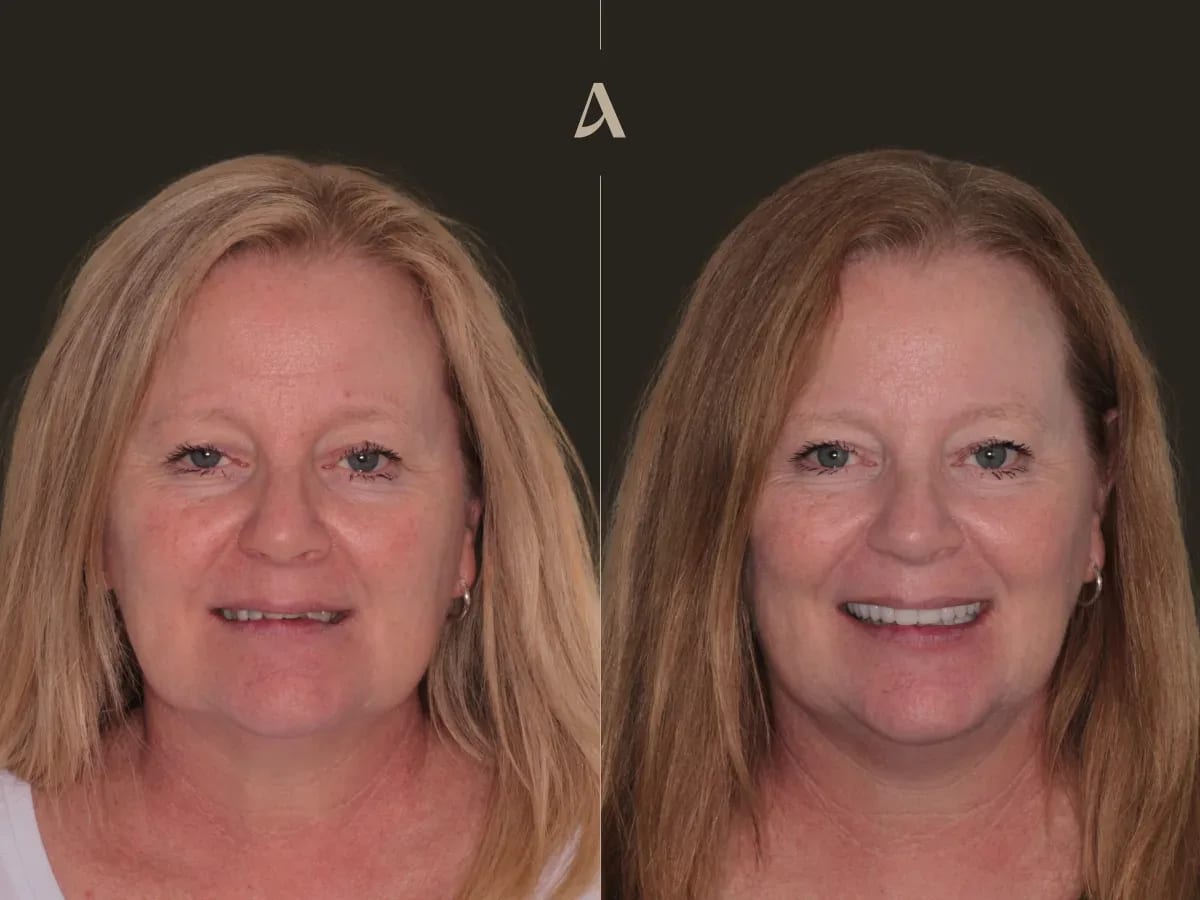
Before and after upper and lower overdentures with a restored vertical dimension. Total treatment time four months. Published with patient consent. Individual results vary.
This case shows the same principle at the other end of the spectrum. The patient had a long history of severe grinding, and the loss of posterior teeth meant there was nothing left holding the bite open at the back. The before photograph shows what that does. There is barely any tooth visible, the lips have rolled inwards and lost their fullness, the corners of the mouth turn down, and the distance from nose to chin has collapsed. The chin sits high and forward, and a deep crease has formed above it.
This is the appearance patients describe as looking older than they feel, and it is very difficult to address with anything other than restoring the height itself. Skincare and cosmetic injectables work on the surface. The problem here is structural and sits underneath.
The plan. Upper and lower overdentures were made at a corrected vertical dimension. An overdenture is retained and stabilised rather than simply resting on the gum, which matters for a patient with this grinding history because the prosthesis needs to stay put under load. Setting the height correctly was the central part of the design, because the prosthetic teeth are what determine the new lower face height. This is also where the trial stage earns its place: the height was assessed and confirmed at the try in stage, with speech and lip position checked, before the definitive prostheses were finished.
The result. The lower face has regained its height, the lips have filled out and now sit in a natural position, and the downturn at the corners of the mouth has resolved. The patient is smiling in the after photograph with a full display of teeth, but the change in the surrounding face is at least as significant. The McGill consensus statement on overdentures reflects why this approach was chosen over a conventional denture: patients consistently report better function and greater confidence with a retained overdenture than with a prosthesis that relies on the ridge alone.
Case 3: Upper Veneers and Bridge with a Lower Implant, Veneers and an Increased Bite
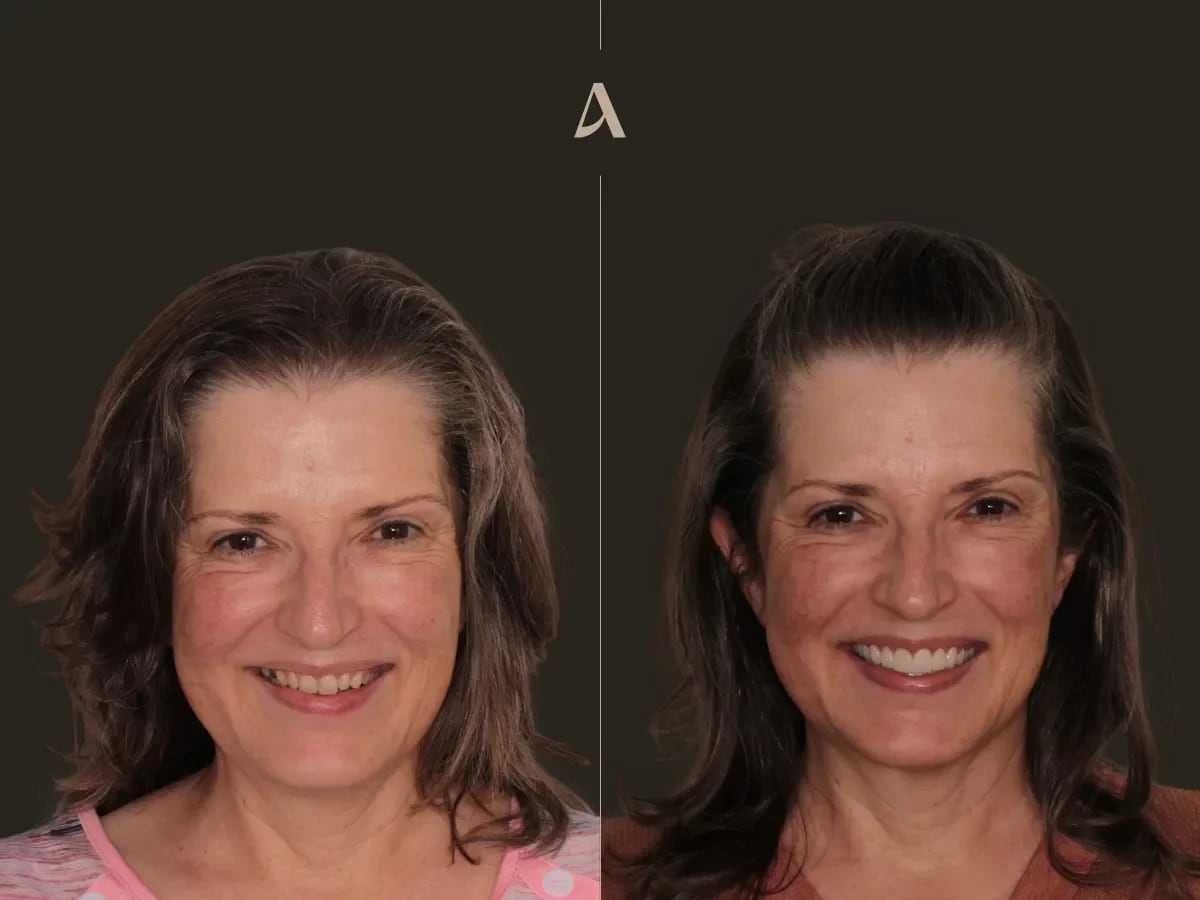
Before and after upper veneers and bridge, with a lower implant and lower veneers, restored at an increased vertical dimension. Total procedure time five months. Published with patient consent. Individual results vary.
The third patient shows a more moderate presentation, which is worth including because most people who need this treatment look more like this than like a full collapse. In the before photograph the teeth are small and worn, the smile is narrow and does not fill the width of the mouth, and the lower face is slightly short for the rest of the face. It is the kind of change that does not look like a dental problem until you compare it with the after.
The plan. This case combined several approaches in one treatment, because different parts of the mouth had different problems. The upper arch was restored with veneers and a bridge to replace a missing tooth and rebuild the worn teeth to proper length. In the lower arch, a single implant replaced a missing tooth and lower veneers were used to rebuild worn teeth. The whole rehabilitation was completed at an increased vertical dimension so the upper and lower arches met correctly at the new height rather than one arch being rebuilt against a bite that had not changed.
Total procedure time was five months, with the restorative phase taking two. The additional time reflects the implant, which needs to integrate with the bone before it can carry a restoration.
The result. The smile is wider and fuller, and it now fills the space between the corners of the mouth. The teeth are longer and better proportioned to the face. The lower third of the face has lengthened slightly and the upper lip sits with more support. The change is less dramatic than case 2, because there was less to recover, and that is the point. The size of the facial change tracks the size of the correction.
What the Three Cases Have in Common
The restorations in these three cases have almost nothing in common with each other. One patient received zirconia veneers, crowns and bridges. One received removable overdentures in both arches. One received a mix of veneers, a bridge and an implant. The materials, the cost, the treatment time and the maintenance requirements are all different.
What is shared is the diagnosis and the planning move. In each case the lower face had lost height, the restorative space that height provides had disappeared, and the treatment began by deciding where the new vertical dimension needed to sit. Everything else followed from that decision. Choose the height badly and even beautifully made restorations will look wrong in the face and feel wrong to bite on.
It is also worth noting that all three patients had a grinding history to some degree. That is not a coincidence. It is the single most common reason we see this pattern, and it is the reason the treatment does not end when the restorations are fitted. Protecting the result matters as much as creating it.
What Increasing the Vertical Dimension Does Not Do
Being clear about the limits is as useful as describing the benefits.
It is not a facelift and it does not treat skin. Wrinkles, skin texture, sun damage and volume loss in the cheeks are unaffected. What changes is the framework the lower face sits on, which is why the effect concentrates around the mouth, lips and chin.
It is also not always indicated. Plenty of patients with worn teeth have adequate restorative space and a vertical dimension that has not meaningfully changed. In those cases the correct decision is to restore at the existing height. Increasing the bite when it is not needed adds complexity, cost and biomechanical risk for no benefit. The starting point is always a full assessment of the teeth, the jaw joints, the muscles and the face together.
And the outcome is individual. The three patients above are real cases with real results, but the amount of facial change achievable depends on how much was lost, the underlying facial structure, the condition of the remaining teeth and bone, and what the patient is willing to undertake. Nothing here is a guarantee of a particular outcome.
Key Takeaways
Vertical dimension is the height of the lower face when the back teeth meet. Grinding, tooth wear, lost back teeth and long term denture wear can all reduce it.
When it drops, the face compresses: the chin moves closer to the nose, lips lose support, folds around the mouth deepen and the corners turn down.
Research measuring 3D facial scans found that raising the vertical dimension increases total and lower face height and changes the nasolabial angle, with 4 mm being the most perceptible change.
The clinical reason to increase the bite is usually to create space for restorations. The rule is the minimum increase that solves the problem, with up to 5 mm justified when the material requires it.
Systematic review evidence supports permanent increases in vertical dimension as safe and predictable when indicated, with any symptoms usually mild and self limiting.
The new height is trialled with a splint or temporary restorations before it is made permanent.
Three very different treatment plans, from zirconia rehabilitation to overdentures to a mixed veneer and implant case, produced the same kind of facial change because they shared the same underlying correction.
Disclaimer. This article is educational and describes real cases treated at ArtSmiles, published with patient consent. It is not personal dental advice and nothing in it is a guarantee of outcome. Individual results vary according to your dental condition, bone and gum health, medical history and what treatment you choose. Any treatment described here carries risks that need to be discussed with a dentist. A clinical examination and appropriate imaging are required before any treatment plan can be recommended.
Cases executed by Dr Cristian Dunker
General Dentist, BDSc, MBA (Qld)
AHPRA DEN0002257085
ArtSmiles, Southport, Gold Coast
Medically reviewed by Dr Cristian Dunker
Frequently Asked Questions
Can changing my bite really change how my face looks?
Yes, and it has been measured. A 2025 study using 3D facial scans found that increasing the vertical dimension produced measurable increases in total face height, lower face height and nasolabial angle, with a 4 mm change being the point at which observers most clearly noticed a difference. The effect is concentrated in the lower third of the face, around the lips, mouth corners and chin.
Is it safe to open the bite?
The evidence supports it when there is a clinical reason to do it. A systematic review of the literature concluded that a permanent increase in vertical dimension is safe and predictable where indicated. Some patients notice mild adjustment symptoms in the first weeks, but these were found to be self limiting. A separate review of the jaw joint question found no indication that a permanent change causes long lasting temporomandibular problems.
How much can the bite be opened?
The guiding principle is the smallest increase that solves the restorative problem. Published guidance supports increases of up to 5 mm where the restorative material genuinely needs that much room. The exact figure comes from planning the case, not from a standard measurement, because the methods described for calculating lost height are not reliable enough to use on their own.
Will I be able to eat and speak normally afterwards?
Most patients adapt within a few weeks. Speech is checked at the trial stage precisely because it is sensitive to the new height, and adjustments are made before anything is made permanent. If speech or comfort is not right at the trial, the height is changed, which is the whole reason the trial exists.
Do I have to grind my teeth for this to be relevant?
No. Grinding is the most common cause we see, but acid wear from reflux or diet, losing back teeth without replacing them, and long term denture wear all produce the same loss of height. Many patients have a combination.
Will I need a night guard afterwards?
If grinding contributed to the original damage, yes. The forces that wore the natural teeth down do not disappear once the teeth are restored, and a protective splint is how the new restorations are given the best chance of lasting. It is a standard part of the plan rather than an optional extra.
How long does this kind of treatment take?
It depends on what is involved. The zirconia rehabilitation case above was completed in a month. The overdenture case took four months. The case involving an implant took five months in total, because the implant needs time to integrate with the bone before it can be restored. Cases requiring extractions, grafting or gum treatment first take longer.
References
Abduo J, Lyons K. (2012). Clinical considerations for increasing occlusal vertical dimension: a review. Australian Dental Journal, 57(1), 2-10. https://pubmed.ncbi.nlm.nih.gov/22369551/
Abduo J. (2012). Safety of increasing vertical dimension of occlusion: a systematic review. Quintessence International, 43(5), 369-380. https://pubmed.ncbi.nlm.nih.gov/22536588/
Moreno-Hay I, Okeson JP. (2015). Does altering the occlusal vertical dimension produce temporomandibular disorders? A literature review. Journal of Oral Rehabilitation, 42(11), 875-882. https://pubmed.ncbi.nlm.nih.gov/26140528/
Kim SW, Ko KH, Huh YH, Cho LR, Park CJ. (2025). Evaluation of perceptual and anthropometrical facial changes according to increase in vertical dimension of occlusion. Journal of Oral Rehabilitation, 52(6), 833-839. https://pubmed.ncbi.nlm.nih.gov/39840459/
Calamita M, Coachman C, Sesma N, Kois J. (2019). Occlusal vertical dimension: treatment planning decisions and management considerations. International Journal of Esthetic Dentistry, 14(2), 166-181. https://pubmed.ncbi.nlm.nih.gov/31061997/
Van't Spijker A, Rodriguez JM, Kreulen CM, Bronkhorst EM, Bartlett DW, Creugers NH. (2009). Prevalence of tooth wear in adults. International Journal of Prosthodontics, 22(1), 35-42. https://pubmed.ncbi.nlm.nih.gov/19260425/
Sterenborg BAMM, Bronkhorst EM, Wetselaar P, Lobbezoo F, Loomans BAC, Huysmans MDNJM. (2018). The influence of management of tooth wear on oral health-related quality of life. Clinical Oral Investigations, 22(7), 2567-2573. https://pubmed.ncbi.nlm.nih.gov/29397468/
Feine JS, Carlsson GE, Awad MA, et al. (2002). The McGill consensus statement on overdentures. Mandibular two-implant overdentures as first choice standard of care for edentulous patients. Gerodontology, 19(1), 3-4. https://pubmed.ncbi.nlm.nih.gov/12164236/
If your teeth have worn down, your back teeth are missing, or you have noticed your lower face looking shorter than it used to, it is worth having the bite assessed rather than only the teeth. You can read more cases on our clinical cases page, including a single case looking at bruxism and facial collapse and another on reversing years of grinding damage. When you are ready, book a complimentary consultation at our Southport clinic and we will assess your bite, your teeth and your facial proportions together.