Compiled from clinical pathology references. Medically reviewed by Dr Cristian Dunker , Principal Dentist, ArtSmiles Cosmetic Dentistry.
Quick summary
Also called | Primary adrenal insufficiency, hypoadrenocorticism, adrenocortical insufficiency |
How urgent? | 🔴 Important, Addisons disease itself can be life-threatening if untreated, although the oral pigmentation it produces is harmless |
Common or rare? | Rare, Addisons disease has a prevalence of about 1 in 10,000 in Western countries; oral pigmentation as a presenting feature is uncommon |
Who it affects | Adults of any age, with a peak in the 30s to 50s; women slightly more often affected than men in autoimmune (when the body's immune system mistakenly attacks its own tissues) cases |
Who treats it | The systemic disease is managed by an endocrinologist (a hormone specialist) with the patient's GP; the oral pigmentation needs no specific dental treatment |
Based on | Cawson, with cross-references in Neville and Regezi |
What is it?
Addisons disease (primary adrenal insufficiency) is a condition in which the adrenal cortex, the outer layer of the small glands sitting on top of the kidneys, fails to produce enough of the hormones cortisol (a key stress hormone) and aldosterone (a hormone that controls salt and water balance). This produces a range of systemic symptoms (lassitude, weight loss, low blood pressure, gastrointestinal upset) and, in many cases, a characteristic diffuse brown to almost black pigmentation of the skin and oral mucosa. The pigmentation itself is harmless, but it can be a useful early sign that prompts the right blood tests and treatment for the underlying disease. The textbooks specifically note that Addisons disease is the most important systemic cause of diffuse oral pigmentation apart from physiological/racial pigmentation.
Who tends to get it?
The textbooks describe a fairly characteristic profile:
Adults of any age, with a peak in the third to fifth decades.
Women slightly more often affected in the autoimmune form.
Most often autoimmune in cause, circulating organ-specific antibodies attack and progressively destroy the adrenal cortex.
Less often caused by tuberculosis or fungal infection of the adrenals; HIV-associated adrenal disease is now an additional, although still uncommon, cause.
A small group of patients have Addisons disease as part of a polyglandular autoimmune syndrome, in which several endocrine glands are affected together, sometimes alongside chronic mucocutaneous candidiasis.
What causes it?
The textbooks describe several mechanisms:
Autoimmune destruction of the adrenal cortex by the patient's own immune system, often with detectable autoantibodies, by far the most common cause in developed countries.
Adrenal infection, historically tuberculosis was the leading cause; today, adrenal involvement in HIV-related fungal and tuberculous infection accounts for a small proportion.
Bilateral adrenal haemorrhage, metastatic cancer or rare genetic causes account for the remainder.
The oral pigmentation itself is driven by feedback from the failing adrenal glands. With cortisol low, the pituitary gland produces high levels of adrenocorticotropic hormone (ACTH) and related peptides, which include melanocyte-stimulating hormone (MSH). MSH directly stimulates melanocytes (the cells that make melanin) throughout the skin and mucous membranes (the soft tissue linings of the mouth, nose and other body cavities) to produce more melanin (the natural brown pigment in skin and oral lining), leading to the characteristic generalised pigmentation.
How does it develop?
Cortisol is essential for blood pressure, glucose regulation and the body's response to stress; aldosterone is essential for sodium and water balance. As the adrenal cortex is gradually destroyed, the body adjusts at first. Eventually, however, the loss of these hormones produces fatigue, low blood pressure, weight loss, salt craving and gastrointestinal upset. The same hormonal changes that drive the systemic symptoms, particularly high ACTH and MSH from the pituitary, also drive the increased melanin production that gives the skin and mouth their characteristic colour. In acute decompensation (an "Addisonian crisis"), low blood pressure, vomiting, dehydration and shock can develop rapidly and require urgent hospital treatment.
What might you notice?
What it looks like
The textbooks describe a fairly distinctive appearance in the mouth:
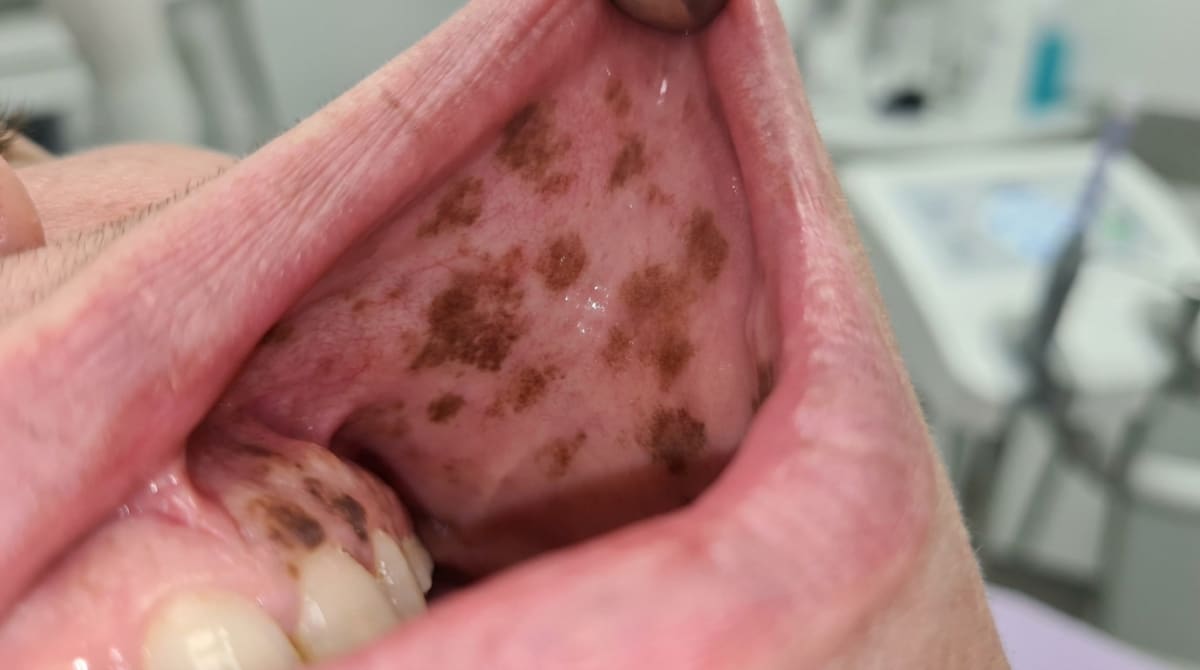
Diffuse, patchy brown or brown-black pigmentation of the gums, particularly along the attached gingiva (the firm gum tightly bound to the underlying bone).
Pigmentation of the buccal mucosa (the soft tissue lining the inside of the cheeks), the lips and sometimes the soft palate.
The pigmentation is bilateral but often patchy rather than perfectly even.
The colour develops over months rather than appearing suddenly, although the patient may not notice it until well established.
Skin pigmentation that looks like a sallow suntan, often most pronounced on sun-exposed areas, scars, palmar creases and pressure points.
The textbooks specifically note that Addisons disease should be considered in any patient (other than a person with naturally darker skin) who develops diffuse oral pigmentation.
What it feels like
The pigmentation itself is asymptomatic. The wider symptoms of Addisons disease are what bring the condition to attention:
Persistent tiredness and weakness, often described as overwhelming.
Loss of appetite and unintentional weight loss.
Nausea, vomiting or diarrhoea.
Low blood pressure, particularly on standing (orthostatic hypotension).
Salt craving.
Lightheadedness or fainting in stress, illness or hot weather.
Mood changes, including depression and irritability.
Sometimes joint or muscle aches.
What an X-ray might show
Dental X-rays are not relevant to Addisons disease. The diagnosis is made on blood tests (low morning cortisol with high ACTH, low sodium, sometimes high potassium) and confirmed with a synthetic ACTH (Synacthen) stimulation test.
What happens at the dentist?
Diffuse oral pigmentation that is new in adulthood is a red flag worth investigating, even when most cases turn out to be benign. A dentist at ArtSmiles, typically as part of a dental check-up and clean, will commonly:
Examine the mouth carefully under good light, noting where the pigmentation is, how symmetrical it is and how it has changed.
Take a careful history, including childhood pigmentation, recent fatigue, weight loss, salt cravings, dizziness, gastrointestinal symptoms and any skin pigmentation changes.
Compare with physiological/racial pigmentation, smoker's melanosis, and drug-induced pigmentation.
Refer the patient to their GP when the pattern suggests a possible systemic cause, with a clear note of the oral findings.
Liaise with the GP or endocrinologist during dental treatment, since patients with Addisons disease may need extra (stress-dose) corticosteroids around dental procedures and should not have routine treatment scheduled when they are systemically unwell.
The textbooks specifically warn against scheduling extensive dental treatment in undiagnosed or poorly controlled Addisons disease, given the risk of an Addisonian crisis under stress.
Is this serious?
🔴 The oral pigmentation itself is harmless and reversible with treatment of the underlying disease. The reason Addisons disease is serious is not the pigmentation but the underlying hormone deficiency, which can be life-threatening if untreated. With proper hormone replacement, however, patients usually live full and active lives. The oral findings are most useful as an early prompt for investigation when other systemic features are present.
If you have noticed new brown patches in your mouth, particularly alongside fatigue, weight loss, low blood pressure, salt craving or skin pigmentation changes, it is worth booking an assessment so the right blood tests and follow-up can be arranged.
Could it be something else?
Several other conditions can produce diffuse oral pigmentation. The textbooks list these as the main differentials:
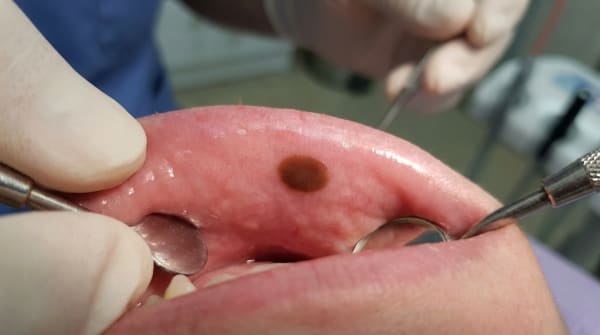
Physiological oral pigmentation, symmetrical, present from childhood, common in people with darker skin.
Drug-induced oral pigmentation, recognised pattern related to medications such as minocycline, antimalarials and chemotherapy agents.
Smoker's melanosis, diffuse brown patches in heavy smokers, particularly on the front gums and inside of the lips.
HIV-associated melanosis, diffuse brown pigmentation associated with HIV infection or its treatments.
Cushing syndrome, typically causes the opposite problem (excess cortisol) but can produce some pigmentation in the rare ACTH-driven forms.
Peutz-Jeghers syndrome, multiple small dark spots around the mouth and inside the cheeks, with intestinal polyps; usually present from childhood with a positive family history.
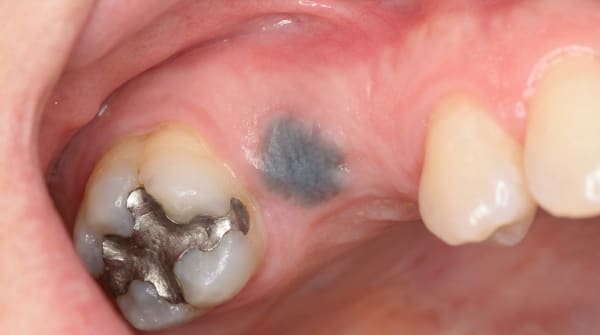
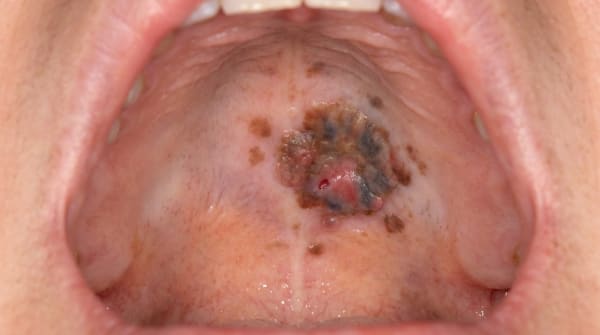
Oral malignant melanoma, a rare but serious cancer, distinguished by asymmetry, irregular borders and any raised or ulcerated component.
Heavy metal pigmentation, a discrete pigmented line along the gum margin in patients with environmental or occupational exposure.
How is it treated?
The textbooks all agree: the oral pigmentation needs no direct dental treatment. The focus is on identifying and managing the underlying Addisons disease.
At-home measures and habits:
Continue any prescribed medications, particularly hydrocortisone or fludrocortisone replacement therapy, exactly as directed.
Carry an emergency steroid card if you have been diagnosed with Addisons disease.
Discuss any planned dental treatment with both your dentist and your endocrinologist or GP.
Maintain excellent oral hygiene with brushing twice a day and flossing daily.
Professional steps your dentist may consider:
Identifying the pattern of oral pigmentation and considering Addisons disease as a possible cause.
Referring the patient to their GP for blood tests, including morning cortisol, ACTH and electrolytes.
Avoiding extensive dental treatment in undiagnosed or poorly controlled disease, due to the risk of an Addisonian crisis under stress.
Coordinating with the patient's medical team for any necessary stress-dose corticosteroid coverage around dental surgery, particularly major procedures or treatment under sedation/general anaesthetic.
Routine dental care, including check-ups, fillings and cleaning, once the underlying disease is well controlled.
No specific treatment of the pigmentation itself, which gradually fades as hormone replacement reduces ACTH levels.
A patient-centred approach is particularly important for patients newly diagnosed with Addisons disease, whose lives may be significantly changed by the new diagnosis. Calm, clear explanation of the dental aspects of the disease, the steroid coverage needed for major procedures, and the safe management of routine care is itself part of effective care, values that sit at the heart of our clinical philosophy.
What's the long-term outlook?
The long-term outlook for Addisons disease has improved dramatically since hormone replacement therapy became available. With consistent oral hydrocortisone and (where needed) fludrocortisone, most patients live full and active lives. Acute crises are rare with good management but require urgent hospital treatment when they occur. The oral pigmentation gradually fades over months as the underlying hormone imbalance is corrected, although some patients retain mild residual pigmentation for years. Regular dental review, well-coordinated medical care and patient awareness of when to seek help in illness or stress are the most important factors in a good long-term outcome.
A note on this article
This article is for educational purposes only and does not constitute a clinical diagnosis. Please consult a registered dental practitioner for assessment and treatment advice.
The cover image above is an AI-generated illustration based on the most common visible features of this condition described in clinical pathology references. It is not a photograph of a real case and should not be used to diagnose or rule out the condition in your own situation. If you are concerned about something you have noticed, please book an assessment with a registered dental practitioner.
References
Cawson, R. A., & Odell, E. W. (2017). Cawson's essentials of oral pathology and oral medicine (8th ed.). Elsevier. Chapter 31, Endocrine Disorders and Pregnancy: Adrenocortical Diseases, Hypofunction (Addisons disease), with Box 31.8 typical clinical features and the characteristic patchy brown-black gingival pigmentation, pp. 408 to 410.
Neville, B. W., Damm, D. D., Allen, C. M., & Chi, A. C. (2023). Oral and maxillofacial pathology (5th ed.). Elsevier. Chapter 6, Fungal and Protozoal Diseases: cross-reference for Addisons disease as part of polyendocrinopathy with chronic mucocutaneous candidiasis.
Regezi, J. A., Sciubba, J. J., & Jordan, R. C. K. (2017). Oral pathology: Clinical pathologic correlations (7th ed.). Elsevier. Chapter on Pigmented Lesions: cross-reference for systemic causes of oral pigmentation including adrenal insufficiency.
Frequently asked questions
What is Addison's disease?
Addison's disease (primary adrenal insufficiency) is an autoimmune condition where the adrenal glands stop making enough cortisol and aldosterone. The body responds by producing high levels of ACTH, which also stimulates melanocytes and causes brown pigmentation on the skin and inside the mouth.
Why does Addison's cause pigmentation in the mouth?
High ACTH levels in the blood activate melanocytes (the cells that make melanin) in skin and mucosal surfaces. This produces brown to black patches on the lips, cheeks, gums and tongue. The pigmentation often appears before other symptoms and can be the first clue to the diagnosis.
What does the oral pigmentation look like?
Patches are usually flat, brown to bluish-black, and may be patchy or diffuse. They commonly affect the cheeks (buccal mucosa), gums, lips and tongue. Skin pigmentation tends to be more noticeable in sun-exposed areas, scars and pressure points.
How is Addison's disease treated?
Treatment is lifelong hormone replacement with hydrocortisone (or prednisolone) and fludrocortisone, managed by an endocrinologist. The oral pigmentation usually fades slowly once steroid replacement is started. Dentists should be informed because steroid cover may be needed for complex procedures.