
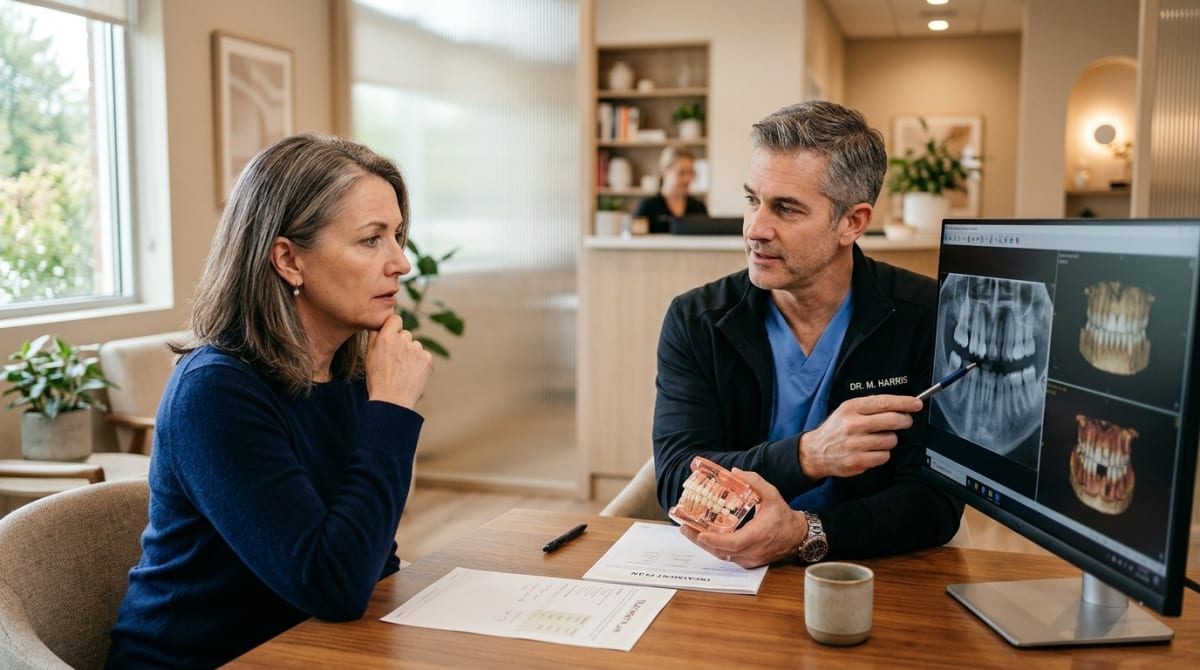
Across Australia and globally, cost remains one of the most common reasons patients delay dental treatment. This is not speculation — it is one of the most consistently documented findings in dental public health research.
This article explains, using published data, why affordability programs like the Blessing Program were created, how they support patients facing financial barriers, and how postponing treatment affects long-term oral health outcomes.
Why People Delay Dental Treatment: What the Research Shows
Multiple large-scale surveys across high-income countries confirm that cost is the primary barrier to dental care. In Australia, the data is particularly clear.
The National Dental Telephone Interview Survey (Luzzi et al., 2023) found that approximately 32 per cent of Australian adults aged 18 and over avoided or delayed dental care due to cost in 2021. Among those without private dental insurance, the figure rose to 47 per cent. Between 1994 and 2017, cost-related avoidance climbed steadily from 26 per cent to 41 per cent before declining to current levels (AIHW, 2023).
The consequences of this pattern are measurable:
Patients who delay care due to cost are significantly more likely to require emergency dental treatment
The AIHW reported approximately 88,600 potentially preventable hospitalisations for dental conditions in 2023–24
Delays beyond 12 months are strongly correlated with increased risk of tooth loss, higher restorative needs, and greater likelihood of needing prosthetics or implants
A systematic review published in Community Dentistry and Oral Epidemiology found that cost-related avoidance is the strongest predictor of oral health decline across all socioeconomic groups (Listl et al., 2015). Financial barriers create a cycle: avoidance leads to disease progression, which leads to more complex treatment, which further increases cost.
Dental Problems Get More Expensive When Left Untreated
Clinical evidence shows a consistent pattern. When treatment is postponed, the problem does not remain stable — it progresses, and the cost of repair progresses with it.
Tooth Decay Does Not Pause
Research published in the Journal of Dental Research demonstrates that untreated tooth decay progresses through dentine at a measurable rate (Hummel et al., 2019). As the cavity deepens toward the nerve, conservative treatment options narrow. What could have been managed with a small filling may eventually require root canal therapy followed by a crown — increasing the overall cost by six to ten times.
Gum Disease Has a Predictable Trajectory
According to the classification system published by the American Academy of Periodontology (Tonetti et al., 2018), periodontal disease can result in bone loss of 0.1 to 1.0 millimetres per year when left untreated. The longer disease progresses, the more involved the treatment becomes — moving from deep cleaning to periodontal surgery and, in advanced cases, tooth replacement.
Prevention Is the Most Economical Choice
A modelling study from the University of Adelaide demonstrated that every dollar invested in preventive dentistry saves between eight and fifty dollars in future treatment costs (Nguyen et al., 2013). In practical terms, postponing care does not reduce expenses — it multiplies them.
Why ArtSmiles Created the Blessing Program
The Blessing Program was developed to address a challenge well documented in the public health literature. Many patients with advanced oral disease genuinely want treatment, but financial barriers prevent them from beginning.
The clinical rationale is supported by several key findings:
Full-Arch Implants Deliver Measurable Results
Long-term studies on All-on-X implant treatment consistently report 94 to 99 per cent implant survival rates over 10 years, with 98 per cent patient satisfaction. Outcomes include documented improvements in chewing function, nutritional intake, confidence, and overall quality of life (Malo et al., 2014).
Delaying Care Reduces Predictability
As bone loss, tooth mobility, and infection continue, treatment planning becomes more complex and outcomes harder to guarantee. Addressing the problem earlier preserves more options and improves predictability.
A Large Group of Patients Need Care but Cannot Access It
In Queensland, a significant proportion of older adults require complex dental rehabilitation but cannot begin due to cost. The Blessing Program was created for these patients — providing access to major treatments at substantially reduced rates so they can step out of the gap between clinical need and financial reach.
How the Blessing Program Works
The Blessing Program gives eligible patients access to large-scale dentistry at significantly reduced rates. Treatments covered include:
Large veneer packages
This is possible because ArtSmiles has invested in advanced in-house digital technologies that reduce external laboratory costs and streamline every stage of treatment — from digital scanning and design through to milling and placement.
Conclusion
Affordability is one of the biggest barriers to oral health, and this is not a matter of opinion. It is one of the most consistent findings in public health research worldwide. Programs like the Blessing Program exist to narrow this gap, connecting clinical need with financial accessibility through the efficiencies created by modern digital dentistry.
The goal is straightforward: to make essential dental care more achievable for patients who genuinely need it, supported by evidence, fairness, and long-term clinical thinking.
References
Australian Institute of Health and Welfare (2023). Oral health and dental care in Australia. AIHW
Listl, S., et al. (2015). Global economic impact of dental diseases. Journal of Dental Research, 94(10), 1355–1361. PubMed
Hummel, R., et al. (2019). Caries progression rates revisited: a systematic review. Journal of Dental Research, 98(7), 746–754. PubMed
Tonetti, M.S., et al. (2018). Staging and grading of periodontitis. Journal of Clinical Periodontology, 45(S20), S149–S161. PubMed
Malo, P., et al. (2014). Five-year outcome of a retrospective cohort study on the rehabilitation of completely edentulous atrophic maxillae with immediately loaded zygomatic implants placed extra-maxillary. European Journal of Oral Implantology, 12(3), 263–277. PubMed