
A cracked tooth is one of the most unpredictable problems in dentistry. Unlike a cavity that follows a clear progression, cracks can behave differently depending on their location, depth, and the forces placed on the tooth every day.
What makes cracked teeth particularly challenging is that symptoms come and go. You might feel a sharp twinge when biting down on something, but it disappears just as quickly. Because the pain is not constant, many patients wait. And waiting with a cracked tooth almost always makes the situation worse.
This article explains how cracks develop, what happens at each stage, and why early treatment leads to far better outcomes.
Table of Contents
Why Teeth Crack
Teeth are incredibly strong, but they are not indestructible. Several factors contribute to cracking:
Grinding and clenching (bruxism): Repetitive forces, especially during sleep, place enormous pressure on teeth over time
Large existing fillings: Teeth with old, large restorations have less remaining natural structure and are more vulnerable to fracture
Biting on hard objects: Ice, bones, popcorn kernels, and hard lollies are common culprits
Sudden temperature changes: Eating very hot food followed immediately by a cold drink can create thermal stress
Age: Teeth naturally become more brittle over time, particularly after the age of 50
Types of Cracks
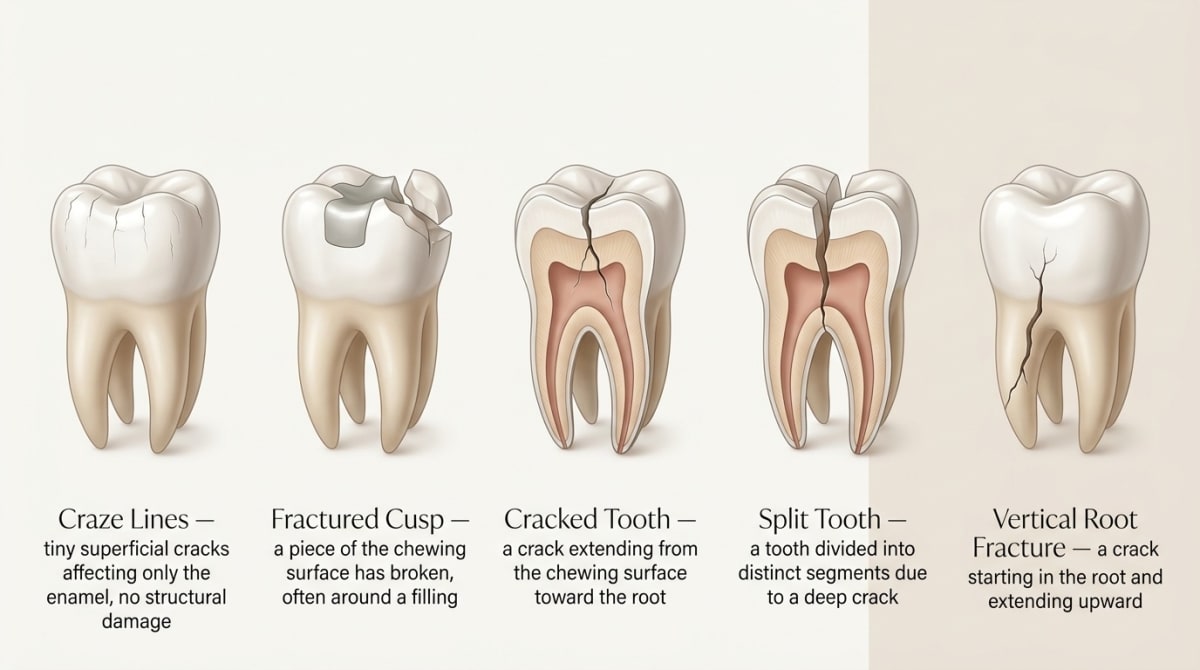
Not all cracks are the same. The American Association of Endodontists classifies tooth fractures into five categories, each with different treatment implications.
Craze lines are tiny, superficial cracks in the enamel only. They are extremely common in adult teeth and usually do not require treatment. They do not cause pain and are primarily a cosmetic concern.
Fractured cusps occur when a piece of the chewing surface breaks off, usually around an existing filling. The break typically does not extend to the pulp, so the tooth can usually be repaired with a crown.
Cracked teeth have a crack that extends from the chewing surface vertically toward the root. If the crack has not reached the pulp, a crown can protect the tooth. If it has reached the nerve, root canal treatment followed by a crown is needed.
Split teeth are cracked teeth that have separated into distinct segments. These teeth cannot usually be saved intact, though in some cases one portion can be retained.
Vertical root fractures begin in the root and extend upward. These are often discovered only when the surrounding bone and gum become infected. Extraction is usually the only option.
Dentists sometimes use the term cracked tooth syndrome to describe a symptomatic crack that has not yet separated the tooth into pieces. The pain is real, but the crack can be hard to see on an x-ray.
Stage One: The Crack You Can Ignore (For Now)
Most cracks start small. You might not even know one is there. At this stage, the crack is limited to the enamel or the outermost layer of dentine. There may be occasional sensitivity to cold or a brief twinge when biting on something firm.
This is the ideal time for treatment. A crown placed at this stage protects the tooth from further stress, prevents the crack from spreading, and preserves the tooth long term. The procedure is straightforward and predictable.
Clinical Tip:
If you feel a dull pain when biting, especially as you release pressure, you may have a cracked tooth. Seek a dental assessment as soon as possible.
Research by Gill et al. (2021) confirmed that early intervention with a crown can preserve cracked teeth effectively, while delays allow cracks to progress to the point where the tooth cannot be saved (PubMed).
Stage Two: Symptoms That Come and Go
As the crack deepens, symptoms become more frequent. You might notice:
Sharp or dull pain when biting that disappears when you release
Sensitivity to hot or cold that lingers for several seconds
Discomfort when eating on one side
Pain that is difficult to pinpoint to one specific tooth
The inconsistency of symptoms is what makes this stage dangerous. Pain that comes and goes makes it easy to assume the problem is minor or temporary. Patients often wait weeks or months at this stage, during which time the crack continues to extend under normal chewing forces.
A study by Hilton et al. (2020) tracked over 1,800 cracked posterior teeth and found that 32% showed symptom changes within one year, and 10% experienced worsening pain. Over three years, 12% showed crack progression and 3% fractured completely (PubMed).
Stage Three: The Crack Reaches the Nerve
When a crack extends into the pulp chamber, bacteria gain access to the nerve and blood supply of the tooth. This triggers an inflammatory response that can escalate quickly.
At this stage, the pain often becomes more persistent and intense. The tooth may become sensitive to pressure, temperature, and even air. Swelling may develop around the gum line.
The tooth can still be saved at this point, but it requires root canal treatment to remove the damaged pulp tissue, followed by a crown to protect the weakened structure. Abbott and Yu (2007) documented that once pulpal inflammation becomes irreversible, conservative management is no longer effective (PubMed).
Stage Four: Complete Fracture
This is the outcome everyone hopes to avoid. A complete fracture can happen at any time, often during routine activities like chewing bread or biting into a sandwich. It can happen without warning.
If the fracture line extends below the gum line or splits the root, the tooth cannot be saved. Extraction is the only option, followed by replacement with a dental implant or bridge.
This stage is what most patients call a broken tooth: the crack has travelled the full height of the tooth, often splitting it into separate pieces during chewing.
What makes this stage particularly frustrating is that a crown placed months or years earlier could have prevented the entire sequence. The difference between saving and losing a tooth often comes down to timing.
Can a Cracked Tooth Heal on Its Own?
Unlike bone, which can repair itself after a fracture, tooth structure does not regenerate. A crack in enamel or dentine will not fuse back together. It will only stay the same or get worse.
Every time you chew, the crack opens and closes microscopically. This repeated flexing gradually extends the fracture line deeper into the tooth. Temperature changes from food and drinks add additional stress. Over time, what started as a minor crack becomes a structural failure.
What to Do if You Suspect a Cracked Tooth
If you are experiencing intermittent sharp or dull pain when biting, sensitivity to temperature, or a feeling that something is not quite right with a tooth, it is worth having it assessed sooner rather than later.
At ArtSmiles, we use careful examination and diagnostic techniques to identify cracks and determine how far they extend. Once we understand the extent of the damage, we can explain your options clearly and recommend the most appropriate treatment for your situation.
Early treatment is almost always simpler, more comfortable, and less costly than waiting. If you have been putting off a dental concern, book an assessment so we can take a closer look.
Frequently Asked Questions About Cracked Teeth
How do I know if I have a cracked tooth?
Common signs include sharp or dull pain when biting that disappears as soon as you release, sensitivity to cold or sweet foods, and discomfort that is hard to trace to one specific tooth. Pain that comes and goes is the most telling pattern. A dentist can confirm the diagnosis with a bite test or transillumination.
Can a cracked tooth fix itself?
No. Unlike bone, tooth enamel and dentine cannot regenerate once damaged. A crack will not close or stabilise over time. Every time you chew, the fracture opens and closes slightly, gradually extending deeper into the tooth.
What happens if a cracked tooth is left untreated for months?
The crack typically deepens. What starts as a minor hairline can reach the nerve within weeks or months, causing persistent pain and infection. Once infection reaches the surrounding bone, treatment becomes more involved and the tooth may no longer be saveable.
Does a cracked tooth always need a crown?
Not always. A very small surface crack may only need monitoring or bonding. But if the crack extends into dentine, causes symptoms, or sits in a molar under heavy chewing load, a crown is usually the most reliable way to protect the remaining structure and stop the fracture progressing.
Is a cracked tooth a dental emergency?
If there is severe pain, visible splitting, or swelling around the tooth, treat it as an emergency and call your dentist immediately. Ongoing mild symptoms without severe pain are still urgent but may not require a same-day visit. Either way, do not wait weeks to have it assessed.
How long does a cracked tooth take to heal?
A cracked tooth does not heal. Enamel and dentine cannot regrow. The more useful question is how long you can safely leave a crack before it reaches the nerve. A hairline crack in enamel may stay stable for years; a crack already causing intermittent pain on biting is already in Stage Two and should be assessed within a week or two. Once cold sensitivity or lingering aching begins, the crack has typically reached the pulp and same-week care is the difference between saving the tooth and losing it.