
Many people grind or clench their teeth without knowing it. This habit, known as bruxism, usually happens during sleep or moments of stress. Because there is often no pain at first, it goes unnoticed for years.
The problem is the force involved. An international consensus led by Lobbezoo et al. (2013) defined bruxism as a repetitive jaw-muscle activity characterised by clenching or grinding of the teeth. It can happen during sleep (sleep bruxism) or while awake (awake bruxism), though most people are unaware of the sleep form.
Night-time grinding can apply several times more pressure than normal chewing. Over time, this pressure slowly wears teeth down, cracks fillings, strains jaw joints, and contributes to gum recession. Most patients only discover the problem once the damage is already visible.
Why Grinding and Clenching Happen
Bruxism does not have a single cause. In most cases, it is triggered by a combination of factors. A systematic review by Castroflorio et al. (2017) identified several key risk factors associated with sleep bruxism in adults.
Common contributors include:
Stress or anxiety
Poor sleep quality
High caffeine intake
Sleep disorders such as sleep apnoea
Bite imbalances or uneven tooth contacts
Genetic tendency
Certain medications
Because grinding often occurs during sleep transitions, many people are completely unaware of it. A partner usually notices the sound first.
Why Grinding Is More Harmful Than Chewing
Chewing applies controlled, vertical pressure. Grinding applies uncontrolled, sideways pressure for long periods.
Research by Nishigawa et al. (2001) measured bite forces during sleep bruxism and found they can match or exceed maximum voluntary bite force. That level of pressure, repeated throughout the night, places enormous strain on teeth, restorations, and jaw joints.
These forces are:
Stronger than normal chewing
Repetitive and sustained
Difficult for teeth and joints to tolerate long-term
Over time, this leads to:
Enamel wear
Flattened teeth
Chipped edges
Cracks within the tooth
Early failure of fillings and crowns
Enamel does not regenerate. Every bit of wear is permanent.
Signs You May Be Grinding Without Realising It
Most people do not feel pain early on. Instead, they notice small changes over time.
Dental signs
Teeth looking shorter or flatter
Chipped edges
Cracks in enamel
Broken or loose fillings
Sensitivity to cold or sweets
Gum recession
Jaw and muscle signs
Morning headaches
Jaw tightness or fatigue
Soreness around the temples
Clicking or stiffness when opening the mouth
Catching these signs early can prevent serious structural damage.
How Grinding Damages Teeth Over Time
Grinding causes slow but predictable changes. Wetselaar et al. (2019) reviewed the associations between tooth wear and sleep disorders, confirming that bruxism-related wear is linked to dental pain, hypersensitivity, and long-term structural problems.
The typical progression looks like this:
Enamel wears down and teeth flatten
Dentin becomes exposed, increasing sensitivity
Cracks develop and may spread suddenly
Fillings and crowns fail earlier than expected
Bite height reduces, sometimes changing facial appearance
What starts as surface wear can eventually lead to fractures, nerve damage, or tooth loss.
Why Grinding Should Not Be Ignored
Many people assume that if it does not hurt, it is not serious. But as Lavigne et al. (2008) explained in their clinical overview of bruxism physiology, the condition is often secondary to sleep-related micro-arousals and can progress silently for years.
Left untreated, grinding can lead to:
Expensive restorative treatment
Root canal therapy from cracked teeth
Jaw joint disorders
Chronic muscle tension headaches
Long-term bite changes
Pain is a late symptom, not an early warning.
How ArtSmiles Helps Protect Your Teeth
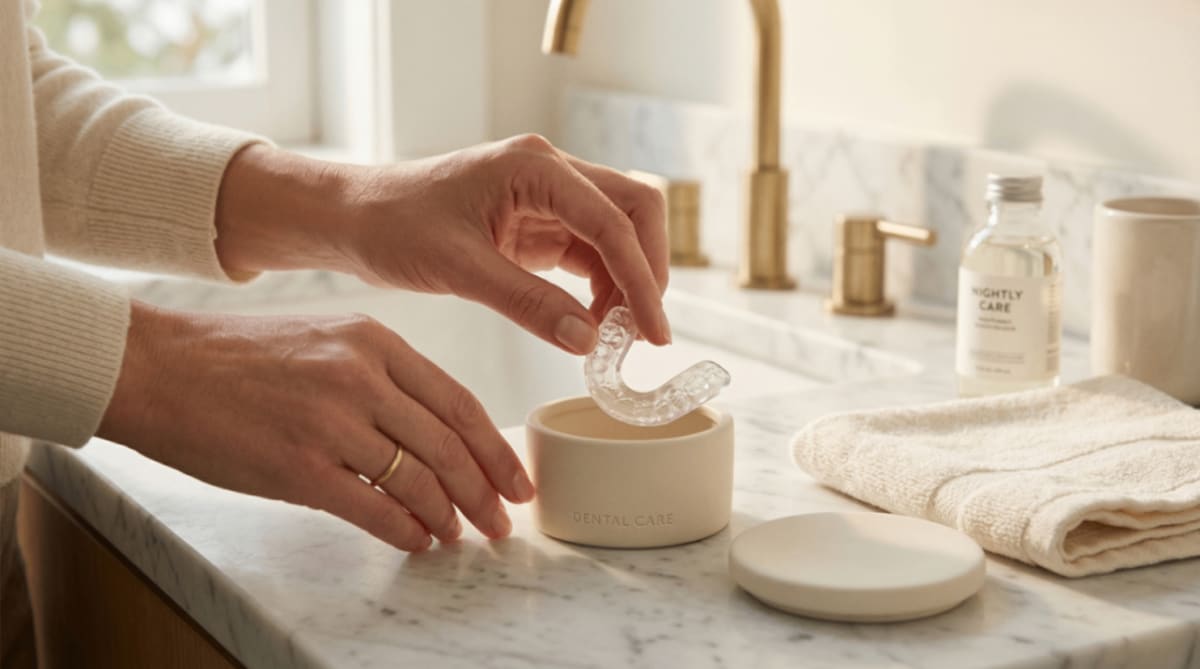
For most people, the first line of defence is a custom-made night guard, sometimes called a mouthguard for teeth grinding or an occlusal splint. A well-fitted night mouthguard cushions the teeth while you sleep and spreads the load away from the spots that tend to wear and crack. Custom guards taken from your own impressions fit better and last longer than the over-the-counter (OTC) boil-and-bite versions, which is why we usually suggest a custom night guard over a shop-bought one if you grind regularly.
At ArtSmiles, bruxism management is personalised to your specific situation.
Custom night guards
Designed to protect teeth and reduce muscle strain. A systematic review by Manfredini et al. (2015) confirmed that occlusal splints remain one of the most widely supported treatments for managing bruxism.
Digital bite assessment
To identify uneven contacts and overload areas that may be contributing to wear.
Restoring worn teeth
Using conservative bonding, veneers, or crowns when needed to rebuild lost tooth structure.
Ongoing monitoring
To ensure wear is controlled and stable over time.
In some cases, collaboration with medical professionals may be recommended if sleep issues are suspected.
Understanding Your Next Steps
Grinding and clenching are common, silent habits that place enormous stress on teeth and jaw joints. Even without pain, damage builds slowly and permanently.
Recognising the signs early and taking simple protective steps can save your teeth, reduce discomfort, and protect your long-term oral health.
If you are concerned about grinding or have not had your teeth checked recently, the team at ArtSmiles Gold Coast is here to help. Book an appointment online or get in touch to discuss your options.
Written by Dr. Cristian Dunker, BDSc, MBA.
Medically reviewed on 15 April 2026 by Dr. Cristian Dunker.
References
Lobbezoo F, Ahlberg J, Glaros AG, et al. Bruxism defined and graded: an international consensus. J Oral Rehabil. 2013;40(1):2-4. PubMed
Lavigne GJ, Khoury S, Abe S, Yamaguchi T, Raphael K. Bruxism physiology and pathology: an overview for clinicians. J Oral Rehabil. 2008;35(7):476-494. PubMed
Nishigawa K, Bando E, Nakano M. Quantitative study of bite force during sleep associated bruxism. J Oral Rehabil. 2001;28(5):485-491. PubMed
Castroflorio T, Bargellini A, Rossini G, Cugliari G, Deregibus A. Sleep bruxism and related risk factors in adults: A systematic literature review. Arch Oral Biol. 2017;83:25-32. PubMed
Manfredini D, Ahlberg J, Winocur E, Lobbezoo F. Management of sleep bruxism in adults: a qualitative systematic literature review. J Oral Rehabil. 2015;42(11):862-874. PubMed
Wetselaar P, Manfredini D, Ahlberg J, et al. Associations between tooth wear and dental sleep disorders: A narrative overview. J Oral Rehabil. 2019;46(8):765-775. PubMed