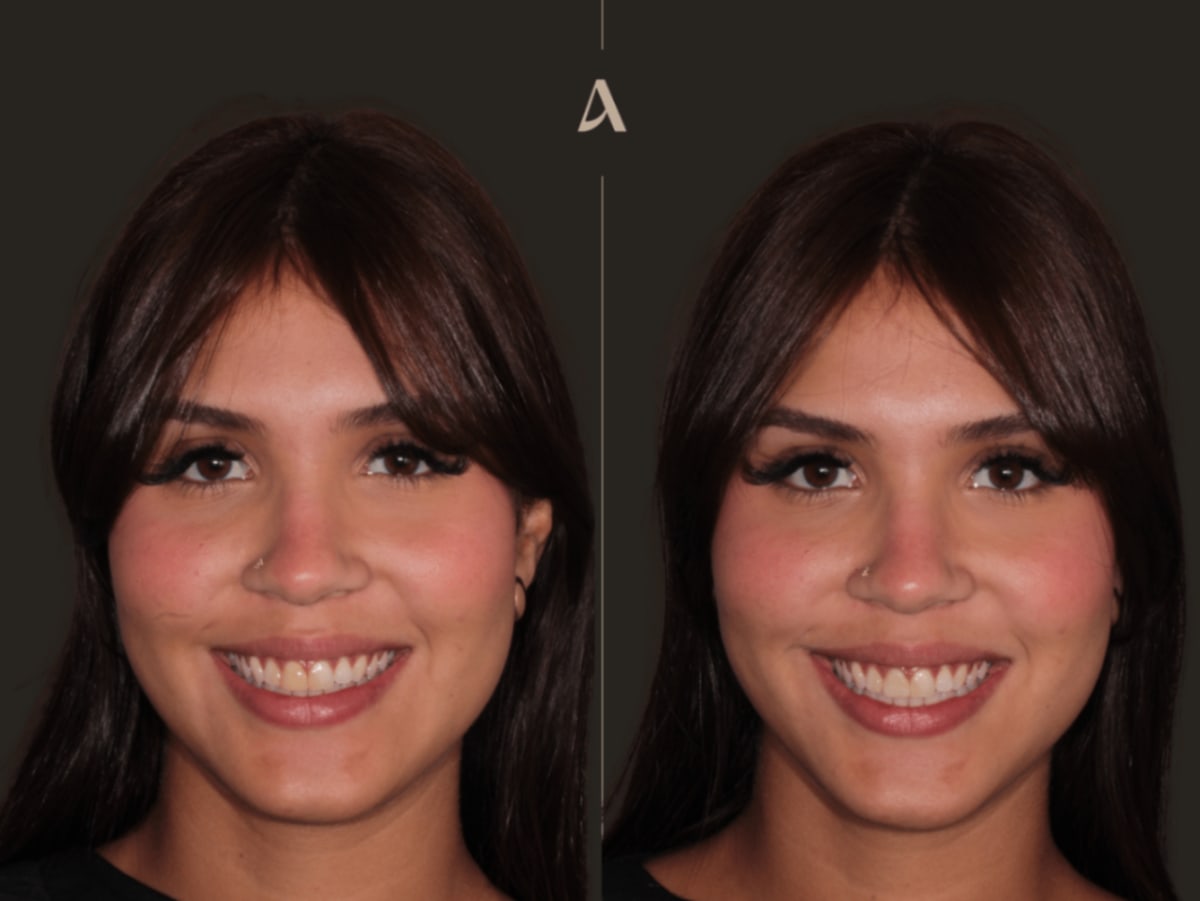
This patient first came to me a couple of years ago for a root canal on one of her top front teeth. She came back recently for the final chapter of that tooth's story, and it is a good example of how a single front tooth can be rebuilt in one visit with a custom porcelain crown.
She is 24, and this particular tooth, her upper right central incisor, had been through a lot. She knocked it as a child, and ever since it had been patched with white filling material. Over the years that filling had been redone five times. Each time the shape was not quite right, and after a while the material would darken and no longer match the tooth next to it.
This is a real clinical case treated at our Southport practice on the Gold Coast. It shows why we sometimes choose a porcelain crown over a veneer for a front tooth that has had a root canal, and how modern scanning and milling let us complete the whole thing in a single appointment.
In this article
The History Behind This Tooth
Knocking a front tooth as a child is common, and it often leads to years of small repairs. In this case the tooth had been rebuilt with composite, a tooth-coloured filling material, again and again. Composite is a wonderful material and the right choice in many situations, but on a heavily restored front tooth it has limits. It can pick up stain over time, the edges can wear, and rebuilding a large part of a tooth in filling material makes it hard to get the shape and the shade exactly right.
By the time she came back to see me, she was simply tired of the cycle. The filling had been replaced five times, the shape still bothered her, and the colour had drifted away from the tooth beside it. She wanted something that would look right and stay looking right, without needing to be touched up every couple of years.
What I Found During the Examination
Two years earlier I had completed a root canal on this tooth, so the first thing I checked was how that root canal was holding up. On the X-ray it looked stable and healthy, with no sign of infection at the tip of the root. That told me the foundation was sound and we could confidently build on it.
Above the gum, the tooth told a different story. It carried a large composite restoration that had been added to many times, the shade no longer matched its neighbour, and the shape was not ideal. There was still enough healthy tooth structure to support a full coverage crown, which gave us a clear path forward.
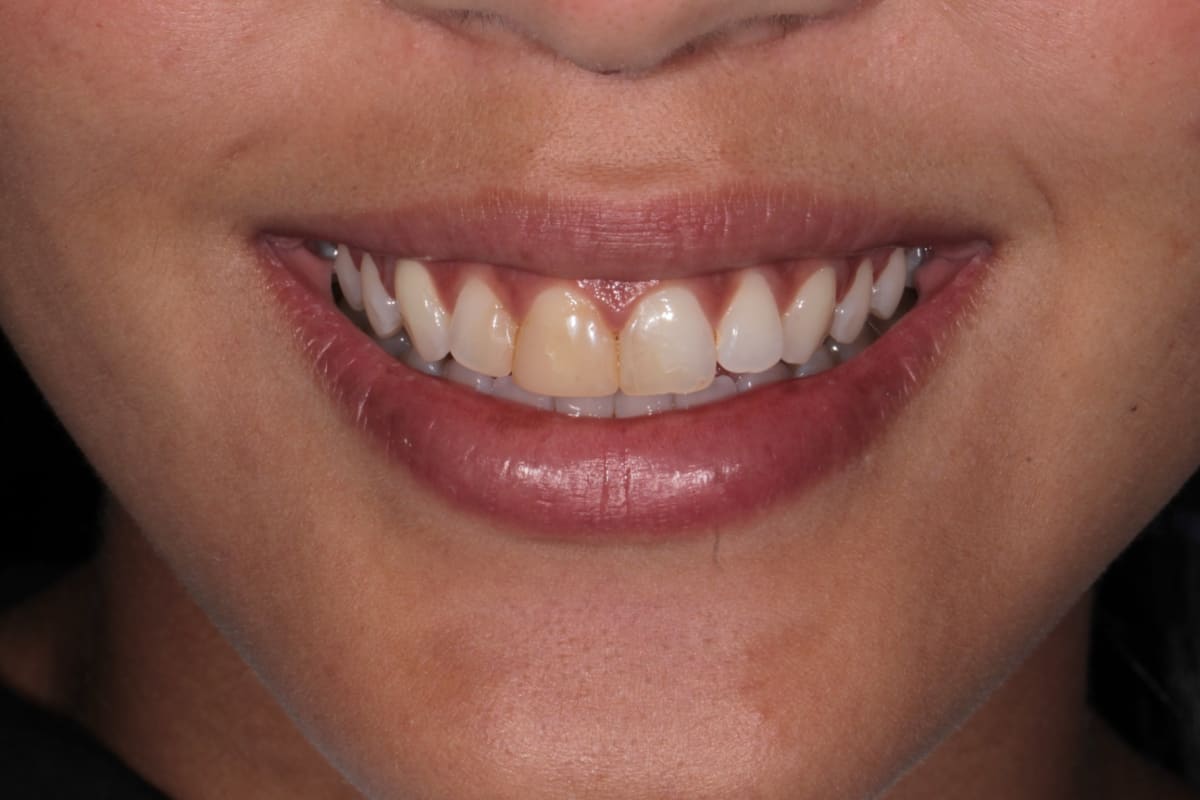
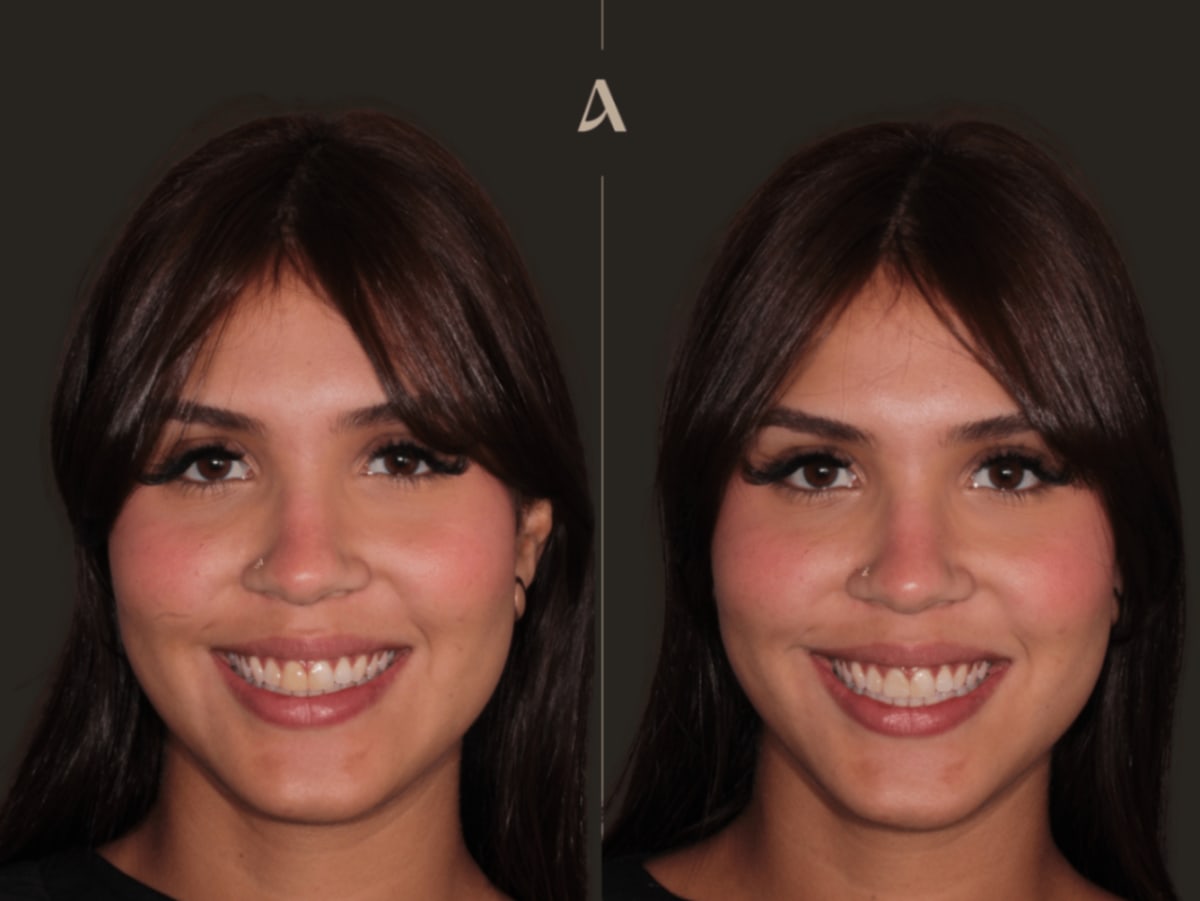
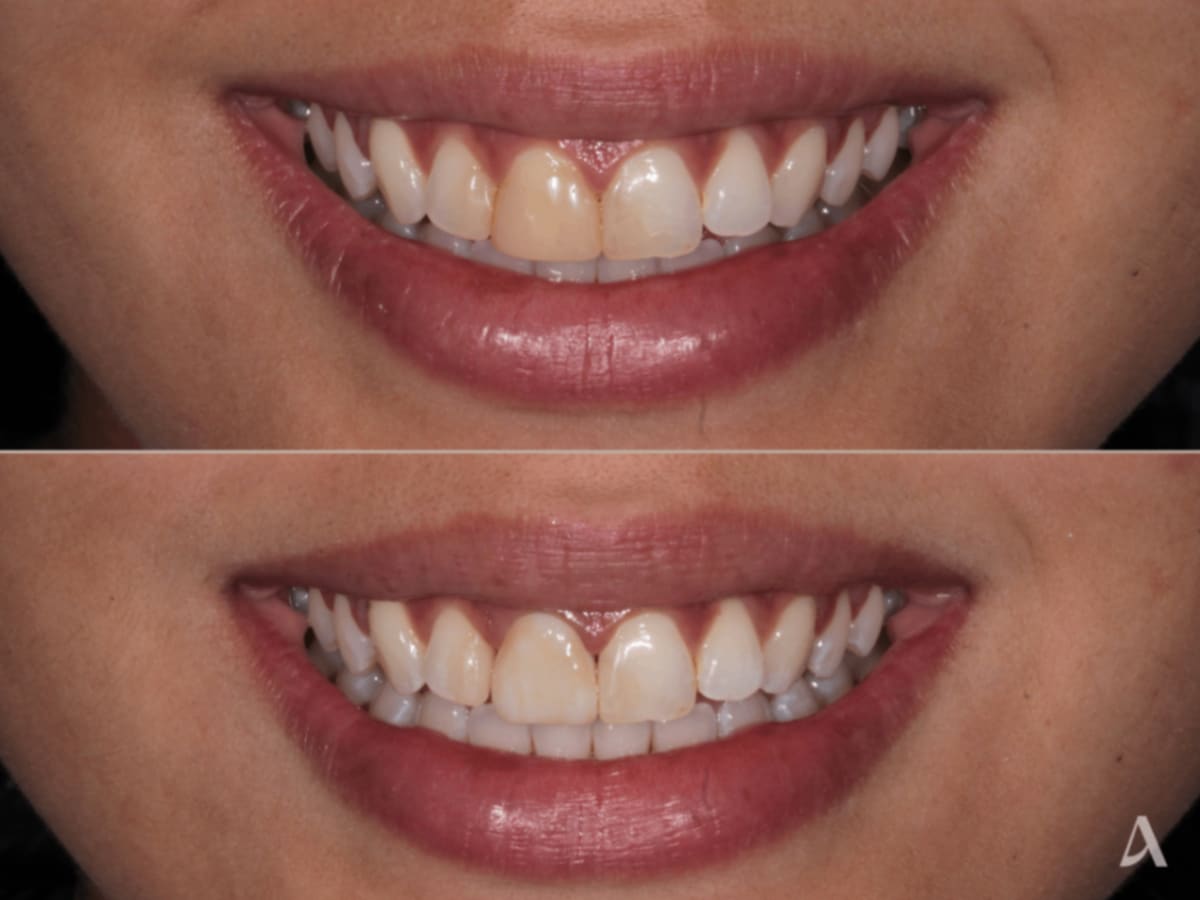
Aspect of the smile before the procedure. You can notice 3 teeth affected by darker fillings. Today our target was the central incisor rigth side of the patient.
Why a Crown and Not a Veneer
This was the most important decision in the case, so it is worth explaining. A veneer is a thin shell that covers the front of a tooth. A crown covers the whole tooth, all the way around. For a front tooth that has had a root canal, that difference matters more than it might seem.
When a tooth has a root canal, the access point used to treat it is sealed with a filling on the back of the tooth. Most problems that show up years after a successful root canal do not come from the root itself. They come from leakage, where bacteria and saliva slowly seep back in past that filling and re-contaminate the canal. A full crown wraps over and seals that access completely, protecting the canal entrance in a way a veneer cannot.
The research supports this. Ray and Trope (1995) found that the quality of the restoration sealing the top of the tooth was at least as important as the root filling itself for keeping the tooth healthy at the root tip. Aquilino and Caplan (2002) went further, showing that root canal treated teeth that were not crowned were lost at around six times the rate of those that were. For a young patient who I want to keep this tooth for life, protecting the canal with a full crown was the right call.
Making the Crown in One Visit with CEREC
The crown was designed, made and fitted in a single visit using CEREC, a system that lets us scan, design and mill a porcelain crown in the practice rather than sending moulds away to a laboratory and waiting weeks with a temporary in the meantime. Here is how the appointment went, step by step.
Preparation. I gently shaped the tooth to make room for the crown, removing the old composite and creating a clean, even surface for the porcelain to sit on.
Digital scan. Instead of a putty mould, I took a 3D digital scan of the tooth with the CEREC Primescan camera. It is faster and more comfortable for the patient and captures very fine detail.
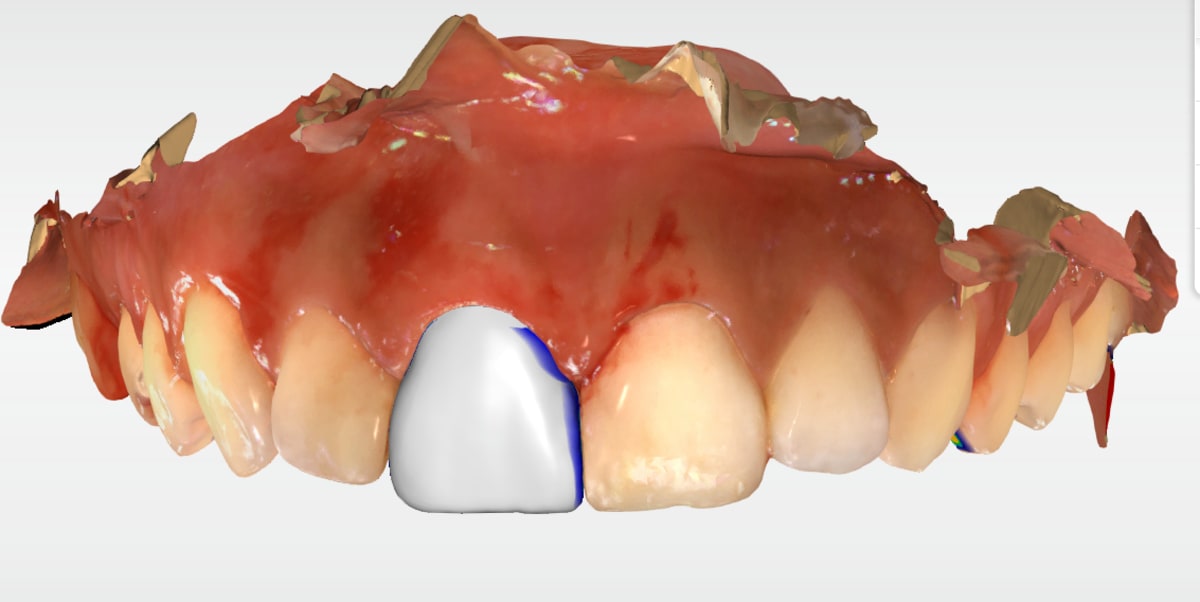
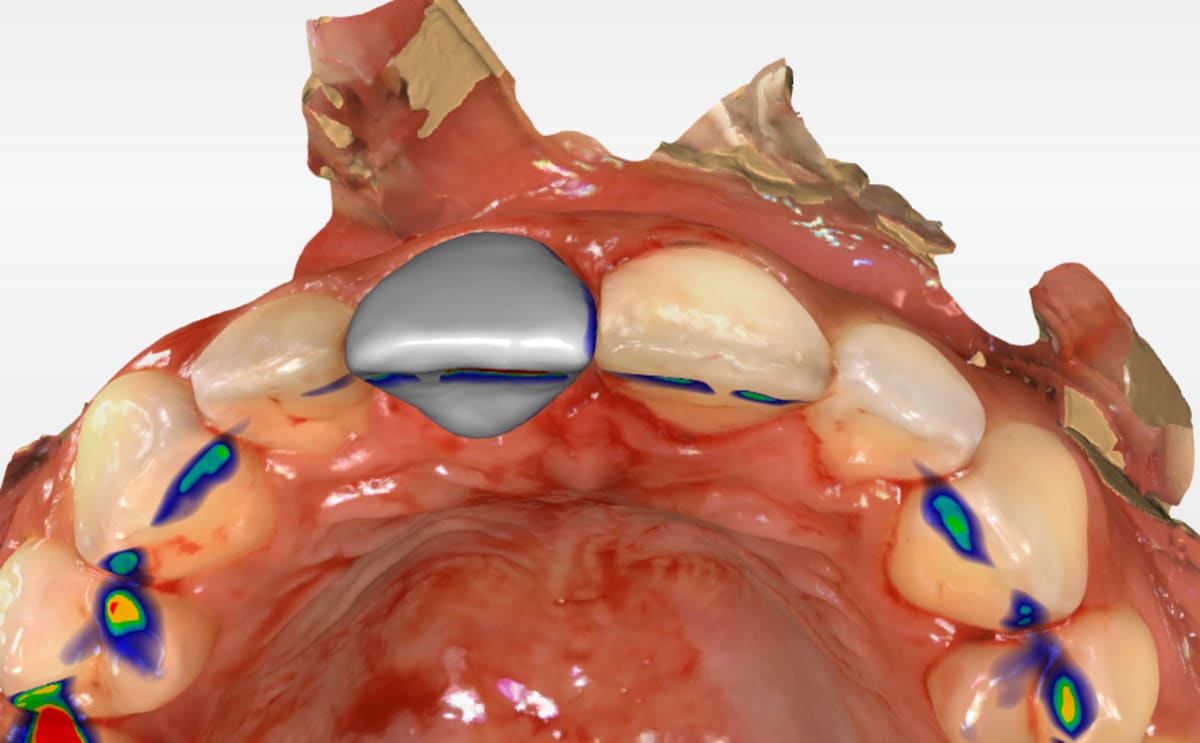
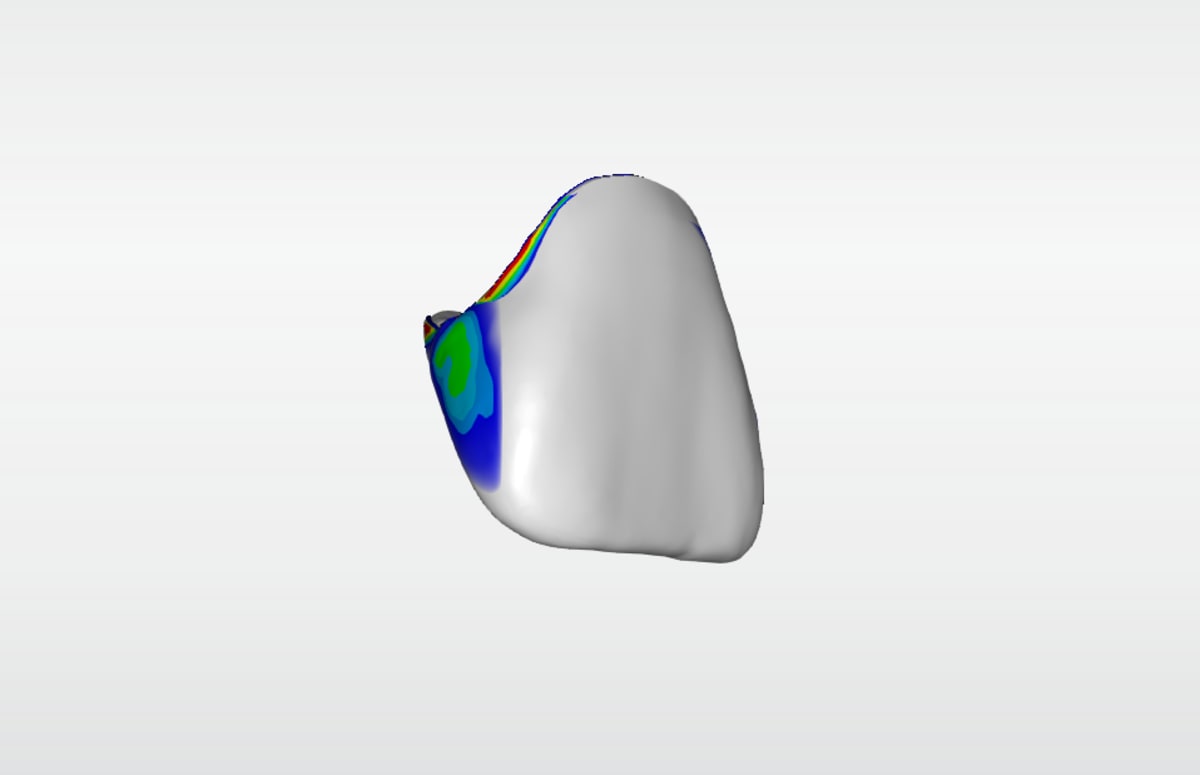
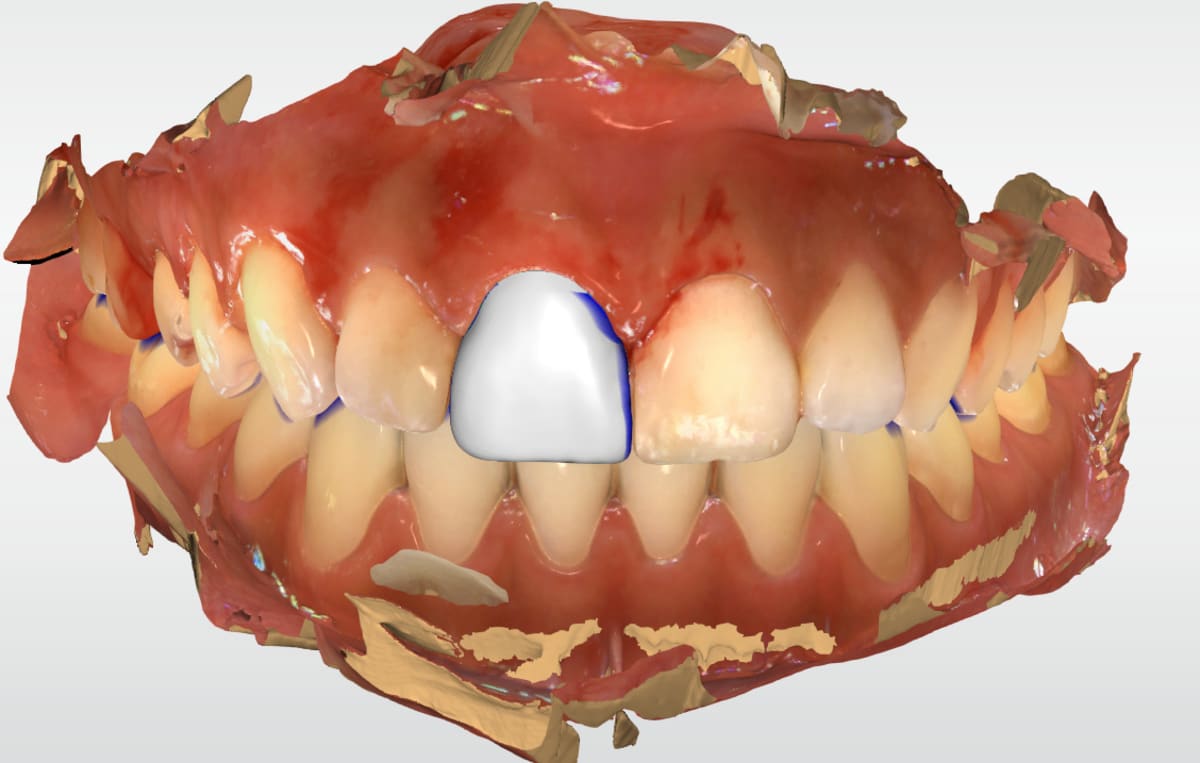
Design. I designed the new crown myself on screen, shaping it to match the size, proportions and contours of her natural front teeth.
Milling. The design was sent to the in-house milling unit, which carved the crown from a single block of high-strength porcelain.
Stain and glaze. To get a seamless match with the tooth next door, I custom stained and glazed the crown over three separate applications, building the colour and character up in layers until it blended naturally.
Cementation. Once we were both happy with the look, I bonded the crown into place with resin cement for a strong, sealed fit.
Bite adjustment. Finally I checked and fine-tuned the way the crown met the opposing teeth, so it felt comfortable and shared the bite evenly.
 |  |  |  |
|---|
Designing the crown on screen in the CEREC software. Once the design is finished, it is sent to the milling unit, which carves the crown from a single block of porcelain, shaped to fit the patient's tooth.
The Result
She walked out the same day with a single porcelain crown on her front tooth that matched its neighbour and finally had the shape she had wanted for years. Just as importantly, the root canal underneath is now sealed and protected, which gives this tooth the best chance of staying healthy for the long term.
Crowns made this way have a strong track record. Long-term research by Rauch and colleagues (2023) on chairside porcelain crowns reports good survival fifteen years on, so a same-day crown is not a shortcut on quality. It is simply a faster and more convenient way to deliver it.
Key Takeaways from This Case
Composite has limits on heavily restored front teeth. Repairing the same tooth again and again can struggle to hold its shape and colour over time.
A root canal needs a good seal on top. Most late root canal problems come from leakage past the filling, not from the root itself.
A crown protects a root canal treated tooth better than a veneer. Full coverage seals the access point and lowers the risk of the tooth being lost.
Same-day does not mean lower quality. Digital scanning and in-house milling deliver a custom crown in one visit, with proven long-term survival.
Custom staining makes the match. Building the colour up by hand is what lets a single crown blend in beside natural teeth.
If you have a front tooth that keeps needing repairs, or a tooth that has had a root canal and you are not sure how best to protect it, I would be glad to take a look. Book a consultation at ArtSmiles and we can talk through your options.
Disclaimer
This article documents one patient's treatment at ArtSmiles. It is shared for educational purposes with the patient's written consent. Individual results vary and depend on factors including oral health, the condition of the tooth and root, general medical history, and how well the restoration is maintained after treatment. Nothing in this article is a guarantee of outcome, a substitute for a clinical examination, or advice specific to your case. Any treatment carries risks and potential complications, which will be explained to you at consultation.
Case executed by Dr Cristian Dunker
General Dentist
AHPRA DEN0002257085
ArtSmiles, Southport, Gold Coast
Medically reviewed by Dr Cristian Dunker.
Frequently Asked Questions
Can a crown really be made in one day?
Yes. With CEREC we scan the tooth, design the crown and mill it from a block of porcelain in the practice, then stain, glaze and bond it the same day. There is no putty mould, no temporary crown, and no waiting weeks between appointments.
Why choose a crown instead of a veneer for a front tooth?
In this case the tooth had a root canal, and a full crown seals and protects the access point on the back of the tooth. A veneer only covers the front. Sealing that access lowers the risk of leakage, which is the main reason root canal treated teeth run into trouble years later. Research by Ray and Trope (1995) and Aquilino and Caplan (2002) supports full coverage for these teeth.
Does every tooth need a crown after a root canal?
No. It depends on how much healthy tooth is left and how much load the tooth carries. Back teeth usually benefit from full coverage, while some front teeth with only small fillings can be restored more conservatively. It is a decision we make tooth by tooth after looking at your case.
Will the crown match my other teeth?
That is the aim. The crown is custom stained and glazed in layers to match the shade and character of the tooth beside it, and it is designed to follow the shape and proportions of your natural teeth.
How long does a porcelain crown last?
With good care, many years. Long-term studies of chairside porcelain crowns report good survival fifteen years on. How long any crown lasts depends on your oral hygiene, whether you grind your teeth, and keeping up with regular check-ups.
References
Ray HA, Trope M (1995). Periapical status of endodontically treated teeth in relation to the technical quality of the root filling and the coronal restoration. Int Endod J. PubMed
Aquilino SA, Caplan DJ (2002). Relationship between crown placement and the survival of endodontically treated teeth. J Prosthet Dent. PubMed
Rauch A, et al. (2023). Long-term survival of monolithic tooth-supported lithium disilicate crowns fabricated using a chairside approach: 15-year results. Clin Oral Investig. PubMed