How long will this actually take, and is what you're feeling right now normal? Most people land on this page for one of two reasons: you're the night before a planned wisdom tooth extraction and want to know what you're signing up for, or you're two days post-op at 11pm, worried that the swelling or the ache means something's gone wrong. Either way, you're in the right place. This is a practical, day-by-day recovery guide from Dr Cristian Dunker and the team at ArtSmiles general dental clinic here on the Gold Coast. We'll walk through what happens hour by hour in the first 24 hours, what each day of the first fortnight looks like, which symptoms are completely normal, and the few warning signs that mean you should call us straight away. No scare tactics, just what we tell our own patients.
In this article
What to Expect in the First 24 Hours
The first day sets the tone for the rest of your recovery, so it's worth knowing what each stretch of hours looks like.
The first 2 hours
Right after the extraction, you'll be biting firmly on a piece of gauze over the socket. That pressure is what helps the blood clot form, and the clot is what your body builds healing on top of. Keep the gauze in place for about 30 to 45 minutes, or for as long as your dentist tells you. Your lip, tongue, and cheek will still feel numb from the numbing injection, so be careful not to bite the inside of your mouth while you can't feel it. You won't be able to drive, so your chaperone should take you home. If you had sedation, you'll feel drowsy for several hours and shouldn't be alone.
Hours 2 to 12
A small amount of bleeding, or pink-tinged saliva, is normal for the first several hours. If it's still actively bleeding after the first gauze change, bite on a fresh piece for another 30 minutes. Pain usually starts to creep in as the numbness wears off, which is why we want you to take your first dose of pain relief before that happens, not after. Stick to soft, cool foods for your first meal: a yoghurt, a smoothie eaten with a spoon (never a straw), or some lukewarm blended soup. Do not rinse your mouth in the first 24 hours. Your first gentle saltwater rinse should be at the 24-hour mark, not before, because rinsing too early can wash out the clot.
The first night
Sleep propped up on two pillows so your head stays above your heart. This keeps swelling down and helps you feel less throbbing. Set an alarm if you need to, because staying on top of your pain medication during the night is easier than catching up after waking in pain. Apply a cold pack wrapped in a tea towel to the outside of your cheek: 20 minutes on, 20 minutes off, for as long as you're awake that first evening. For a complete printable checklist, see our wisdom tooth aftercare checklist.
Day-by-Day Recovery Timeline (Days 1 to 14)
Here's what each phase looks like once wisdom teeth are removed, so you can check what you're feeling against what's typical.
Days 1 to 3: Swelling and pain peak
This surprises a lot of patients. Swelling doesn't peak on the day of surgery, it peaks around day 2 or 3. Your cheek will look puffier on the morning after than it did the evening of the extraction, and that's completely expected. Pain tends to peak in this same window. Keep using ice packs for the full first 48 hours and stay on your pain medication on a schedule rather than waiting for discomfort to hit. This is also when jaw stiffness sets in.
Days 4 to 7: Swelling fades, bruising shows
Around day 4 the puffiness starts to go down, but don't be alarmed if a yellow or purple bruise appears on your cheek, jaw, or even lower down your neck. Bruising after wisdom tooth surgery is normal, and gravity pulls it downward as it fades. Switch from ice to a warm compress now, which helps the bruising clear faster. Warm saltwater rinses, a few times a day after meals, help keep the socket clean while it heals.
Days 7 to 14: Gum healing and return to normal routines
By the end of the first week the gums are closing over the socket. If you have dissolvable stitches they'll start breaking down around now; if your stitches need removing, that appointment is usually around day 7. You can start gently brushing the area with a soft toothbrush from day 7, keeping the bristles soft and the movements slow. Most people are back to normal eating by the end of week 2, though the socket itself will still feel slightly tender if you press on it.
Weeks 2 to 6: Deeper bone healing
You'll feel like you're fully recovered by this point, but bone is still quietly filling in underneath. Full bone remodelling where the tooth used to be takes about 3 to 6 months, and you won't notice any of it happening. No restrictions on activity, food, or brushing by this stage, unless your dentist has told you otherwise.
What's Normal vs What's Not (Warning Signs)
This is the section people come back to at 10pm wondering if they should worry. Here's the honest answer.
What's normal
A dull, throbbing ache for the first 3 to 5 days
Swelling on your cheek that peaks day 2 or 3
Minor oozing or pink saliva on day 1
Bruising showing up around day 3, even spreading down the neck
Stiffness in your jaw when you try to open wide
A bad taste or slight odour on day 1 that clears with gentle rinsing from day 2 onward
Call us today
Get in touch with us, or contact an emergency dentist after hours, if you notice any of these:
A fever over 38 degrees
Severe throbbing pain that suddenly starts on day 3 or later (this is the classic sign of dry socket)
Pus from the socket or a foul smell that doesn't clear
Numbness in your lip, tongue, or chin that hasn't faded after 24 hours
Bleeding that won't stop with 30 minutes of firm gauze pressure
For a broader look at how easy it is to miss the early warning signs your mouth gives you, read about signs that dental problems are often missed.
Dry socket, in plain English
Dry socket (the clinical name is alveolar osteitis) is what happens when the blood clot in the socket gets dislodged or dissolves too early, leaving the bone underneath exposed. It isn't dangerous and it isn't an infection, but it is painful, and the pain is the giveaway: instead of getting better after day 3, it suddenly gets much worse, and the ache often radiates up to your ear on the same side. It's more common in lower wisdom teeth than upper ones, more common in smokers, and statistically more common in people taking hormonal contraceptives. If we diagnose dry socket, the fix is simple: we clean the socket and pack it with a medicated dressing that settles the pain quickly. Most people feel dramatic relief within an hour.
Eating and Drinking After Wisdom Teeth Are Removed
What you eat in the first fortnight genuinely affects how smoothly you heal. Here's the rough map.
Days 1 to 3: soft and cool
Stick to foods that don't need chewing:
Smoothies eaten with a spoon (never a straw)
Yoghurt
Mashed potato
Blended soup, lukewarm rather than piping hot
Scrambled egg
Applesauce
Ice cream as a treat (the cold genuinely helps)
Days 4 to 7: expanding the menu
You can start adding soft pasta, flaky fish, soft-cooked vegetables, and minced meat. Chew on the opposite side from where your tooth was removed if you had a lower extraction, and take your time.
The 2-week avoid list
Until at least the end of week 2, keep these off the plate:
Popcorn (the hulls are notorious for getting stuck in healing sockets)
Nuts and seeds
Crunchy chips and crackers
Crusty bread
Sticky toffee or caramel
Anything drunk through a straw, because the suction can pull the clot right out of the socket
Hydration
Drink plenty of water throughout the day, straight from the glass. Water keeps the tissues healthy and helps flush the mouth gently. Avoid alcohol for the first 48 hours, especially if you're taking prescription pain relief.
Pain Management and Medication
First 48 hours: stay ahead of it
The golden rule is to take your pain relief on schedule, not "when I feel it." Most people do best on a combination of paracetamol and ibuprofen, taken at alternating intervals so you've always got something working. Always follow your dentist's written instructions and the dose on the packet.
Ice then warm
Use an ice pack on your cheek for the first 48 hours: 10 minutes on, 10 minutes off, whenever you're awake. From day 3, swap to a warm compress, which helps shift bruising and relaxes the jaw muscles that have been holding tension.
Saltwater rinses from day 2
Half a teaspoon of salt dissolved in a glass of warm (not hot) water. Swish gently, don't gargle, and let it fall out of your mouth rather than spitting forcefully. Three or four times a day, especially after meals.
When to stop
Most people are comfortable enough to stop scheduled pain relief by day 4 or 5 and just take something if they feel a twinge. If you're still needing strong pain relief every few hours after day 4, or the pain has got worse rather than better, call us. Pain that doesn't respond to your usual medication is the single biggest red flag for dry socket.
Why Wisdom Teeth Are Removed in the First Place
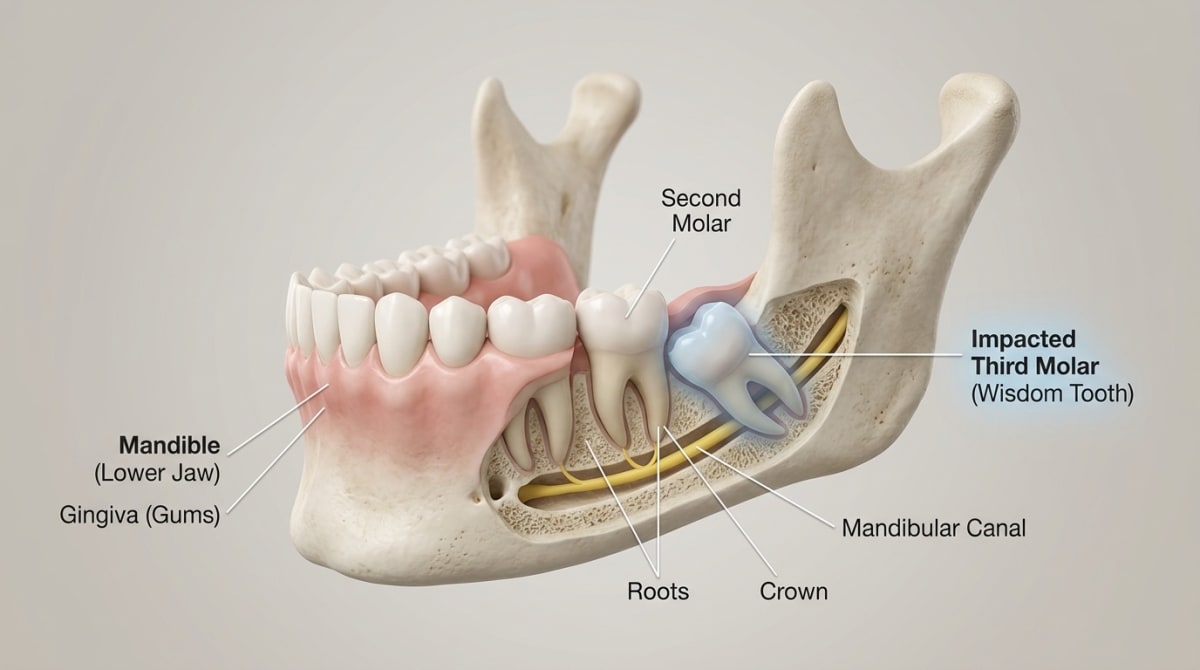
The most common reason for removal is impacted wisdom teeth, where a tooth is stuck against the one in front or trapped under the gum and cannot come through properly. Impacted wisdom teeth can crowd neighbouring teeth, trap food, decay or become infected, which is why they are often taken out before they cause pain.
Not every wisdom tooth needs to come out. Here's how we decide.
Types of impaction
"Impacted" means the tooth can't fully come through the gum in the right position. There are three broad types:
Soft tissue impaction: the tooth has broken through the bone but is still partly covered by gum. These are usually the easiest to remove.
Partial bony impaction: part of the tooth is still stuck in the jawbone. Removal usually involves a small incision and sometimes sectioning the tooth.
Full bony impaction: the tooth is completely encased in jawbone. These take longer to remove and tend to have a slightly longer recovery.
Reasons we recommend removal
Pain from the tooth pressing on neighbouring teeth
Recurring infection under a gum flap (the clinical name is pericoronitis, which just means inflammation around a partially erupted tooth)
Decay forming on the back of the molar in front because the area can't be cleaned properly
Gum pocketing behind the second molar
Cysts forming around an impacted tooth on an x-ray
When wisdom teeth can stay
If the tooth is fully erupted, sitting in a useful position, easy for you to clean with a toothbrush and floss, has no decay, and isn't causing gum problems, there's usually no reason to remove it. We prefer to keep healthy teeth wherever we can. For a government-backed overview of the decision, the Australian government's healthdirect service has a useful patient summary.
What Happens During the Procedure
Simple vs surgical extraction
A simple extraction is what we do when the tooth is fully through the gum and we can lift it out with standard instruments. A surgical extraction is used when the tooth is partly or fully buried, and involves a small gum incision, sometimes a little bone removal, and often sectioning the tooth into two or three pieces so each piece comes out cleanly.
Anaesthetic options
Most wisdom tooth extractions are done with a numbing injection only, which keeps you awake and is comfortable for most patients. For anxious patients or more complex cases we can add sedation (you're relaxed and drowsy but still responsive). For very complex cases, some patients prefer a full general anaesthetic in hospital.
How long the appointment takes
Anywhere from 30 minutes for a straightforward single extraction to around 90 minutes if we're removing all four at once, or if the roots are close to the nerve.
Stitches
Most of the stitches we use are dissolvable and break down on their own over the first 1 to 2 weeks. Occasionally we use non-dissolvable stitches, in which case you'll come back at around day 7 for a short, straightforward removal appointment.
A quick word on cost
Costs vary depending on complexity, whether sedation is used, and how many teeth are removed. See our wisdom teeth removal cost guide for a breakdown (coming soon).
For more detail on what to do after a surgical extraction specifically, our surgical extraction aftercare guide covers the post-op steps in depth.
When Recovery Takes Longer Than Expected
Most people are back to normal within 10 to 14 days, but a handful of situations can stretch that out.
Multiple extractions or bone grafts at once
If we removed all four wisdom teeth in one appointment, expect the first few days to feel more intense and the overall recovery to take a few days longer. If a bone graft was placed at the same time (sometimes needed when a cyst or large defect has to be filled), add another 1 to 2 weeks of gentle-diet eating.
Lower wisdom teeth
Lower wisdom teeth sit closer to the inferior alveolar nerve, the nerve that supplies feeling to your lower lip and chin. That proximity often means a slightly bigger surgical site, more swelling, and a longer return to full chewing than the upper ones.
Factors that slow healing
Age: healing genuinely slows as we get older
Smoking: significantly increases dry socket risk and slows tissue healing
Uncontrolled diabetes
Hormonal contraceptives (increase dry socket risk)
Blood-thinning medications or conditions that affect clotting
When to book a follow-up
If day 10 has come and gone and the socket still feels raw, swelling hasn't fully gone, or you're still relying on pain relief to get through the day, come and see us. A quick look is all it takes to rule out dry socket, delayed infection, or a stuck food particle. We also have flexible payment options for any extended follow-up care you might need.
Frequently Asked Questions
How long after wisdom teeth are removed can I eat normally?
Most people return to a completely normal diet by the end of week 2. You can start reintroducing softer versions of your usual meals from about day 4, chewing on the opposite side of the mouth. Keep popcorn, nuts, seeds, and anything hard or sticky off the menu for the full fortnight to protect the healing socket.
When can I exercise after wisdom tooth removal?
Avoid any vigorous exercise, heavy lifting, or contact sport for the first 3 to 5 days. Raising your heart rate too much in that window can restart bleeding and dislodge the clot. Gentle walking from day 2 is fine and actually helps recovery. You can return to a normal gym routine from about day 7 if you're feeling well.
Is it normal to still feel pain a week after wisdom teeth are removed?
A mild, dull ache or tenderness when you press on the area at day 7 is perfectly normal. Sharp, throbbing pain that's as bad as, or worse than, the first few days is not. If the pain is increasing rather than fading at the one-week mark, or it's keeping you up at night, call us so we can check for dry socket or delayed infection.
Can I drive myself home after wisdom tooth removal?
No, even if you only had a numbing injection. Your judgement can be affected by the stress of the procedure, your lip and tongue will still be numb, and if you had any sedation or nitrous oxide you legally cannot drive for the rest of the day. Arrange a chaperone in advance, or book a taxi or rideshare to collect you.
How long do I need to take off work?
For a straightforward upper wisdom tooth with a desk job, one or two days is usually enough. For a surgical lower extraction, or if you had all four removed, plan on 3 to 5 days off. Physical jobs that involve heavy lifting, bending, or exposure to dust need a full week. Book your extraction for a Thursday or Friday if you can.
Why is recovery from a bottom wisdom tooth often harder than an upper?
Lower wisdom teeth tend to have denser bone around them, thicker roots, and sit closer to the nerve that supplies your lip and chin. That means a bigger surgical site and more post-operative swelling than the uppers. Dry socket is also more common in lower sockets. None of this is a problem, it just means a slightly longer and slower recovery.
Ready to Book an Assessment?
If your wisdom teeth are giving you trouble, or you've had an x-ray that shows they're impacted, the first step is a proper assessment so you know exactly what you're dealing with. We'll talk you through your options clearly, with no pressure. You can book an assessment online at a time that suits you.
Written by Dr Cristian Dunker, BDSc, MBA
Medically reviewed by Dr Cristian Dunker, BDSc, MBA · April 2026