
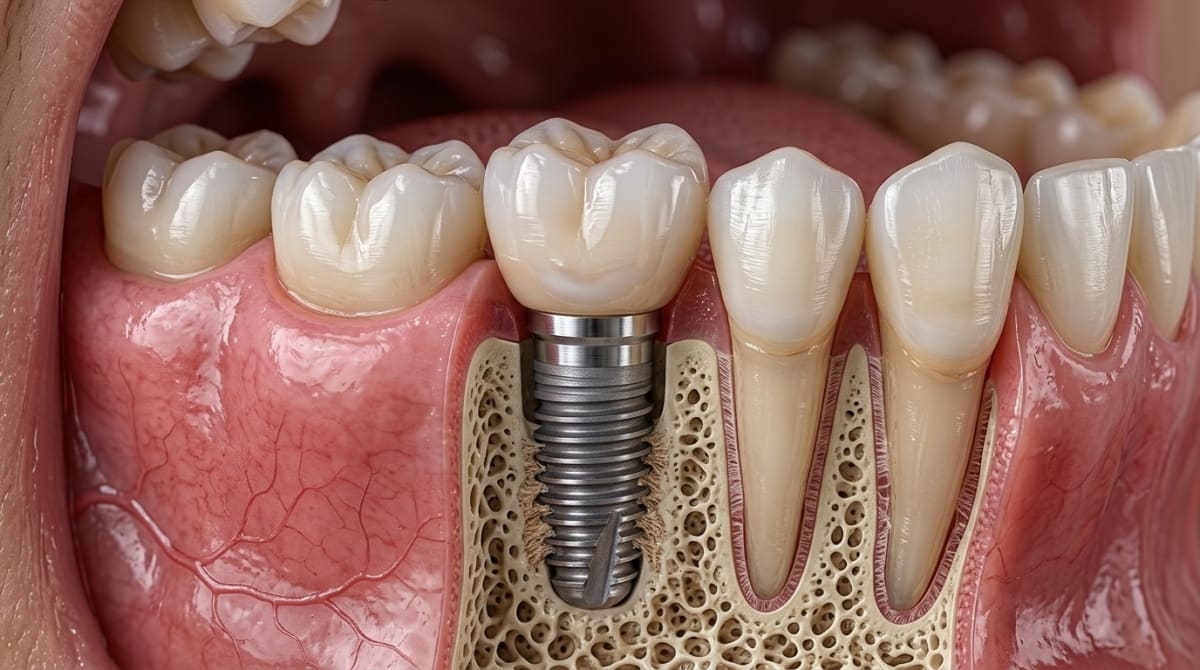
You've lost most of your upper teeth, or you're researching ahead of a parent's appointment, and the same question keeps coming up: should it be All-on-4, or a set of traditional dental implants? The short answer is that it depends on how many teeth are missing and how much healthy bone and gum you have left. All on 4 dental implants replace a full arch with just four implants and a fixed bridge. Traditional implants replace missing teeth one by one. This guide walks you through the differences, who qualifies for each, and how to decide with confidence. Individual results vary, so a clinical assessment is always the final word.
On this page
Key takeaways
Traditional dental implants replace missing teeth one at a time, using one titanium post and crown per tooth. Best for people missing 1 to 3 teeth with good supporting bone.
All-on-4 replaces an entire upper or lower arch using four angled implants that support a fixed full-arch bridge. Best for people missing most of their teeth or already wearing a denture.
Typical Australian cost: traditional implants from $5,000 per tooth; All-on-4 from $18,000 per arch.
Both treatments have around 95% implant survival at 10 years when candidates are selected carefully.
The only way to know which treatment your anatomy supports is a clinical exam plus a 3D scan of your jaw.
What's the difference between All-on-4 and traditional dental implants?
Both treatments use titanium implants placed into the jawbone, but they solve very different problems.
A single dental implant replaces one missing tooth. You get one titanium post in the bone, a small connector called an abutment, and a crown on top. It looks and works like one natural tooth. If you're missing two, three, or a few teeth in a row, you can either place one implant per tooth, or use two implants to support a small bridge.
All on 4 dental implants work differently. Instead of replacing each tooth one by one, four implants are placed at specific angles across the jaw. Those four implants support a fixed full arch bridge with twelve teeth. It's a whole upper or lower row of teeth, anchored to just four posts.
The key distinction is arithmetic and anatomy. Single implants replace teeth one for one. All-on-4 replaces an entire arch as a single fixed prosthesis. That changes everything: the surgery, the timeline, the cost, and importantly, who qualifies. Traditional dental implants need enough healthy bone around each site. All-on-4 is designed to work around reduced bone volume by angling the back implants forward, which is why it often suits people who've been wearing dentures for years.
At-a-glance comparison
Here's a quick side-by-side look at the three common pathways. Numbers are indicative only and individual results vary.
Factor | Single implant | Multiple single implants | All-on-4 |
|---|---|---|---|
Teeth replaced | 1 | 2 to 6 | Full arch (10 to 12) |
Teeth per Implant | 1:1 | Varies | 4 implants support 12+ teeth |
Surgery visits | 1 to 2 | 1 to 2 | Usually 1 (24 hours teeth) |
Temporary teeth | Immediate or after 3 to 6 months | Varies | 24 hours provisional bridge |
Final restoration timeline | 3 to 6 months | 3 to 6 months | 3 to 6 months for the final bridge |
Typical AU cost | From around $5,000 per implant | $10k to $30k+ | From around $18,000 per arch |
Lifespan | 15 to 25+ years | 15 to 25+ years | 15 to 25+ years (bridge may need refurbishment at 10 to 15 years) |
Best suited to | 1 missing tooth | A few missing teeth | Most or all teeth missing in an arch |
Who's a candidate for traditional dental implants?
Traditional implants work well for people whose mouths are mostly healthy, with only one or a few gaps to fill. If that sounds like you, a single-implant treatment is usually the simpler path.
You're typically a good candidate if:
You still have most of your natural teeth
You're missing one tooth, or a few teeth that aren't all next to each other
You have good bone density in the jaw. Implants need enough bone to fuse with, a process called osseointegration (the implant bonding with the bone)
Your gums are healthy, with no untreated gum disease
You don't smoke, or you're willing to stop during healing. Smoking slows healing and raises the risk of implant failure
Your general health supports minor surgery. Well-controlled diabetes and most other chronic conditions are usually fine
The Australian Dental Association notes that implant success depends heavily on bone quality, gum health, and good day-to-day cleaning. That's why the first step is always a clinical exam and a 3D scan of your jaw. We look at bone volume, nerve position, and the health of the teeth around the gap.
If bone is thin or has shrunk over time, bone grafting can often build it back up. That adds three to nine months to the treatment, but it opens the door to implants for people who thought they'd missed the chance.
Try Smile Studio
Curious how a new smile might look on you before you commit to anything? Try Smile Studio, our free online tool. Upload a photo of your smile and preview different tooth shapes and shades right in your browser, in your own time and with no pressure. It works best on a computer or laptop, so open it on a desktop rather than your phone for the easiest experience. It is a simple way to explore the look you are after and bring those ideas to your consultation, so we can talk through what is realistic for your teeth. Keep in mind it is a visual guide to spark the conversation, not a treatment plan or a promise of results.
Who's a candidate for All-on-4?
All-on-4 is built for a very different situation. It suits people who are missing most or all of their teeth in one jaw, or whose remaining teeth are failing and likely to come out soon.
Common candidates include:
Current denture wearers who are tired of movement, sore spots, or food getting underneath
People with multiple failing teeth due to advanced decay or gum disease
People who've experienced bone loss in the back of the jaw. All-on-4 treatment at ArtSmiles is designed to work within reduced posterior bone volume by angling the back implants forward, though individual candidacy depends on a 3D scan
Adults whose overall health supports implant surgery under local anaesthetic with sedation if needed
A long-term study by Maló, Nobre and colleagues on All-on-4 ten-year outcomes reported high implant survival rates over a decade. That doesn't mean the treatment is right for everyone. It means the technique has a good track record when candidates are chosen carefully.
Reasons All-on-4 might not be right for you include uncontrolled diabetes, heavy smoking that you can't pause, severe osteoporosis on certain medications, or a history of head-and-neck radiotherapy. These aren't automatic refusals, but they need careful discussion. Data from the AIHW shows tooth loss is still common in older Australian adults, so this conversation comes up often in our chair.
Cost comparison without the firm numbers
Cost is often the deciding factor, and it shouldn't be the only one. We've covered the detail in a separate piece on how much dental implants cost in Australia, so here's the shorter version to help you compare.
Think of cost as "per tooth" versus "per arch":
One missing tooth: a single implant is almost always the better value. You're paying for one post, one abutment, one crown
A few missing teeth in a row: either path can work. Two implants with a bridge can replace three or four teeth at lower total cost than three or four individual implants
Most or all teeth missing: All-on-4 is usually cheaper than replacing twelve teeth with twelve implants and twelve crowns. Four implants plus one bridge is less hardware and less surgery than a dozen individual implants
Final treatment and pricing are confirmed after clinical assessment, because the picture shifts with bone grafting, sedation choice, and which implant system fits your anatomy. Health fund rebates and payment plans can help spread the cost. When you're ready for real numbers on your case, book an assessment and bring any recent X-rays with you.
Process and timeline
Both treatments follow a similar shape: consultation, planning, surgery, healing, and a final restoration. The differences are in how many steps you feel, and how quickly you have teeth again.
Single implant, step by step
Consultation and 3D scan to check bone and plan the position
Surgical placement under local anaesthetic, often with light sedation
A healing period of three to six months while the implant fuses with the bone
The abutment is attached
Impressions are taken and the final crown is fitted
Some cases allow a temporary crown on the same day, so you're not walking around with a gap. Your dentist will tell you if your bone and bite support that.
All-on-4, step by step
Consultation, 3D scan, and full treatment planning. Any teeth that need to come out are identified
Surgery day: remaining teeth are removed if needed, four implants are placed, and a provisional fixed bridge is attached in 24 hours.
A healing period of three to six months while the implants integrate and your gums settle
A final bridge, usually in zirconia, is crafted to fit your settled mouth and fitted in place of the provisional
Both paths can include bone grafting if needed, which adds three to nine months. Neither path should be rushed, because healing time protects your long-term result.
Longevity, maintenance, and day-to-day living
A common worry is "how long will this last?" Both treatments are designed for the long term when cared for well.
A systematic review by Moraschini and colleagues reported implant survival rates of around 95% at ten years across a wide range of studies. That figure covers both single implants and full-arch treatments in general terms. Individual results vary, and survival of the implant is not the same as survival of the crown or bridge on top, which may need maintenance or replacement sooner.
Day-to-day care with single implants
You brush and floss like you would with natural teeth. The crown is a ceramic tooth on a titanium root, so regular check-ups and professional cleans keep it in good shape.
Day-to-day care with All-on-4
You brush the bridge morning and night. Cleaning under the bridge is the big difference, and a water flosser or floss threaders make it easy once you're used to them. Every six to twelve months, we remove the bridge at a check-up to clean thoroughly underneath. Around year ten to fifteen, the bridge itself may need refurbishment or replacement, even if the implants are still going strong.
Most people find they can eat almost anything: steak, apples, crusty bread. Very sticky lollies and chewing ice are best avoided with any dental work, but the everyday diet feels close to natural teeth.
Which one is right for you?
Here's a simple way to narrow it down. Match yourself to the closest line.
Missing 1 to 3 teeth with good supporting bone. Single implant or implants are usually the best fit. You preserve your other teeth and replace only what's gone
Several failing teeth, but some healthy ones remaining. Have a mix conversation. Sometimes we can save the healthy teeth and use single implants for the rest. Sometimes the long-term picture is better if we plan for a full-arch solution now
Existing denture wearer, tired of movement and sore spots. All-on-4 is often a strong fit. Fixed teeth feel and chew very differently from a removable denture
Remaining teeth are failing and you're already thinking "full replacement". All-on-4 is often more durable and more cost-effective than replacing every tooth with an individual implant
One thing is non-negotiable: a 3D scan of your jaw is the only way to know which treatment your anatomy actually supports. Photos and symptoms only get you so far. The scan shows bone volume, nerve position, and sinus anatomy, and that's what turns a general recommendation into a plan for your mouth.
Frequently Asked Questions
What's the main difference between All-on-4 and traditional dental implants?
Traditional dental implants replace missing teeth one at a time. Each implant supports one crown, so six missing teeth could mean six implants. All-on-4 replaces an entire arch of twelve to fourteen teeth using just four implants that support a single fixed bridge. Single implants suit people with mostly healthy mouths and a few gaps. All-on-4 suits people missing most or all of their teeth in a jaw, or whose remaining teeth are failing. The surgery, timeline, and cost structure differ significantly between the two approaches.
Is All-on-4 the same as having 4 individual implants?
No, and this is a really common mix-up. Four individual implants would replace four missing teeth, one crown per implant. All-on-4 uses four implants to support a full bridge of twelve to fourteen teeth across the whole arch. The back two implants are angled forward on purpose, which lets them anchor into stronger bone and support teeth further back without needing extra implants. It's a different design concept: four implants working as a team to hold one long bridge, not four implants replacing four teeth.
Can I have individual implants instead of All-on-4 if I'm missing most of my teeth?
Yes, technically you can, but it usually isn't the better option. Replacing every missing tooth with its own implant means more surgery, more cost, more healing time, and more hardware in the jaw. In most full-arch cases, All-on-4 gives a similar or better result with four implants and one bridge instead of twelve implants and twelve crowns. Some people do choose a hybrid plan: individual implants where bone allows, plus a small bridge elsewhere. A 3D scan and a detailed chat are the way to decide which suits you.
How long do All-on-4 and single implants last?
Both treatments are built for the long term. Published research, including a systematic review by Moraschini and colleagues, reports implant survival rates of around 95% at ten years. Individual results vary with bone health, oral hygiene, smoking, and medical conditions. For single implants, the crown on top may need replacing before the implant itself does. For All-on-4, the bridge may need refurbishment around year ten to fifteen, even if the implants are still solid. Good daily cleaning and regular check-ups are the biggest factors in longevity.
Can All-on-4 be converted to individual implants later if I want to?
Generally, no. All-on-4 implants are placed at specific angles and positions to support the full bridge, not individual crowns. Once those four implants are in, the plan is to keep them anchoring the bridge, with the bridge itself refurbished or replaced over time as needed. If an All-on-4 patient later wants individual teeth, it usually means removing the existing implants and starting fresh, which is a big procedure. That's why the decision between the two treatments is made carefully upfront, with full discussion of the long-term path.
Is All-on-4 cheaper than replacing every tooth with a separate implant?
For a full arch, yes, All-on-4 is usually less expensive than replacing every tooth with its own implant. Four implants and one bridge is less hardware, less surgery, and less overall treatment time than twelve implants and twelve crowns. It also typically involves fewer appointments. Firm pricing varies with bone grafting needs, sedation, implant system, and whether it's upper, lower, or both arches. Final treatment and pricing are confirmed after clinical assessment. Health fund rebates and payment plans can help spread the cost for either option.
Do I need bone grafting for either treatment?
Maybe, maybe not. Bone grafting is needed when the jawbone has shrunk too much to hold an implant securely, which often happens after teeth have been missing for years. Single implants need enough bone around the specific site. All-on-4 is designed to work around reduced back-of-jaw bone by angling the posterior implants, so it often avoids the need for grafting in that area. A 3D scan shows exactly what's there. Many people need no grafting at all, and those who do can still have implants once the graft has healed.
Next step
If you're weighing up All-on-4 against traditional implants, the most useful thing you can do is sit down with a dentist, have a 3D scan, and talk through what your anatomy actually supports. That's when the guesswork ends and a clear plan starts.
ArtSmiles is a general dentistry clinic in Southport, on the Gold Coast, Queensland. Dr Cristian Dunker offers a complimentary implant assessment so you can get specific answers on your situation: how many implants you'd need, what the timeline looks like, and what the investment would be. There's no pressure to proceed, and no charge for the conversation.
Book a complimentary implant assessment to take the next step. Bring any recent X-rays or scans if you have them.
References
Australian Dental Association (teeth.org.au). Information on dental implants and candidacy. https://www.teeth.org.au/dental-implants
Maló P, de Araújo Nobre M, Lopes A, Ferro A, Gravito I. A longitudinal study of the survival of All-on-4 implants in the mandible with up to 10 years of follow-up. J Am Dent Assoc. PubMed. https://pubmed.ncbi.nlm.nih.gov/21357865/
Moraschini V, Poubel LA, Ferreira VF, Barboza E. Evaluation of survival and success rates of dental implants reported in longitudinal studies with a follow-up period of at least 10 years: a systematic review. PubMed. https://pubmed.ncbi.nlm.nih.gov/25467073/
Australian Institute of Health and Welfare. Oral health and dental care in Australia. https://www.aihw.gov.au/reports/dental-oral-health/oral-health-and-dental-care-in-australia
Written by Dr Cristian Dunker.
Medically reviewed by Dr Cristian Dunker.